A new study in Nature Communications models Europa’s internal geology and concludes its seafloor is likely too geologically quiet to support sustained hydrothermal vents. While Europa hosts a vast subsurface ocean, the researchers find current tidal forces and residual core heat are probably insufficient to drive significant seafloor volcanism. The team notes Europa may have been more active in the past and that modest tidal heating likely keeps the ocean from freezing. Future missions such as NASA’s Europa Clipper should help test these predictions.
New Study Finds Europa’s Seafloor May Be Too Quiet To Sustain Life
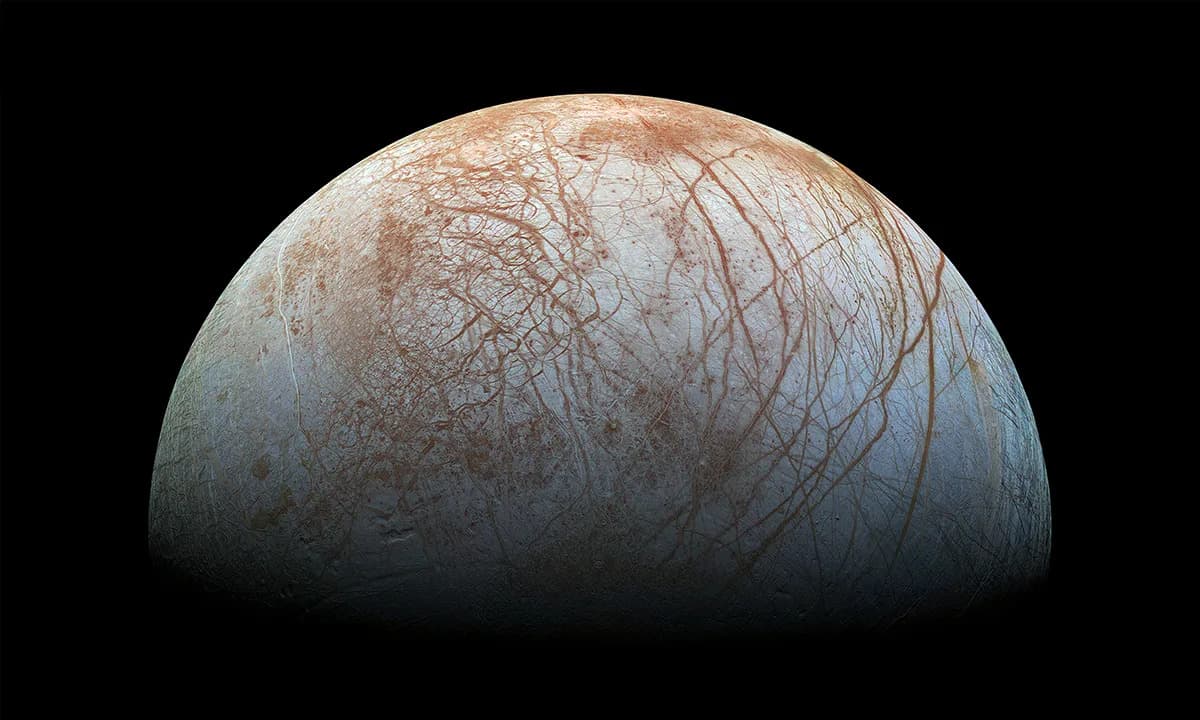
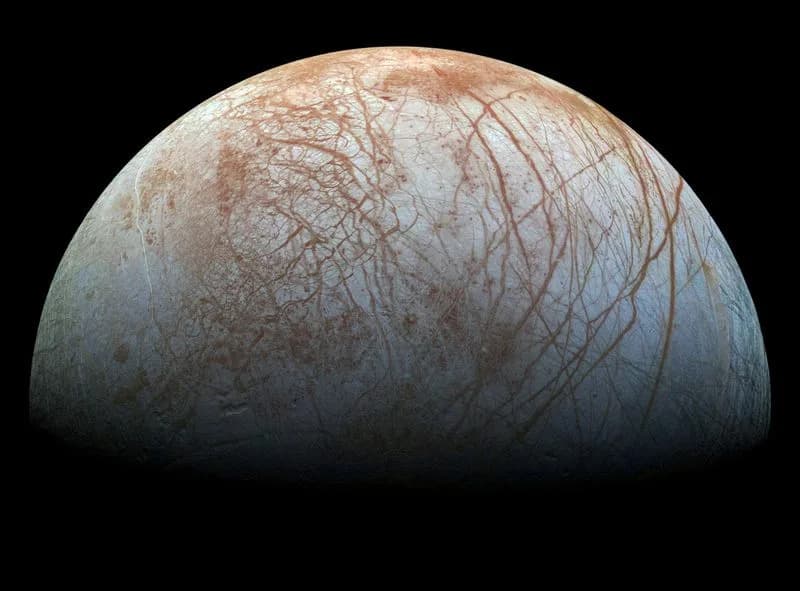
The puzzling, fascinating surface of Jupiter's icy moon Europa looms large in this newly-reprocessed color view, made from images taken by NASA's Galileo spacecraft in the late 1990s. This is the color view of Europa from Galileo that shows the largest portion of the moon's surface at the highest resolution. Credit: NASA / Jet Propulsion Lab-Caltech / SETI Institute.
Europa — one of Jupiter’s four Galilean moons — has long been a top target in the search for life because a vast ocean of liquid water lies beneath its icy crust. A new modeling study published in Nature Communications led by Paul Byrne of Washington University in St. Louis challenges the optimism that Europa’s subsurface ocean hosts life-supporting hydrothermal systems.
Scientists generally consider two conditions especially important for life: stable liquid water and a dependable energy source. Europa clearly provides the first, but whether it supports sufficient energy flux at the seafloor has been uncertain. On Earth, deep-sea hydrothermal vents — powered by tectonics and residual heat — create oases of life independent of sunlight; analogous activity on Europa would boost its habitability prospects.
Byrne and colleagues used known measurements and physical constraints for Europa — including its size, orbital geometry, the gravitational influence of Jupiter, and plausible core properties — to simulate the moon’s thermal and geological evolution. Their models indicate the seafloor is likely far more quiescent than previously hoped, with insufficient tidal heating or residual core heat to sustain vigorous seafloor volcanism or prolonged hydrothermal venting.
“If we could explore that ocean with a remote-control submarine, we predict we wouldn’t see any new fractures, active volcanoes, or plumes of hot water on the seafloor,” Byrne said. “Geologically, there’s not a lot happening down there. Everything would be quiet.”
The contrast with Io — Jupiter’s innermost large moon, which endures intense tidal flexing and dramatic volcanism — helps explain the result: Europa orbits farther out and experiences weaker tidal forcing. The team also finds that Europa may have been more geologically active in the distant past, but much of any primordial heat has likely dissipated.
Importantly, the study does not claim Europa's ocean is completely sterile. The authors allow that modest tidal heating probably prevents the ocean from freezing solid and that localized, short-lived processes could still deliver chemical energy to the water column. However, the absence of sustained, large-scale hydrothermal systems would make Earth-like vent ecosystems far less likely.
Implications And Next Steps
The findings refine expectations for where and how to look for signs of life on icy moons. Upcoming and planned missions — notably NASA’s Europa Clipper, which will gather detailed data on Europa’s ice shell and subsurface ocean — can test these model predictions by measuring tidal deformation, magnetic signatures, and surface chemistry.
As Byrne emphasizes, a quieter Europa does not diminish the broader search for life beyond Earth. It narrows the range of likely habitats and helps scientists prioritize targets and instruments for future exploration.
Lead image: NASA / Jet Propulsion Laboratory - Caltech / SETI Institute
Help us improve.