
ESA has approved a lander mission to Enceladus to sample plume fallout from a subsurface salty ocean that contains organics and salts. Launch is planned for 2042–2043, with arrival in the Enceladus system around 2055 after Titan gravity assists. The lander will map the South Pole, search for biosignatures such as molecular chirality and spatial clustering, and inform potential future missions to access the ocean directly.
ESA Greenlights Mission to Search for Life on Saturn’s Icy Moon Enceladus

Scientists hope to sample jets of water spouting from the surface of Enceladus - Mark Garlick/SPL
The European Space Agency (ESA) has approved a mission to land on Enceladus, one of Saturn’s icy moons, and search for signs of life by sampling material ejected from the moon’s subsurface ocean. Scientists hope to study plume fallout, map the South Pole, and look for chemical biosignatures that could indicate biological activity beneath the ice.
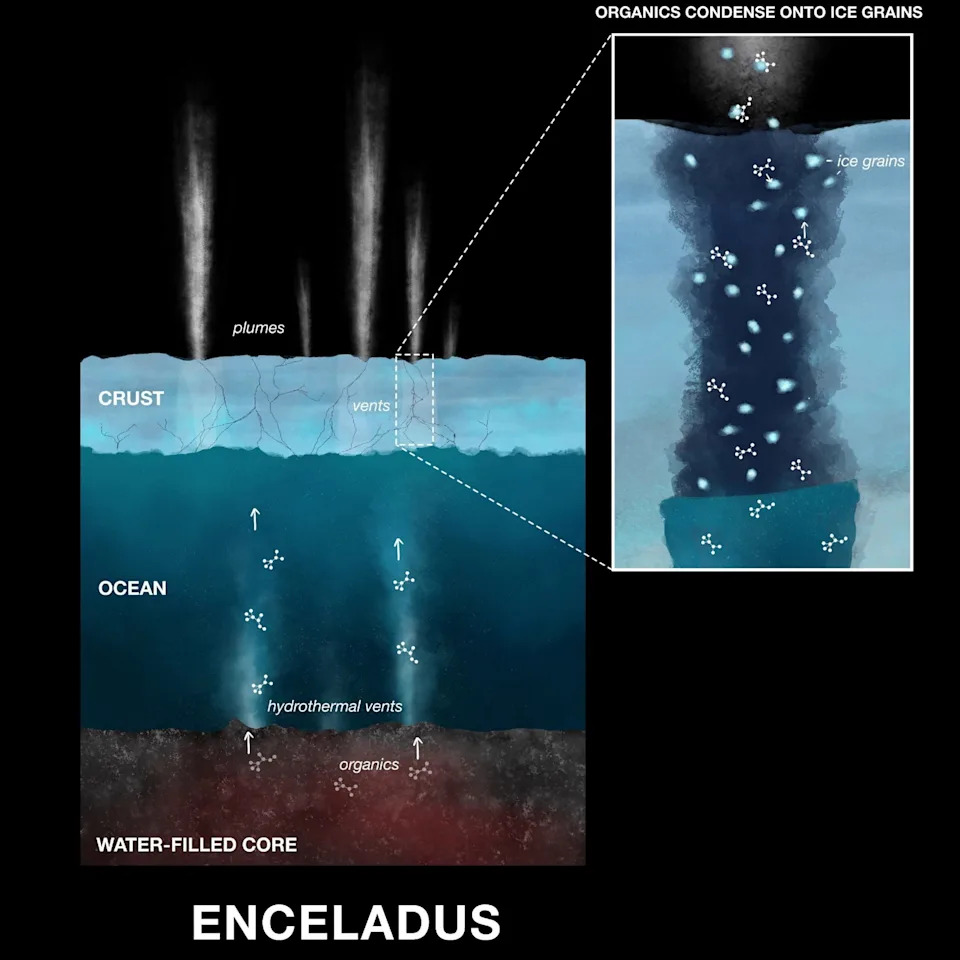
A cross-section of Enceladus, showing its rocky core, the internal ocean and its icy shell - ESA/SWNS
Why Enceladus? Enceladus has been a prime target since NASA’s Cassini spacecraft flew past in 2005 and observed geyser-like plumes of water vapour and ice particles erupting through fractures in the moon’s icy shell. Cassini’s analyses showed the subsurface ocean contains salts, organics and other elements considered essential for life. More recent re-analyses of Cassini data revealed complex organic molecules in the plumes, strengthening the case that active chemistry — and possibly habitability — exists beneath the ice.
1112 Saturn mission
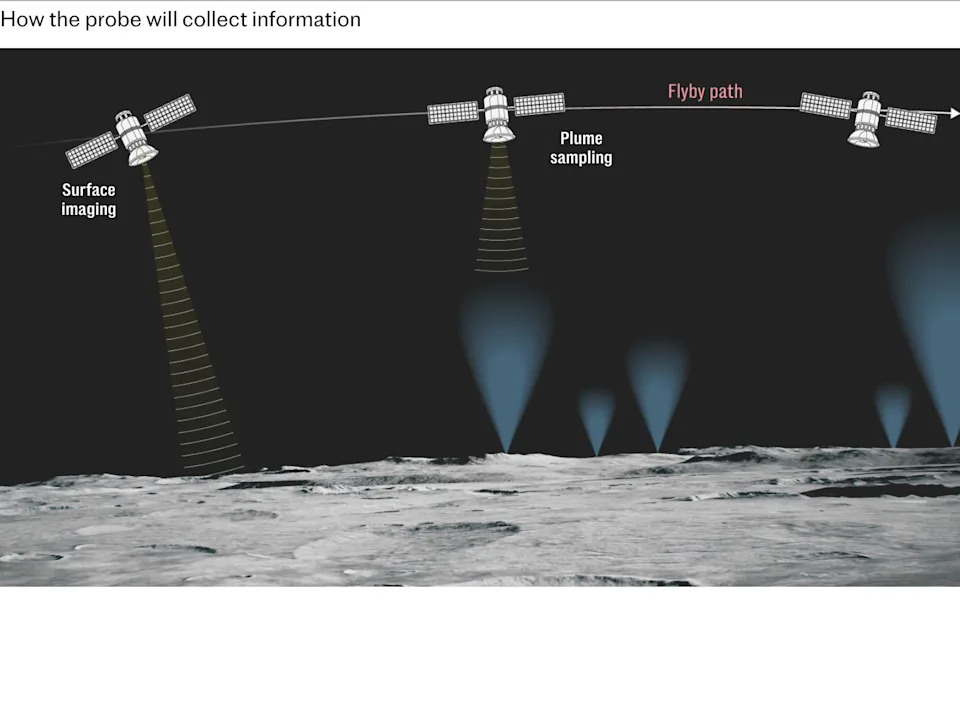
Mission Overview The proposed spacecraft is scheduled for launch in 2042–2043, with an expected arrival in the Enceladus system around 2055 after an eight-year cruise that includes gravity-assist fly-bys of Titan to insert the vehicle into Enceladus orbit. The mission will spend one to two months mapping the South Pole region — where the ice shell is thinnest and plumes are concentrated — to find a safe landing site and avoid surface hazards before deploying a lander to collect plume fallout and perform in situ analyses.
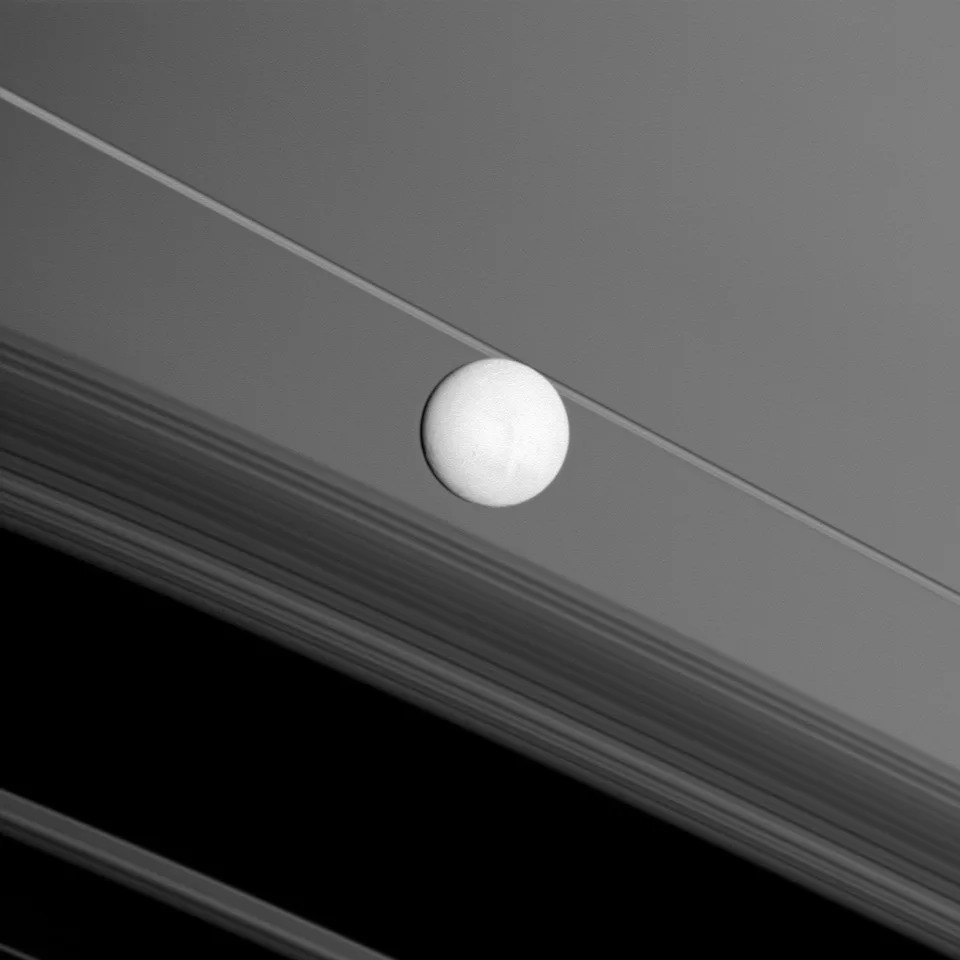
Encedalus reflects light against a backdrop of Saturn’s rings - Universal Images Group via Getty Images
What the Team Will Look For The science team will search for biosignatures: chemical fingerprints or structures that strongly suggest biological origins. One key target is molecular chirality. On Earth, biological amino acids are almost exclusively "left-handed" while the sugars in DNA and RNA are "right-handed"; a similar handedness bias on Enceladus would be a compelling hint of life. Scientists will also look for spatial clustering of biosignatures, which on Earth often indicates biological communities or localized habitability.
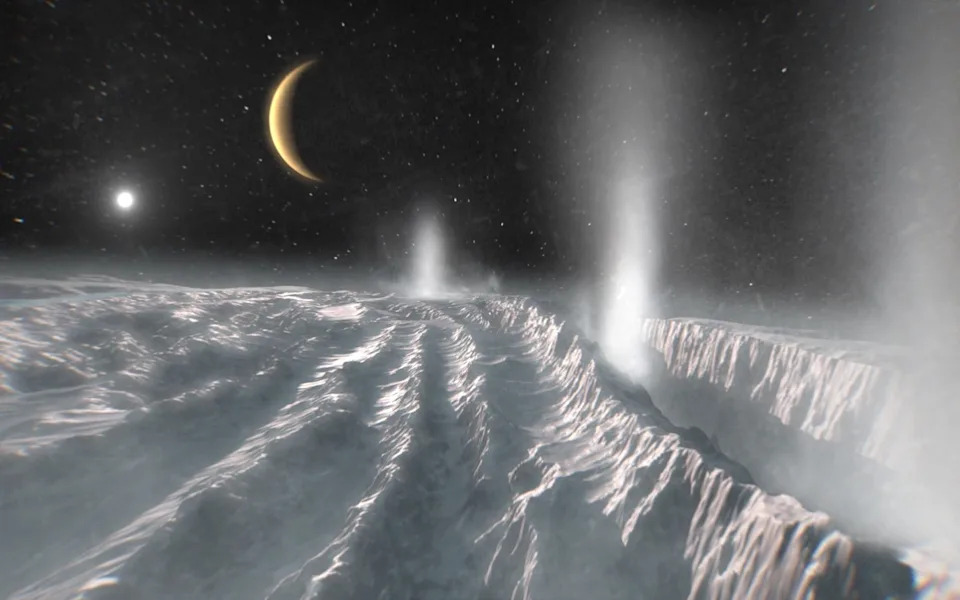
An artist’s impression of the southern polar region of Enceladus, which the spacecraft will scan for a potential landing spot - Esa
Dr Joern Helbert, Head of ESA’s Solar System Science Directorate: "In Enceladus, we have a very special case because ocean water is being expelled, so you can sample it. It makes a super fascinating target because you have heat, you have liquid water, you have organics — basically everything you would need naturally to form life."
The team does not rule out the remote possibility that intact microorganisms might be transported up through the fractures and deposited on the surface, but they consider detecting chemical biosignatures (for example, complex amino acids with a biological bias) the more likely and realistic outcome. As Dr Helbert noted: "If we saw something moving under a microscope, that would be extraordinary — but we are not designing the mission on that assumption."
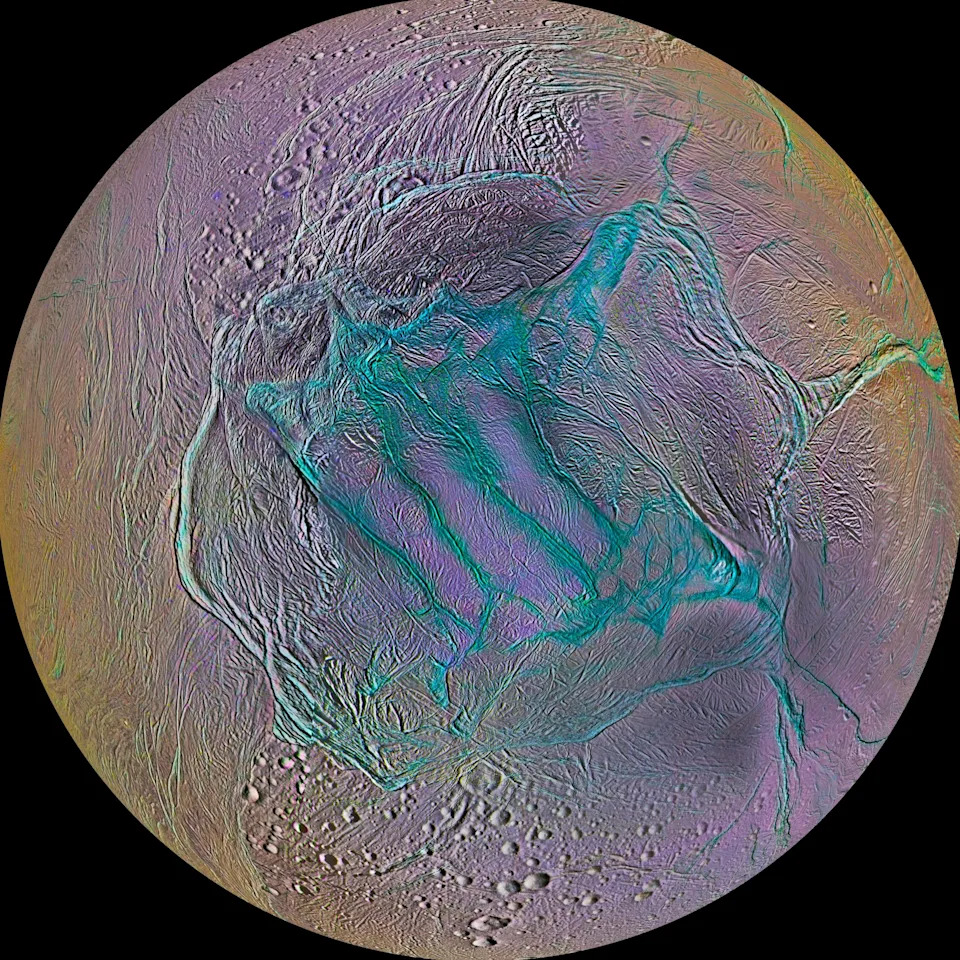
It is unknown if the surface of Enceladus is hard ice or soft snow - Universal Images Group via Getty/Universal History Archive
Analogue on Earth If life exists on Enceladus, it might resemble extremophiles that thrive around Earth’s deep-sea hydrothermal vents ("black smokers"). Those ecosystems operate without sunlight, using chemical energy (chemosynthesis) and support diverse organisms from microbes to larger animals. Similar chemosynthetic systems beneath Enceladus’ ice could host microbial life adapted to dark, high-pressure, chemically rich environments.
Follow-up and Future Technology If promising biosignatures are detected, follow-up missions could aim to penetrate the ice and access the ocean directly. NASA is developing concepts for swarms of small autonomous swimmers and a nuclear-powered thermal drill that could melt a tunnel through thick ice to deliver probes to subsurface seas.
Scientific and Cultural Impact Discovering life on Enceladus would profoundly expand our understanding of habitability, showing that life can arise and persist in icy ocean worlds far from the Sun and potentially suggesting that many icy bodies across the galaxy could host life. The mission received funding approval from European science ministers at an ESA conference in November. Dr Joseph Aschbacher, ESA Director General, emphasised the excitement: "Just imagine for a moment what this means to go there to search, possibly find traces of life. I think this is just too amazing."


