
The study introduces a hybrid interior model suggesting Uranus and Neptune may contain far more rock than previously believed, challenging their classification as pure “ice giants.” Researchers produced eight candidate core structures for each planet, three of which are rock-rich. All models include ionic water layers that could power the planets’ unusual, multipolar magnetic fields. The team calls for new missions and better high-pressure laboratory data to resolve remaining uncertainties.
Uranus and Neptune Could Be 'Rock Giants' — New Hybrid Core Models Challenge the 'Ice Giant' Label

Neptune (left) and Uranus (right) might be rockier than they seem. | Credit: NASA/JPL/STScI
New computational models suggest that the interiors of Uranus and Neptune may contain significantly more rock than scientists previously thought, challenging the long-standing label of these worlds as “ice giants.” The study, published Dec. 10 in Astronomy & Astrophysics, also offers fresh insight into the planets’ unusual magnetic fields.
Uranus and Neptune lie in the cold outer reaches of the Solar System; Neptune orbits at an average distance of about 2.8 billion miles (4.5 billion kilometers) from the Sun. At such distances, light gases like hydrogen and helium and volatile compounds such as water are expected to condense and form icy, compressed interiors — which is why the pair have traditionally been called ice giants.
“The ice-giant classification is oversimplified as Uranus and Neptune are still poorly understood,” said Luca Morf, lead author of the study and a doctoral student at the University of Zurich.
How the Hybrid Model Works
Morf and his supervisor, Ravit Helled, developed a hybrid modelling approach that combines physics-based calculations with observational constraints. Purely theoretical interior models can depend heavily on the modeller’s assumptions, while purely observational fits can be too simplistic. By iterating between a physically consistent interior model and the planets’ measured gravitational fields, the team derived self-consistent density, temperature, and composition profiles for the cores.
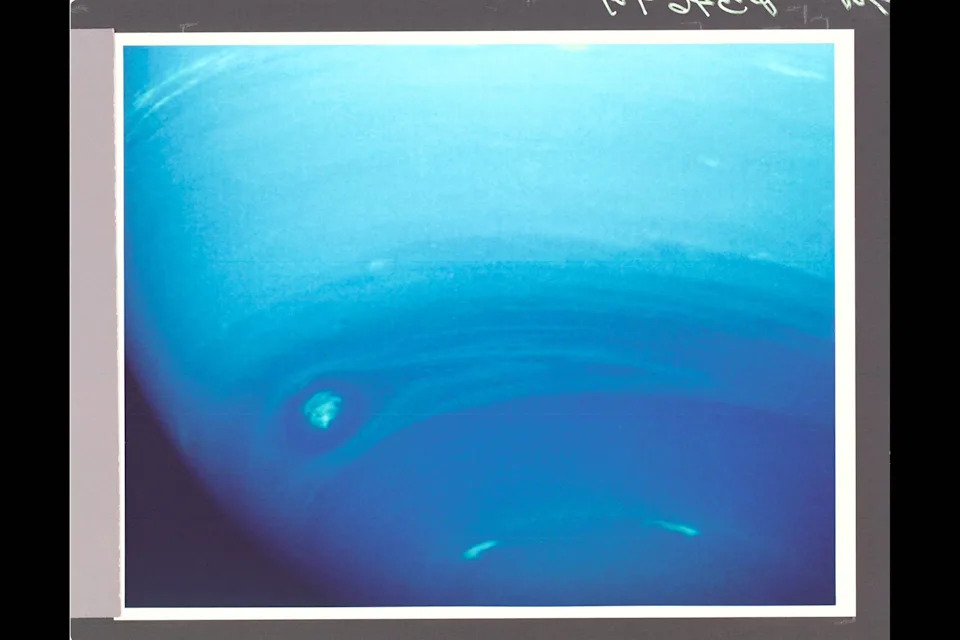
Voyager 2 took this snaphost of Neptune in 1989. Data on Uranus and Neptune taken during Voyager's flybys are still some of the best we have. | Credit: NASA / Voyager 2
The method produced eight viable core models for each planet. Three of those models have high rock-to-water ratios, indicating that substantial rocky material could be present rather than a simple, ice-dominated interior.
Ionic Water Layers and Magnetic Fields
All candidate cores include convective regions where water is predicted to exist in an ionic state: under extreme pressures and temperatures, water molecules dissociate into charged protons (H+) and hydroxide ions (OH-). The researchers propose that these ionic, convective layers could drive the complex, multipolar magnetic fields observed on Uranus and Neptune. Their models further suggest that Uranus’ magnetic field may be generated closer to its center than Neptune’s.
“One of the main issues is that physicists still barely understand how materials behave under the exotic conditions of high pressure and temperature found at the heart of a planet, and this could impact our results,” Morf said. The team plans to extend the model to include other likely core constituents such as methane and ammonia.
Helled noted that much of our empirical knowledge of these planets still rests on data collected by the Voyager 2 flyby in the 1980s. “Current data is insufficient to distinguish the two [rocky versus icy interpretations], and we therefore need dedicated missions to Uranus and Neptune that can reveal their true nature,” she said.
The researchers hope their hybrid model will serve as an unbiased framework that can be updated with measurements from future missions and laboratory studies of materials under extreme conditions.


