The study models Europa's interior and finds its rocky seafloor is likely too strong to support the tectonic or volcanic activity that creates hydrothermal systems and drives rock-water chemical reactions essential for life. Europa still meets two habitability criteria — a global subsurface ocean and detected organic molecules — but Jupiter-driven tidal heating may not be sufficient to power seafloor vents today. NASA's Europa Clipper, launched in 2024 and planning close flybys from 2031, could help confirm these findings. The authors note Europa may have been more active billions of years ago.
New Study Raises Doubts About Life on Jupiter's Moon Europa
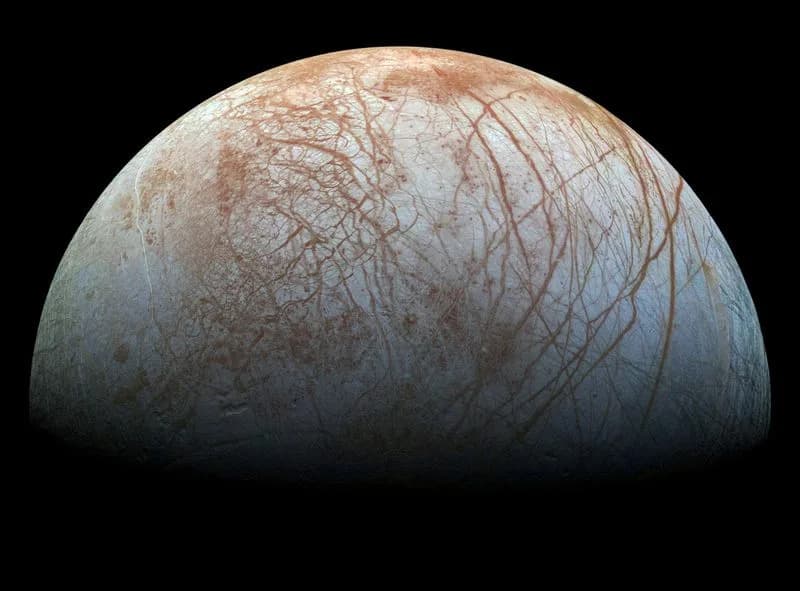
FILE PHOTO: A view of Jupiter's moon Europa created from images taken by NASA's Galileo spacecraft in the late 1990's, according to NASA, obtained by Reuters May 14, 2018. NASA/JPL-Caltech/SETI Institute/ Handout via REUTERS /File Photo
WASHINGTON, Jan 6 (Reuters) — A new study modeling the interior of Jupiter's moon Europa suggests the moon's rocky seafloor may be too mechanically strong to support the tectonic and volcanic activity that, on Earth, drives chemical reactions essential for life.
The research, published in Nature Communications, evaluated Europa's size, the composition and strength of its rocky core, and the tidal forces from Jupiter. The authors conclude that active faulting, seafloor fracturing or hydrothermal venting are likely minimal or absent — conditions that could limit the supply of chemical energy and nutrients needed by life.
What the Study Found
Lead author Paul Byrne of Washington University in St. Louis and co-author Christian Klimczak of the University of Georgia modeled how Europa's seafloor would respond to stresses. Their results indicate the seafloor is probably too stiff to undergo the kind of tectonic deformation and volcanism that create hydrothermal systems on Earth.
“On Earth, tectonic activity such as fracturing and faulting exposes fresh rock to the environment where chemical reactions, principally involving water, generate chemicals such as methane that microbial life can use,” Byrne said. “Without such activity, those reactions are harder to establish and sustain, making Europa's seafloor a challenging environment for life.”
Klimczak added that their models show few major tectonic landforms are expected on Europa's seafloor — no long ridges, deep troughs, underwater volcanoes or black smoker–style hydrothermal vents — though he left open the possibility that future observations could overturn the conclusion.
Europa’s Habitability: Mixed Signals
Europa remains a strong candidate in the search for life because it meets two important ingredients: a global subsurface ocean and evidence of organic molecules on its icy surface. Europa's ocean lies beneath an estimated 10–15 mile (15–25 km) ice shell and may be 40–100 miles (60–150 km) deep, potentially holding roughly twice the water of Earth's oceans.
However, the third ingredient — a sustained source of chemical energy — may be lacking if seafloor hydrothermal activity is absent. The study notes that Jupiter-driven tidal heating likely keeps Europa's ocean from freezing solid but, at Europa's orbital distance, may not be strong enough to deform the ocean floor tectonically in the present day.
“The effect of this tidal heating drops off quickly with distance,” Byrne said. “So although there's enough heating to keep the ocean liquid, according to our calculations there's not nearly enough to tectonically deform the ocean floor the way tidal forces deform Io.”
Context And Future Exploration
The study focuses on Europa's current state; the authors acknowledge the moon may have been more geologically active billions of years ago, a period when conditions could have temporarily supported life if chemical energy sources were then available.
NASA launched the Europa Clipper mission in 2024 to investigate Europa's habitability. The spacecraft is scheduled to begin dozens of close flybys in 2031 and may provide observational data to confirm or challenge these modeling results.
Reporting by Will Dunham; Editing by Rosalba O'Brien.
Help us improve.