
Key point: A November 2025 study warns the Atlantic Meridional Overturning Circulation (AMOC) — a major ocean "conveyor belt" — may weaken or collapse under ongoing human-caused warming. The AMOC redistributes heat and supports nutrient cycles; its disruption could reduce European rainfall, increase drought risk, alter global temperature patterns and stress marine ecosystems. Models show the worst outcomes are more likely after 2100, but substantial uncertainty remains, reinforcing the need for rapid emission reductions and enhanced monitoring.
Scientists Warn Atlantic Ocean May Be Near a Climate 'Tipping Point' — AMOC Could Weaken or Collapse

Swimmers in the ocean. - Joe Raedle/Getty Images
Many people think of the ocean as a place to swim, surf or relax on the shore, but scientists and seafarers see it as the engine of Earth's climate. Covering roughly 71% of the planet, the oceans — and the Atlantic in particular, which spans about 41.1 million square miles — play a central role in regulating temperature, weather and marine ecosystems.
A study led by René M. van Westen and colleagues, published in Hydrology and Earth System Sciences in November 2025, warns that the Atlantic Meridional Overturning Circulation (AMOC) is likely to weaken and could even collapse under continued human-driven warming. The AMOC is a large system of currents that transports heat and salt between the tropics and high latitudes — the Met Office describes it as a "conveyor belt" of ocean circulation that helps moderate climate across hemispheres.
Why the AMOC Matters
The AMOC moves warm, salty surface water northward and returns colder, denser water southward at depth. This circulation helps distribute heat, influence regional climates (notably in Europe) and support nutrient cycling in the ocean. The United Nations also highlights the ocean's broader climate role: producing roughly 50% of the planet's oxygen, absorbing about 30% of global CO2 emissions and storing nearly 90% of the excess heat from those emissions.
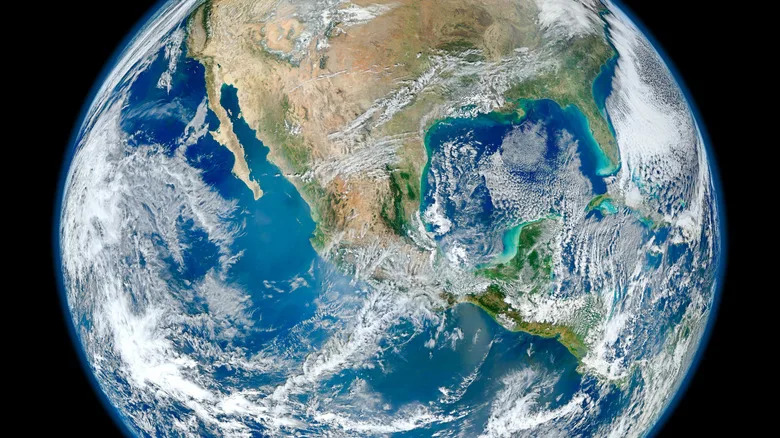
View of Earth from space. - UrbanArtr/Shutterstock
How Warming Disrupts Circulation
Warming seas and increased freshwater input from melting ice and changing precipitation can reduce surface water salinity and density in regions where deep water forms — a key process that drives the AMOC. When that balance is disturbed, the circulation slows. The study models several scenarios and finds that sustained anthropogenic warming increases the probability of a substantial AMOC weakening, with collapse possible under more severe scenarios.
"The Atlantic Meridional Overturning Circulation (AMOC) is expected to weaken or even collapse under anthropogenic climate change," the authors write.
Potential Impacts
The researchers and climate agencies warn that AMOC decline would have wide-reaching consequences:
- Reduced European precipitation: A weaker AMOC is likely to decrease rainfall over parts of Europe, altering the European hydroclimate and raising risks of hotter summers, drought and impacts on agriculture and water supplies.
- Shifted global temperature patterns: The AMOC currently cools the Southern Hemisphere and warms parts of the Northern Hemisphere; its disruption would change those regional balances and could amplify climate extremes elsewhere.
- Marine ecosystem stress: Weakening circulation and altered upwelling can reduce nutrient supply to surface waters, threatening phytoplankton productivity and cascading through food webs.
The study notes that responses vary by scenario and region and that the most severe modelled impacts are more likely to appear after 2100 rather than immediately. However, the timing is uncertain and depends on future greenhouse gas emissions and regional changes such as freshwater input from melting ice.

Photograph of the Atlantic Ocean near the coast of Nantucket. - Wikimedia Commons / Andywallxyz, resized and cropped, CC BY-SA 4.0.
What Can Be Done
Some climate impacts can be mitigated or delayed by rapid reductions in greenhouse gas emissions and by strengthening climate resilience (water management, agricultural adaptation, and protection of coastal ecosystems). Yet tipping points — thresholds beyond which changes accelerate and become harder to reverse — are inherently risky because they can lead to abrupt and long-lived shifts in the climate system.
Bottom line: The new study underscores the vulnerability of a key ocean circulation system to human-driven warming. While major AMOC changes are not projected to be widespread before 2100 in many scenarios, the potential for long-term, hard-to-reverse impacts reinforces the urgency of strong emission cuts and continued monitoring of ocean circulation.
Sources: René M. van Westen et al., Hydrology and Earth System Sciences (Nov 2025); Royal Netherlands Meteorological Institute; Met Office; United Nations.


