
Enjoy a brief Christmas-night sky tour on Dec. 25: a 35% waxing crescent Moon sits low in the southwest with Saturn less than 15° to its upper left. Jupiter will blaze in Gemini near Castor and Pollux, while Orion and the Taurus clusters (Hyades, Pleiades) are prominent. Polaris will stand about 40° above the northern horizon — a great reference for star-trail photography. Use binoculars or a 6-inch telescope to enhance views; check local times and skies for best results.
Christmas Night Sky 2025: What To See On Dec. 25 — Moon, Jupiter, Saturn And Holiday Sky Tips

Dec. 25 is a perfect time to appreciate the beauty of the winter night sky. | Credit: Borchee via Getty Images
Christmas night offers a simple, shared spectacle for anyone who celebrates: the winter sky. After dinner and gift-opening, step outside with friends and family for a relaxing tour of constellations, bright planets and the Moon.
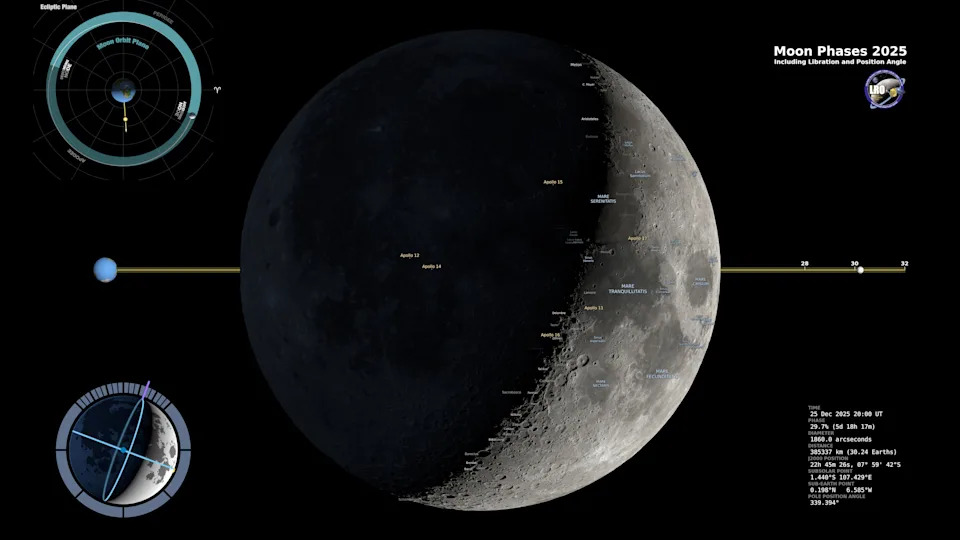
A NASA graphic showing key lunar features visible on Dec. 25. | Credit: NASA Scientific Visualization Studio
What To Look For
When: Soon after sunset on Dec. 25. Best viewing is away from city lights and on clear, calm nights.
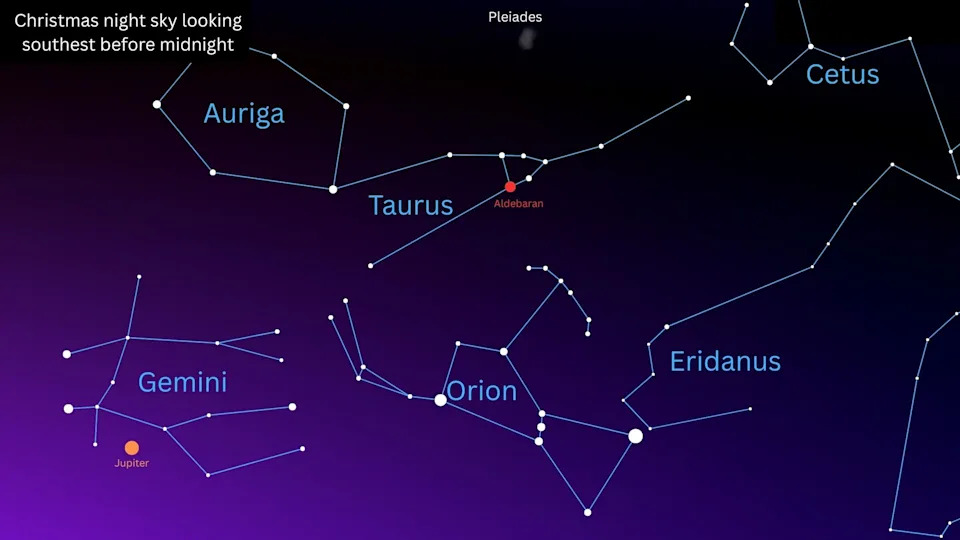
The Christmas night sky looking southeast before midnight. | Credit: Created by Anthony Wood in Canva.
Moon
Look toward the southwestern horizon after sunset to find a waxing crescent Moon lighting roughly 35% of its face. The crescent will be attractive to the unaided eye; with binoculars or a small telescope you can enjoy details on the near side including the broad, smooth lava plains Mare Crisium and Mare Fecunditatis.
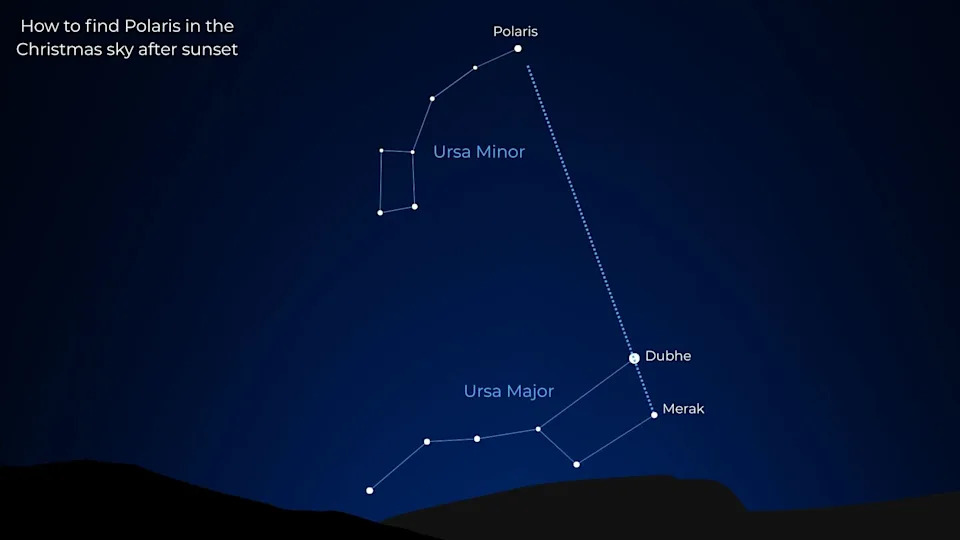
How to find Polaris using the "Big Dipper" asterism. | Credit: Created by Anthony Wood in Canva
Saturn
Saturn will appear as a bright "evening star" less than 15° to the Moon's upper left. A 6-inch (150 mm) telescope will reveal several of Saturn's larger moons — Rhea, Titan, Tethys and Dione — though the planet's rings will appear only as a thin line because we see them nearly edge-on after a ring-plane crossing in March 2025. In the U.S., Saturn and the Moon will set shortly after 11 p.m. local time.
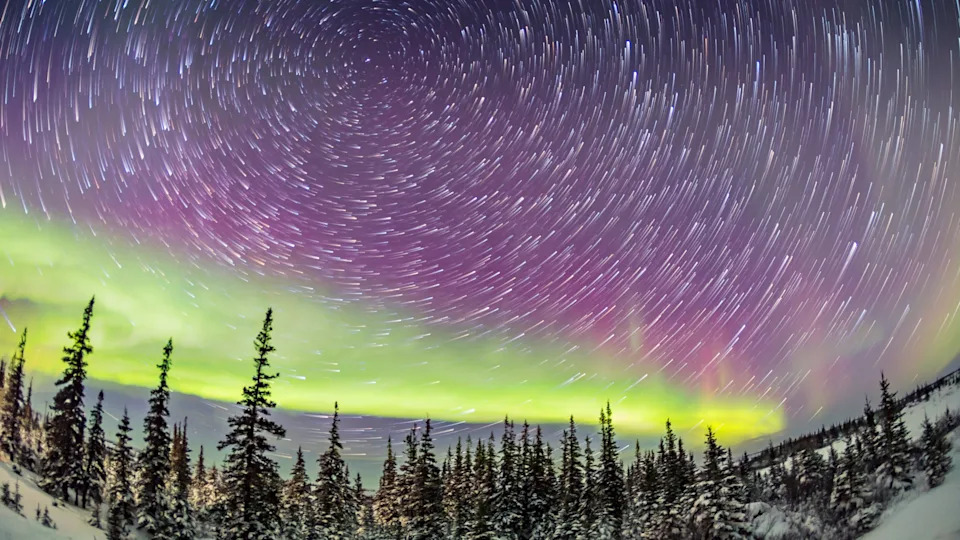
Star trails circle Polaris in the skies over Canada. | Credit: Alan Dyer /VW PICS/Universal Images Group via Getty Images
Jupiter, Orion And Taurus
Turn to the eastern sky to find mighty Jupiter blazing amid the stars of Gemini, close to Castor and Pollux. Jupiter will be the second-brightest object that night after the Moon and will track from east to west as the night progresses. To Jupiter's right you can spot Orion, while the Hyades and Pleiades open clusters sit in Taurus above it.
Polaris And Star Trails
Look north to locate Polaris, the North Star, roughly 40° above the horizon (its altitude equals your latitude and will vary by location). Use the familiar Big Dipper asterism in Ursa Major to find it: draw a line from Merak through Dubhe and follow it outward to the brightest star — Polaris. Polaris provides a steady anchor if you want to record star-trail time-lapses.
Practical Tips For Observing
- Use simple angular measures: a fist at arm's length ≈ 10°; three middle fingers ≈ 5°.
- If you got optics for the holidays, start with binoculars (7x–10x) before moving to a small telescope.
- Check local sunset and moonset times and the weather forecast; light pollution maps and astronomy apps help locate targets quickly.
- For photography, use a tripod, a wide-angle lens for star fields, and longer exposures or stacking for faint objects. For star trails, point near Polaris and shoot repeated long exposures or a single multi-minute exposure.
We hope this short tour helps you enjoy the seasonal sky. If you'd like to share your astrophotography with Space.com readers, send photos, comments, your name and location to spacephotos@space.com. From everyone at Space.com — Merry Christmas!


