Mike Goldsmith’s analysis of ~200 years of AAVSO records finds that the Mira variable R Leonis has shortened its pulsation period by roughly three days since the early 1800s. The study also reveals long-term modulations near 35 and 98 years and decades-long coherence in the star’s minima, likely linked to evolving circumstellar dust shells. While historical visual data include systematic uncertainties, upcoming digital surveys should clarify whether this acceleration reflects true, real-time stellar evolution.
R Leonis' Accelerating 'Heartbeat': Are We Watching a Star Evolve in Real Time?
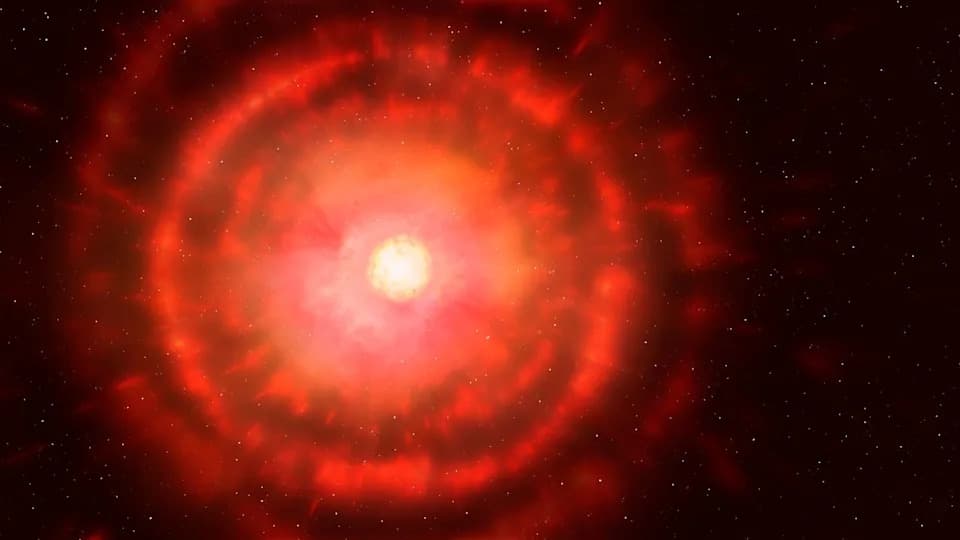
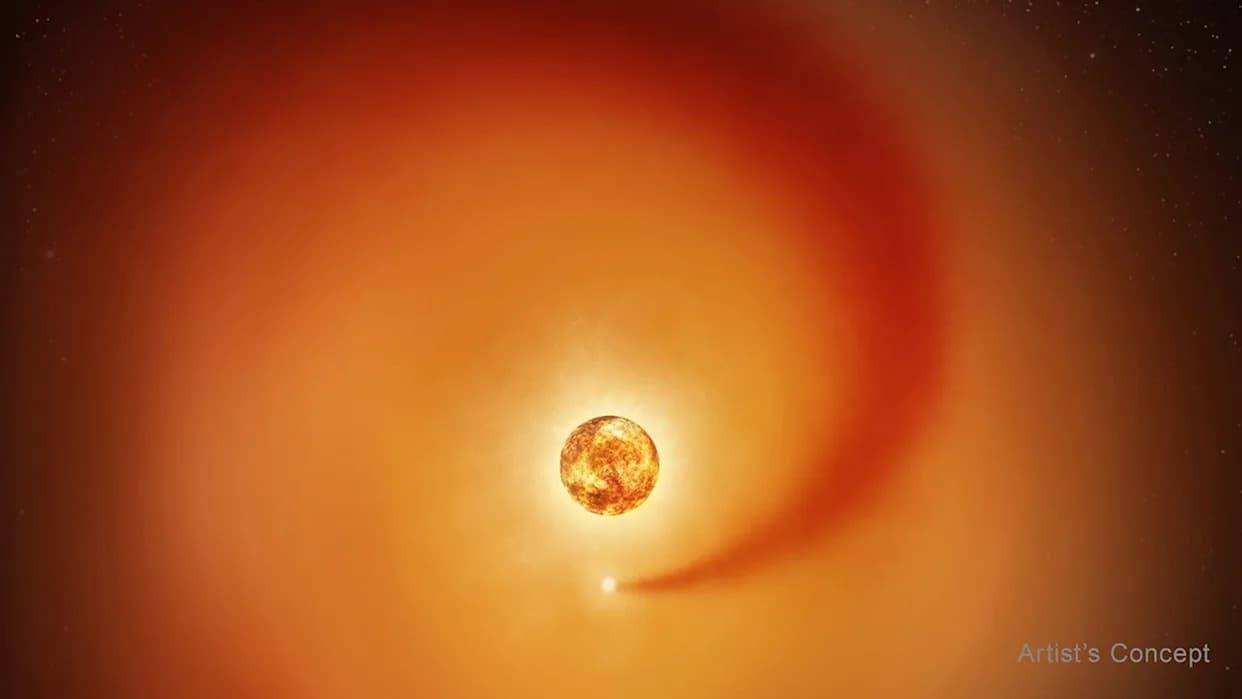
An illustration of a red giant star shedding its outer layers. | Credit: MARK GARLICK/SCIENCE PHOTO LIBRARY/Getty Images
Could a star have a heartbeat? For the red giant R Leonis, the metaphor is surprisingly apt. New analysis of roughly 200 years of observations suggests this Mira variable’s pulsation is shortening — and we may be witnessing a star’s messy final stages in near real time.
What Is R Leonis? R Leonis is an oxygen-rich Mira variable, an aging red giant in the constellation Leo. Mira variables regularly expand and contract, producing predictable cycles of brightening and dimming that have made objects like R Leonis popular targets for both amateur observers and professional astronomers.
New Analysis and Key Findings
In a paper accepted to Monthly Notices of the Royal Astronomical Society and posted as a preprint on arXiv, researcher Mike Goldsmith compiled two centuries of magnitude estimates from the American Association of Variable Star Observers (AAVSO). By reconstructing the timings of recorded maxima and minima, Goldsmith finds that R Leonis’s fundamental pulsation period has shortened by about three days since the early 1800s.
Although three days may sound small on stellar timescales, for a star that historically followed a remarkably steady cycle this change is significant. Goldsmith also detects long-term modulations superimposed on the overall trend, with characteristic timescales near 35 years and 98 years, indicating multiple overlapping rhythms in the star’s behavior.
Dust, Dips, and Decades-Long Patterns
Another striking result concerns the star’s faint phases: the recorded minima stay at nearly the same brightness for decades before shifting to a different level. This coherence suggests evolving circumstellar dust shells — layers of gas and soot the star ejects — which can thicken or thin over time and alter the light we observe from Earth.
Possible Interpretation: If intrinsic, the period shortening and long-term modulations point to genuine, real-time structural changes in a late-stage giant as it burns remaining fuel and sheds mass.
Caveats and Observational Limits
The study relies heavily on historical visual magnitude estimates dating back to the early 1800s. Visual observations differ in precision and systematic effects from modern CCD photometry, so some century-scale signals could reflect archival inhomogeneities rather than intrinsic stellar physics. Goldsmith’s careful reconstruction mitigates many issues but does not eliminate all observational uncertainty.
Why This Matters
Whether temporary or permanent, these changes offer a rare opportunity: R Leonis may provide a front-row view of the complex, often chaotic processes that accompany a star’s late evolution. Upcoming high-cadence, uniform digital sky surveys will supply more precise photometry to test whether the acceleration persists and to separate real stellar evolution from archival artifacts.
Bottom line: Goldsmith’s analysis suggests the "heart of the lion" is beating faster — a provocative hint that R Leonis is changing on human-observable timescales, and worth close watching by observers and theorists alike.
Help us improve.