Observations from the Vera C. Rubin Observatory uncovered a group of extreme fast-spinning asteroids, including one larger than 500 metres that rotates in about two minutes. A study of 76 objects found 16 super-fast rotators and three ultra-fast rotators — MM45 spins in 1.88 minutes. Such rapid rotation implies strong internal cohesion rather than a loose "rubble pile" structure. The discoveries were made in roughly 10 hours of imaging, highlighting Rubin's rapid survey capabilities ahead of LSST operations in 2026.
Rubin Observatory Spots Record-Breaking Fast-Spinning Asteroid — One >500 m Rotates in ~2 Minutes
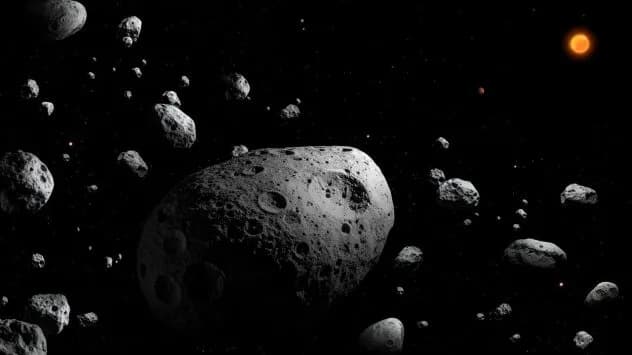
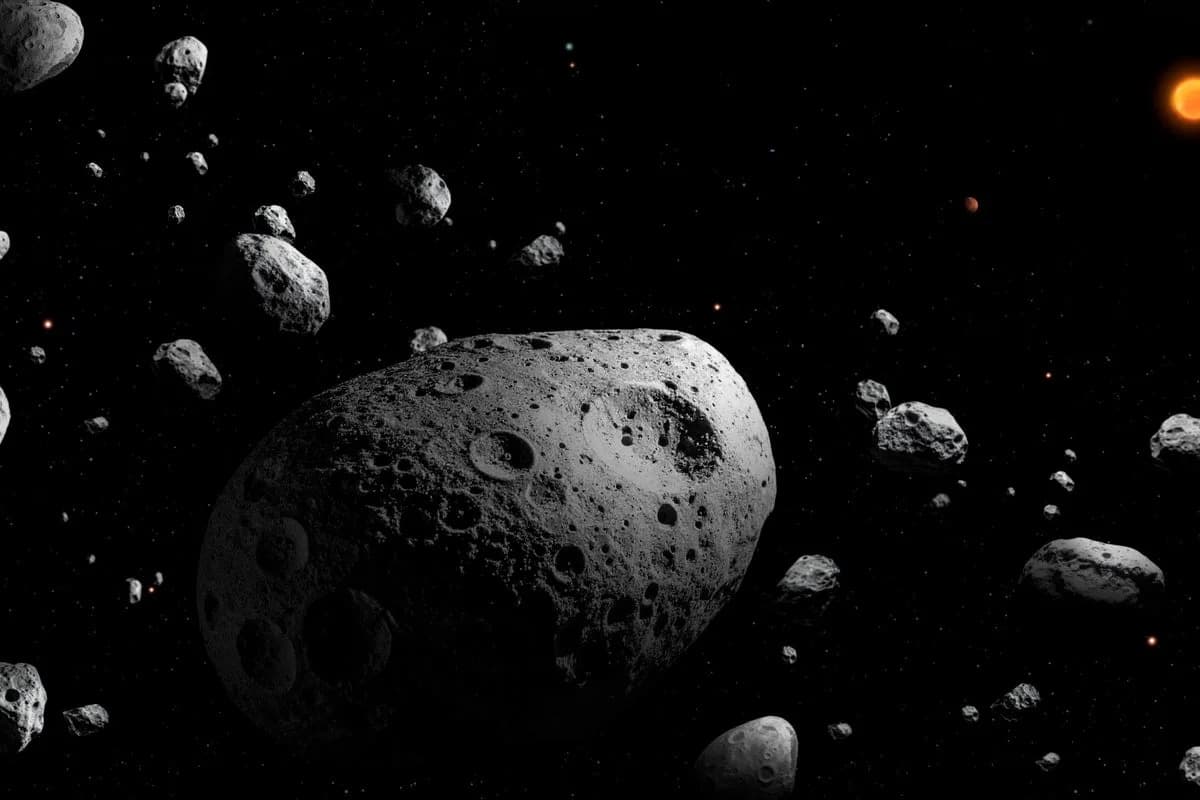
This artist’s illustration depicts 2025 MN45 — the fastest-rotating asteroid with a diameter over 500 meters that scientists have ever found. The asteroid is shown surrounded by many other asteroids, depicting its location within the main asteroid belt. The Sun and Jupiter are shown in the distance. (Image credit: NSF–DOE Vera C. Rubin Observatory/NOIRLab/SLAC/AURA/P. Marenfeld)
A burst of new discoveries from the Vera C. Rubin Observatory has revealed a group of extraordinarily fast-spinning asteroids — including one larger than 500 metres that completes a full rotation in roughly two minutes.
Key Findings
The Rubin telescope, operated by the National Science Foundation's NOIRLab in partnership with SLAC National Accelerator Laboratory, detected nearly 2,000 asteroids last year. A new study published in The Astrophysical Journal Letters examined 76 of those objects and identified 19 as super-fast or ultra-fast rotators.
Among the findings: 16 asteroids are classified as super-fast rotators with spin periods between about 13 minutes and 2.2 hours, while three are ultra-fast rotators completing a full spin in under five minutes. The fastest of these — including asteroid MM45 — spins every 1.88 minutes, making it the quickest-known asteroid larger than 500 metres.
Why The Rotation Matters
Most asteroids are thought to be "rubble piles": loose aggregates of rock and dust held together mainly by gravity. An object spinning as rapidly as MM45 cannot be a loose collection of fragments without flying apart — it must possess substantial internal cohesion or solid-rock strength.
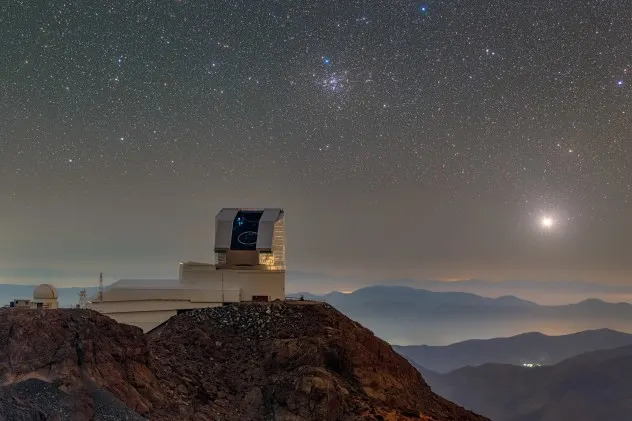
NSF–DOE Vera C. Rubin Observatory is seen with its dome open during First Look observation activities in April 2025. Messier 41, the Little Beehive Cluster, can be seen over the telescope in this telelens photo. (Image credit: RubinObs/NOIRLab/SLAC/NSF/DOE/AURA/P. Horálek (Institute of Physics in Opava)
"Clearly, this asteroid must be made of material that has very high strength in order to keep it in one piece as it spins so rapidly," said study author Sarah Greenstreet of NOIRLab. "We calculate that it would need a cohesive strength similar to that of solid rock, which is surprising because most asteroids are believed to be rubble piles formed by accumulation or collisions."
The record-holder is roughly the size of eight American football fields, implying that unusually strong material or internal structure keeps it intact at its extreme spin rate.
Speed Of Discovery And Looking Ahead
Notably, these discoveries came from only about 10 hours of imaging — a demonstration of Rubin's rapid survey capability. Rubin's Legacy Survey of Space and Time (LSST) will eventually produce the largest time-lapse survey of the Southern Hemisphere night sky over a 10-year mission.
"We have known for years that Rubin would act as a discovery machine for the Universe, and we are already seeing the unique power of combining the LSST Camera with Rubin's incredible speed," said Aaron Roodman, Deputy Head of LSST and professor of particle physics and astrophysics at SLAC. "Together, Rubin can take an image every 40 seconds. The ability to find thousands of new asteroids in such a short period of time is a preview of what the 10-year survey will reveal."
The observatory is funded by the National Science Foundation and the U.S. Department of Energy and is named for the late astronomer Vera Rubin, who provided foundational evidence for dark matter. LSST is scheduled to begin full operations in 2026 and will use the largest digital camera ever built.
Help us improve.