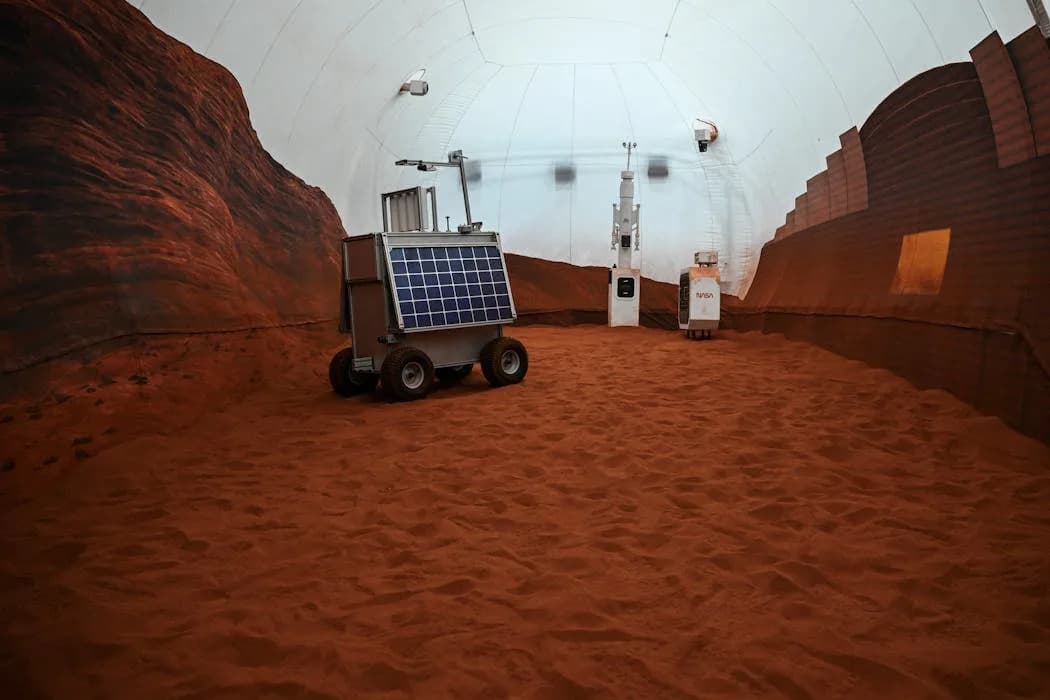
NASA's 'Mars to Table' challenge invites teams to design two-week meal plans and sustainable food-production systems for Mars, with a $750,000 prize available to U.S. winners. Entries may assume up to 50% of supplies initially come from Earth, prioritizing nutrient-dense and resource-efficient crops. Submissions are due by Aug. 21, and winners will be announced in September. The competition aims to inform long-duration mission planning and improve resilient food systems on Earth.
Mars to Table: Help NASA Feed Astronauts on Mars — $750,000 Prize for U.S. Winners

NASA has sent five robotic vehicles to Mars. Sojourner, Spirit, Opportunity, Curiosity, and Perseverance. Look back at the missions.
NASA has launched an international design challenge called 'Mars to Table' asking innovators to create reliable, high-nutrition food systems and two‑week meal plans for crews on Mars. The contest is meant to accelerate ideas that could sustain astronauts on long-duration missions and also improve resilient food production on Earth.
Competition Overview
The contest invites teams to design systems for growing, producing and packaging food under the extreme constraints of the Martian environment. Entries may assume that up to half of the initial food supply originates from Earth, encouraging proposals that prioritize nutrient density and efficient use of mass and volume. The top U.S. entrants are eligible for a $750,000 prize; international teams may participate and be judged but are not eligible for the cash award.
"By designing food systems that operate reliably under extreme constraints, Mars to Table highlights approaches that reduce dependence on fragile supply chains, maximize resource efficiency, and enable food production where traditional systems fall short," competition organizers said.
Deadlines and Eligibility
Teams have until Aug. 21 to submit proposals; winners are expected to be announced in September. Submissions will be evaluated for practicality, resource efficiency, nutritional completeness, and ability to operate in a Martian environment.
Why This Matters
Astronauts traveling to—and living on—Mars will face unique food challenges, including strict mass and volume limits, nutritional completeness, and "menu fatigue" from repetitive meals. NASA already uses experiments on the International Space Station to refine food technologies, but farming and sustainable production on Mars will require new approaches to conserve water, power and other scarce resources.
Broader Exploration Context
The challenge comes as NASA and private industry advance plans for deep-space exploration. NASA aims to send humans to Mars in the 2030s and is developing technologies for power, shelter and life support. Nuclear power systems, radiation- and micrometeoroid-resistant habitat designs, in-situ oxygen production, and laser-based communications are among the areas under development. Earlier programs such as the proposed Mars Sample Return would have helped mature some of these technologies before being canceled by Congress in January.
Public Interest and Industry Views
The contest has a cultural echo in the film 'The Martian,' in which a stranded astronaut survives by growing potatoes. Private companies also push their own timelines: SpaceX CEO Elon Musk has argued for faster, large-scale settlement plans that would require dramatically higher launch cadences to transport people and cargo.
Quick Facts About Mars
- Mars is the fourth planet from the Sun and appears red due to oxidized, iron-rich rocks.
- Depending on orbital positions, Mars and Earth can be about 33 million to roughly 249 million miles apart.
- Gravity on Mars is about 40% of Earth's; a 200 lb person would weigh about 76 lb there.
- The Martian atmosphere is thin and contains almost no breathable oxygen.
Innovators and teams interested in practical, high-impact solutions for long-duration spaceflight and resilient terrestrial food systems are encouraged to enter. Proposals that demonstrate scalability, resource efficiency and crew acceptability will be most competitive.
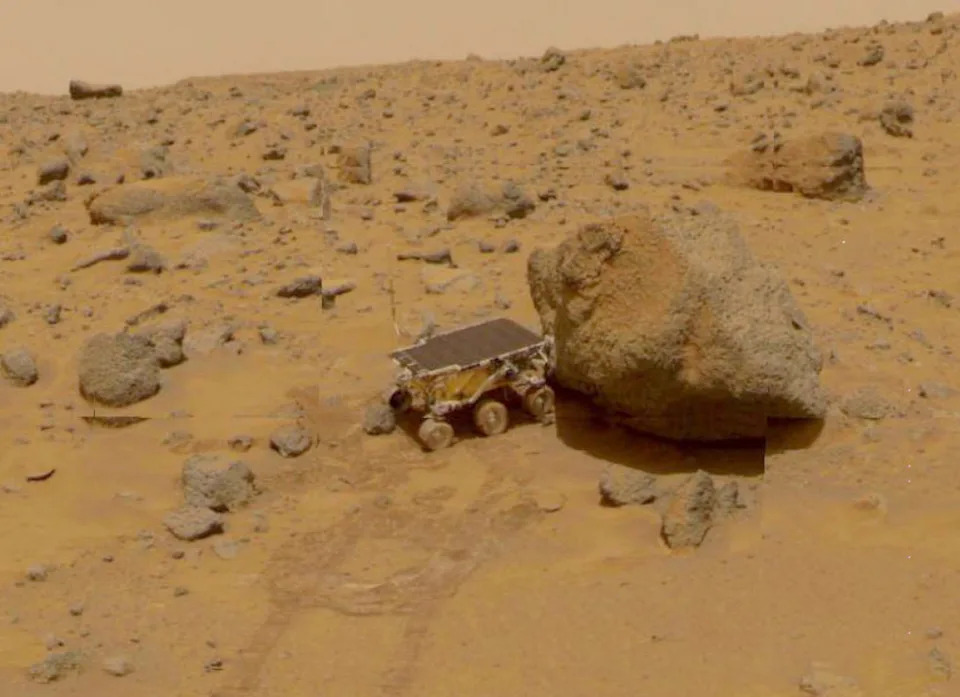
View of the NASA Pathfinder Sojourner Rover robotic data gathering vehicle exploring the surface terrain of the planet Mars, 1997.
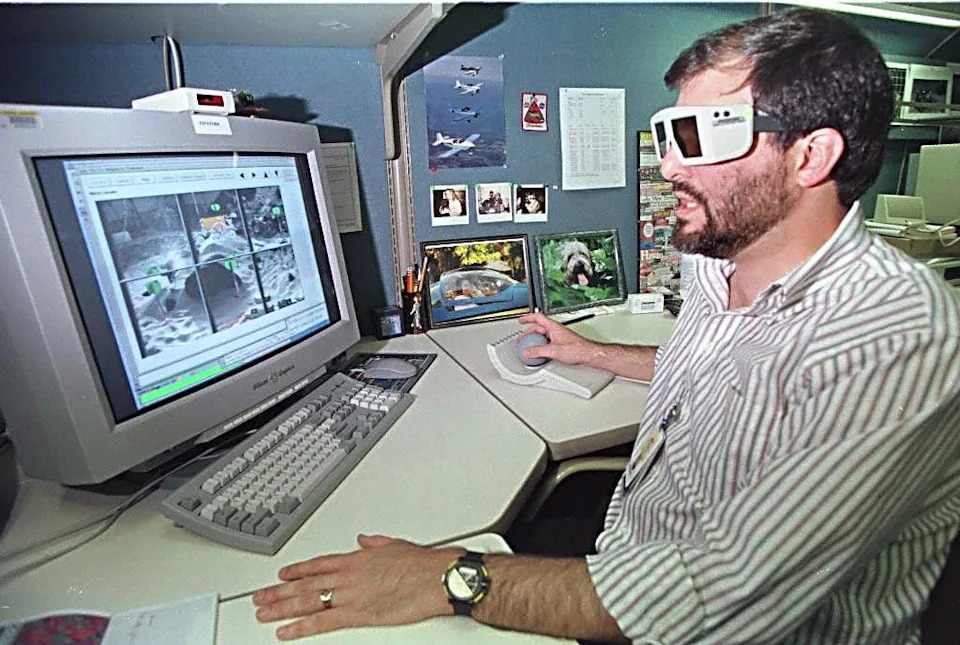
Brian Cooper, who will command the Mars Pathfinder rover "Sojourner", uses 3-D glasses on July 1,1997 to operate the mechanical explorer which will give him a three dimensional view of the Martian surface. He will receive pictures of the Martian surface including Sojourner from the camera on the Mars Pathfinder Lander.
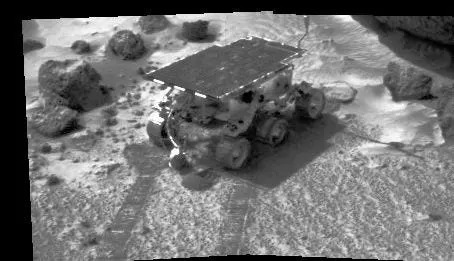
This July 8, 1997 NASA photo taken by the Mars Pathfinder shows the Sojourner rover on the rocky Martian terrain. The Sojourner is making an analysis of the soil content and transmitting data back to earth.
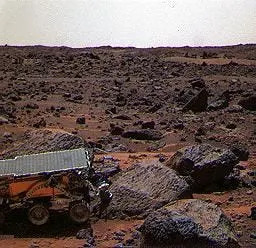
This image taken by the Imager for Mars Pathfinder (IMP) and released on October 8, 1997 by the Jet Propulsion Lab (JPL) shows the Sojourner rover's Alpha Proton X-ray Spectrometer (APXS) deployed against the rock "Moe". The rock behind rover is "Half Dome", which has also been analyzed.
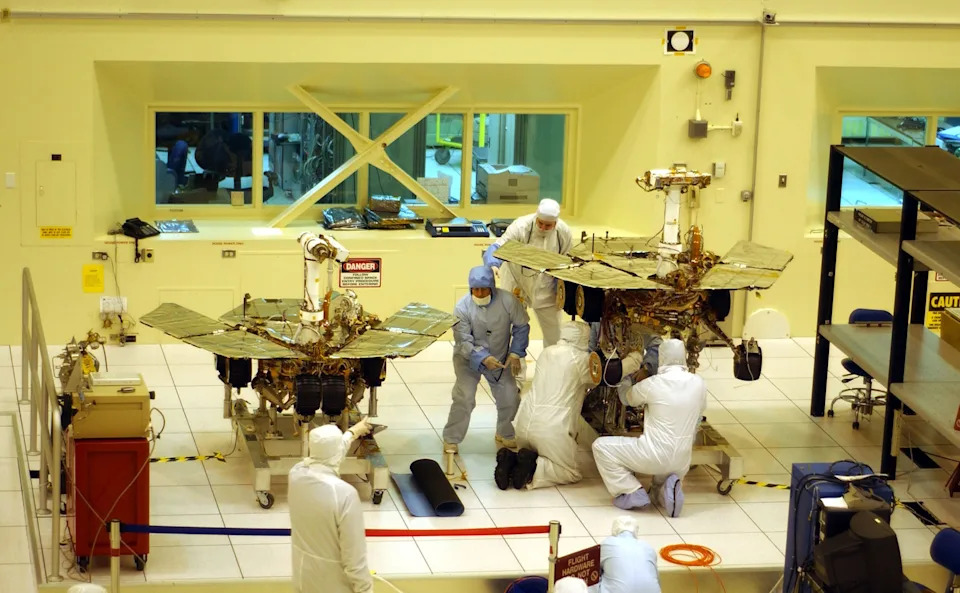
Workers put final touches to the two new Mars exploration rovers at NASA Jet Propulsion Laboratory (JPL) February 10, 2003 in Pasadena, California. The identical robotic explorers, Spirit and Opportunity, will trek up to 109 yards each Martian day, far more than the much smaller Mars Pathfinder was able to do in 1997. The rovers will search for evidence of liquid water in two separate areas of the red planet. The rovers stand about five feet tall and weigh in around 400 pounds. The first rover has a launch opportunity May 30, 2003 and the second June 25, 2003.
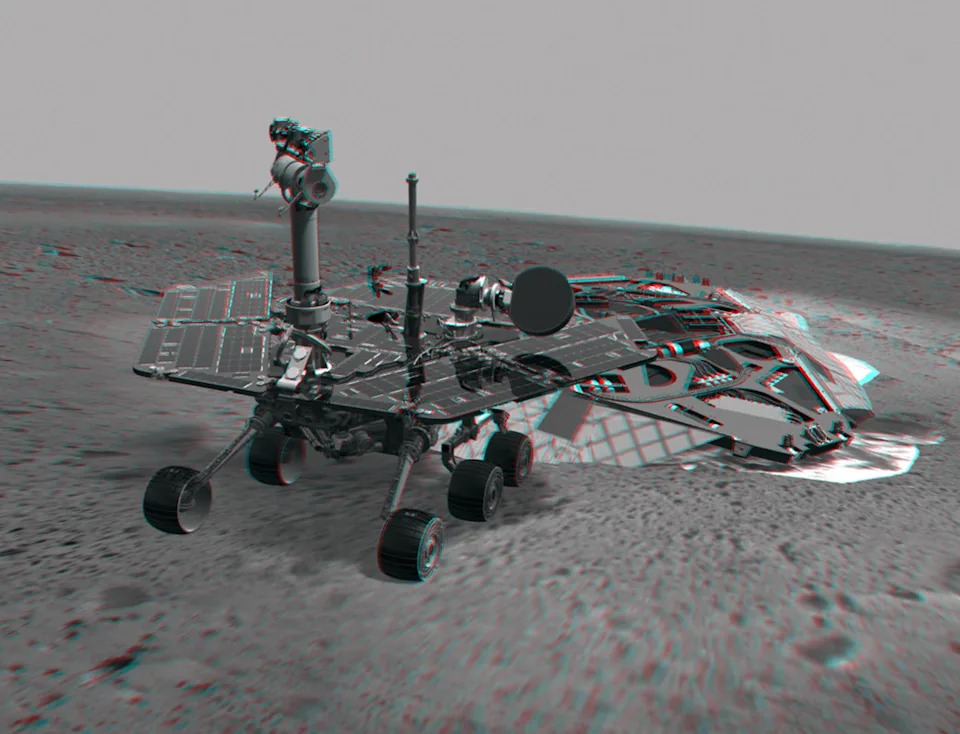
This 3-D image released by NASA January 23,, 2004 combines computer-generated models of the Mars Exploration Rover Spirit and its lander with real surface data from the rover's panoramic camera. NASA made progress in fixing its malfunctioning Mars rover Spirit by finding a work-around for a balky memory card. "We made good progress overnight. The rover has been upgraded from critical to serious." said Peter Theisinger, rover project manager, at an afternoon press briefing 24 January at the Jet Propulsion Laboratory (JPL). Theisinger said that ground controllers have established an ability to communicate with and control the vehicle reliably. Scientists said they managed to reset Spirit's computer and put the rover into what's called "cripple" mode to bypass software problems. Still, the problems may prevent the rover from taking another drive on Mars for as long as three weeks.
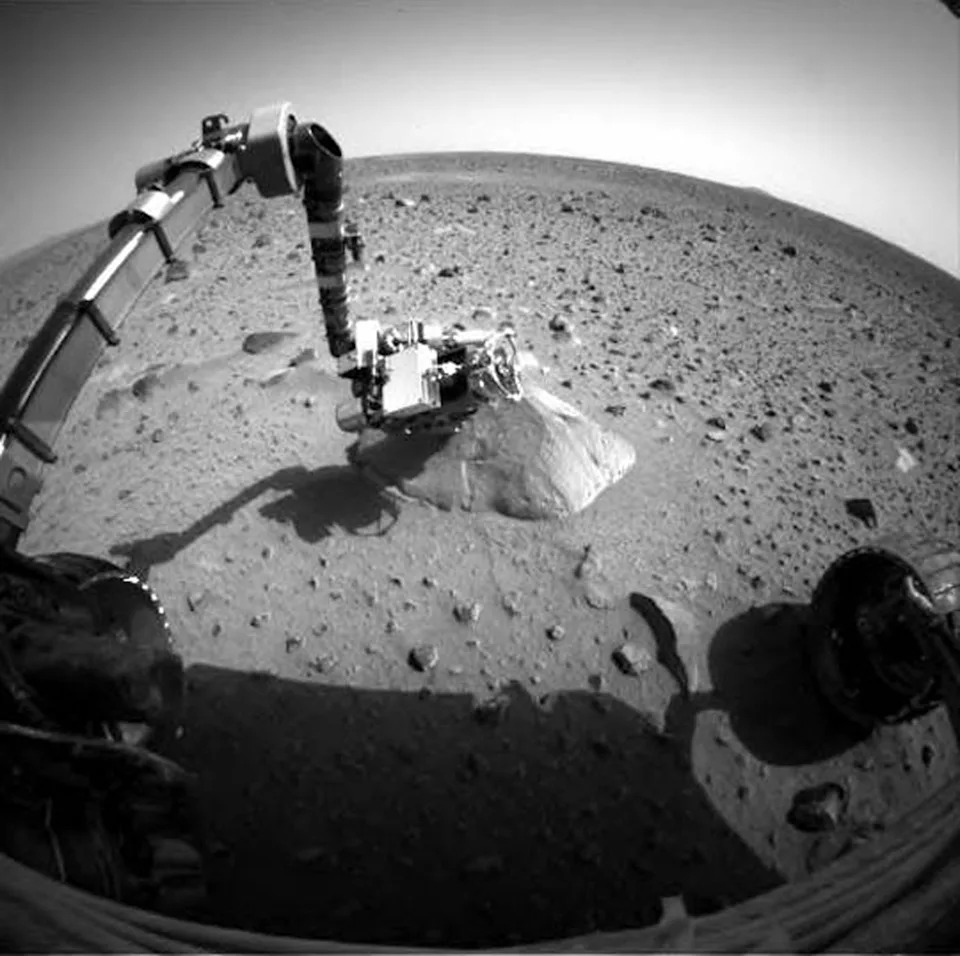
In this handout image provided by the National Aeronautics and Space Administration (NASA)/JPL, NASA's Mars Exploration Rover Spirit took and returned this image on January 28, 2004, the first picture from Spirit since problems with communications began a week earlier. The image from the rover's front hazard identification camera shows the robotic arm extended to the rock called Adirondack. As it had been instructed a week earlier, the Moessbauer spectrometer, an instrument for identifying the minerals in rocks and soils, is still placed against the rock. Engineers are working to restore Spirit to working order so that the rover can resume the scientific exploration of its landing area.
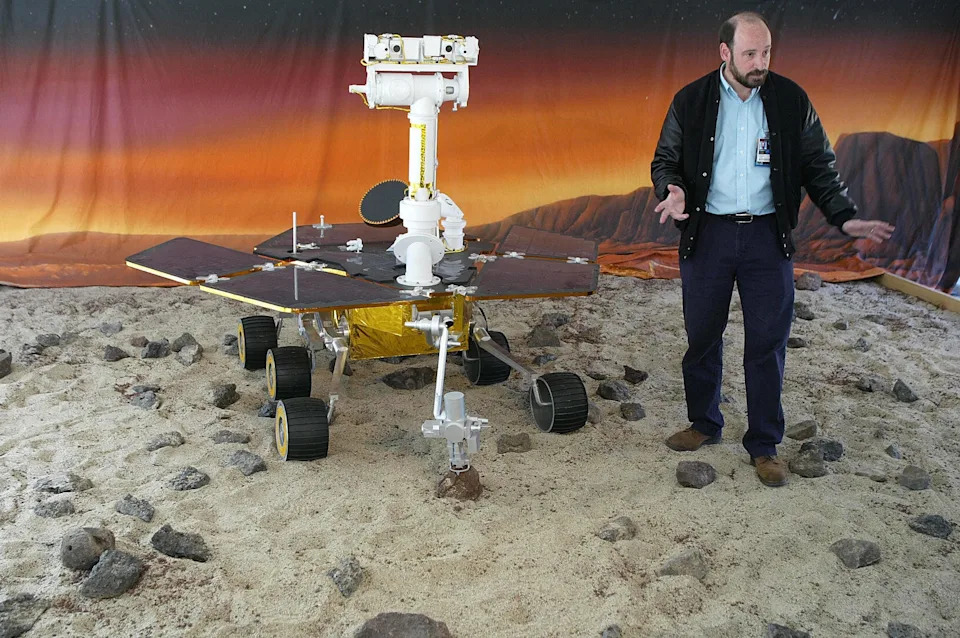
NASA's Jet Propulsion Laboratory (JPL) Navigator Program Engineer Dr Randii Wessen discusses the Mars Exploration Rover (MER) beside a model of the MER in a "sandbox" at the JPL in Pasadena, California on January 21, 2004. With the first rover named "Spirit" already safely on martian soil, engineers and scientists are gearing up for the scheduled landing of the second rover "Opportunity" on the opposite side of Mars later this week.
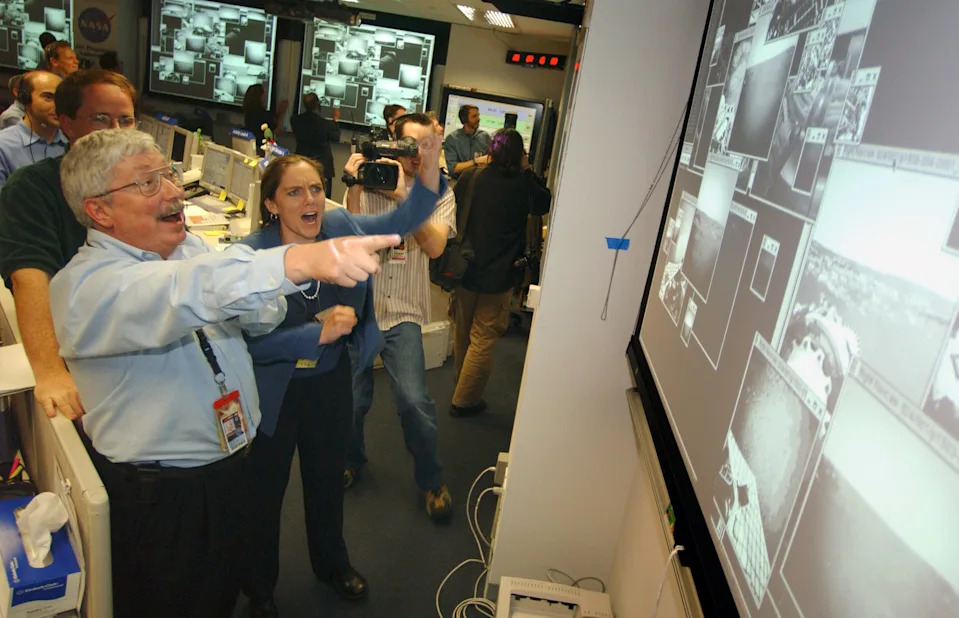
Pete Theisinger, project manager, lef, and Jennifer Trosper, Spirit Mission Manager for Surface Operations, react as the first images arrive from the NASA Mars Rover, "Opportunity," at Jet Propulsion Laboratory (JPL) on January 25, 2004 in Pasadena, California.
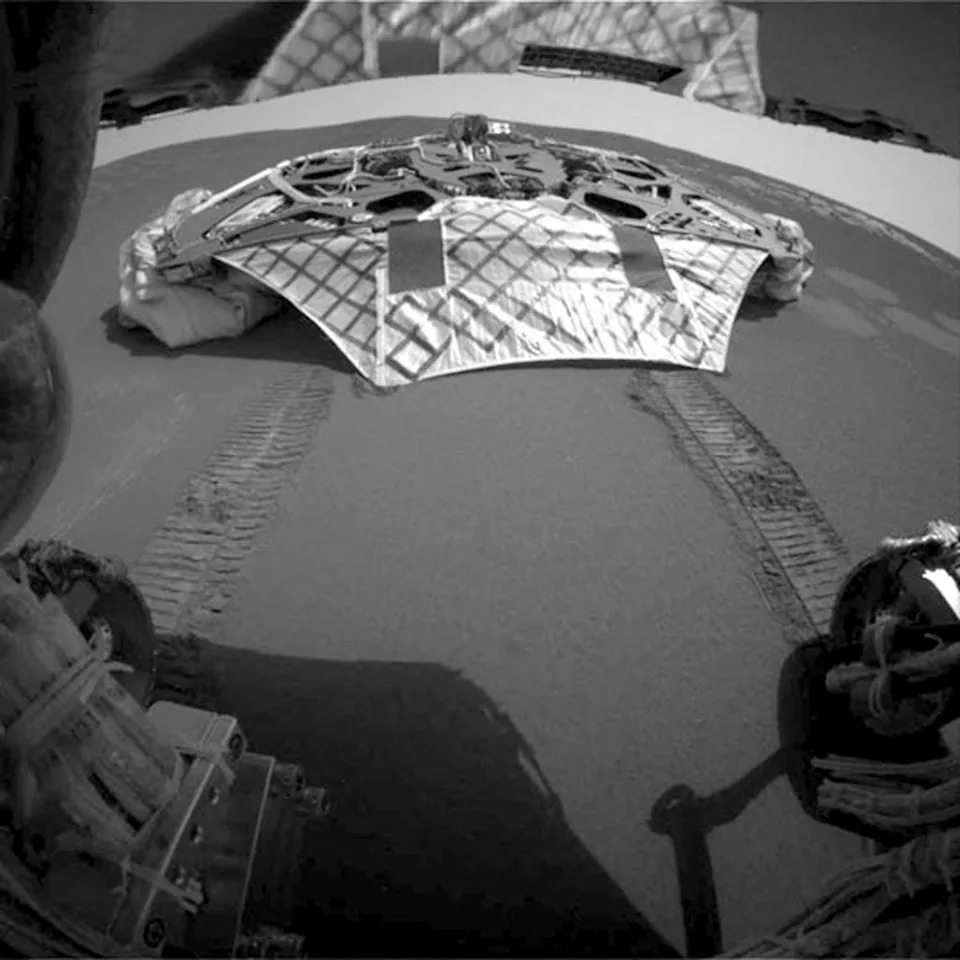
This black and white image released by NASA on January 31, 2004, shows rover lander Opportunity successfully drives off onto the surface of Mars. The US rover Opportunity drove across the surface of the planet Mars for the first time early Saturday nearly a week after landing on the planet, the US space agency NASA said.
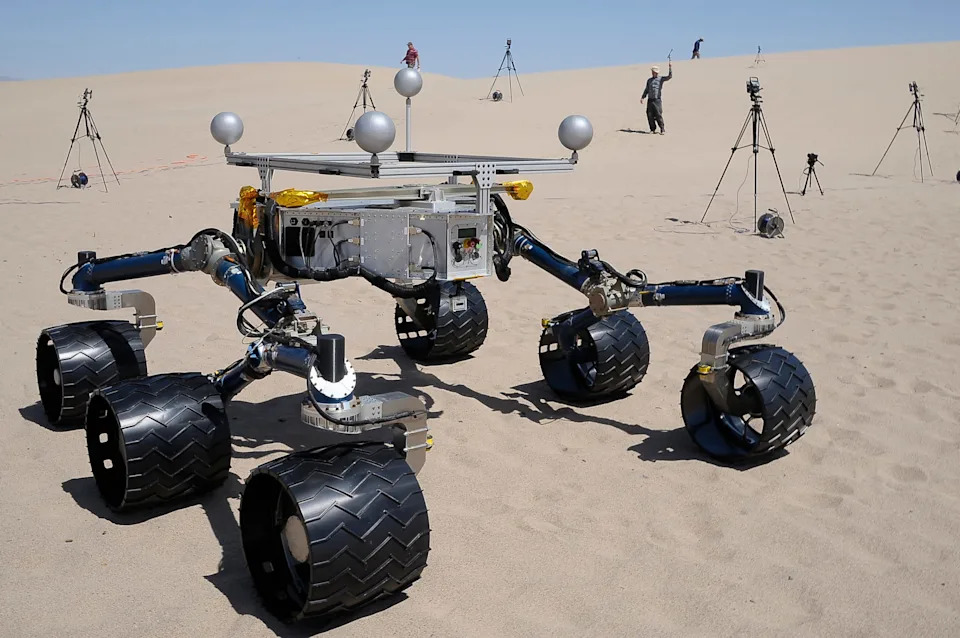
Members of the Mars Science Laboratory/Curiosity team, which includes rover drivers and scientists, test out an engineering model of its next generation Mars rover, dubbed "Curiosity", in the desert near Baker, California May 10, 2012. According to a press release from NASA, the rover is 89 days away from its August appointment with Mars.
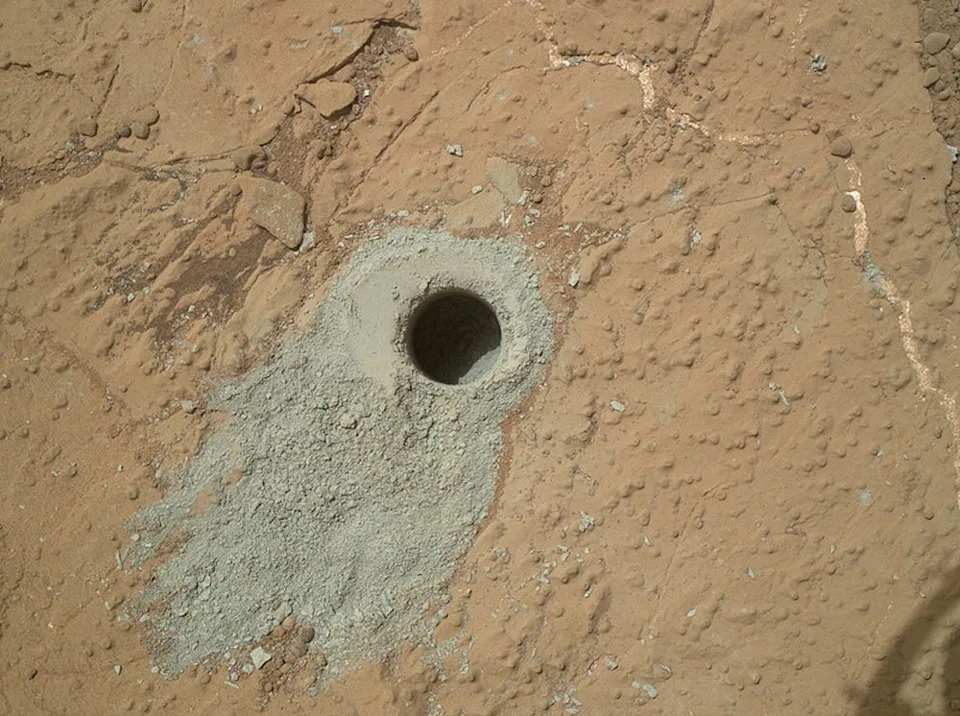
NASA's Mars rover Curiosity drilled into this rock target, "Cumberland," during the 279th Martian day, or sol, of the rover's work on Mars, on May 19, 2013 and collected a powdered sample of material from the rock's interior, in this handout photo provided by NASA . Methane in the Martian atmosphere and organic chemicals in the red planet's soil are the latest tantalizing findings of NASA's Mars Curiosity rover as it hunts for clues about the possibility of extraterrestrial life, scientists said on December 16, 2014.
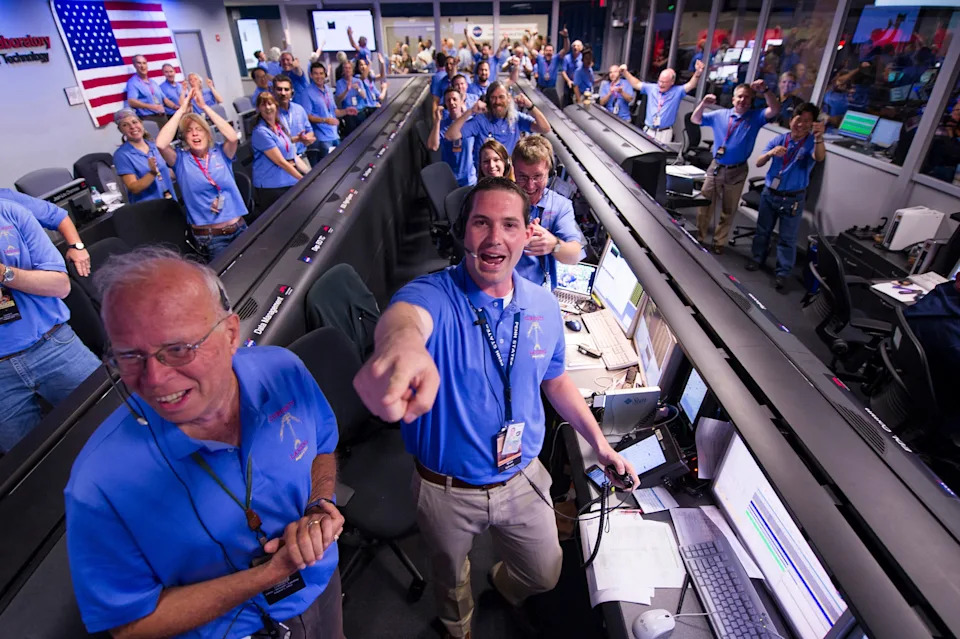
The Mars Science Laboratory (MSL) team in the MSL Mission Support Area reacts after learning the Curiosity rover has landed safely on Mars and images start coming into the Jet Propulsion Laboratory, in Pasadena, California in this August 5, 2012 handout photograph provided by NASA. Curiosity survived its daredevil landing on Mars one year ago Tuesday and went on to discover that the planet most like Earth in the solar system could indeed have supported microbial life, the primary goal of the mission.
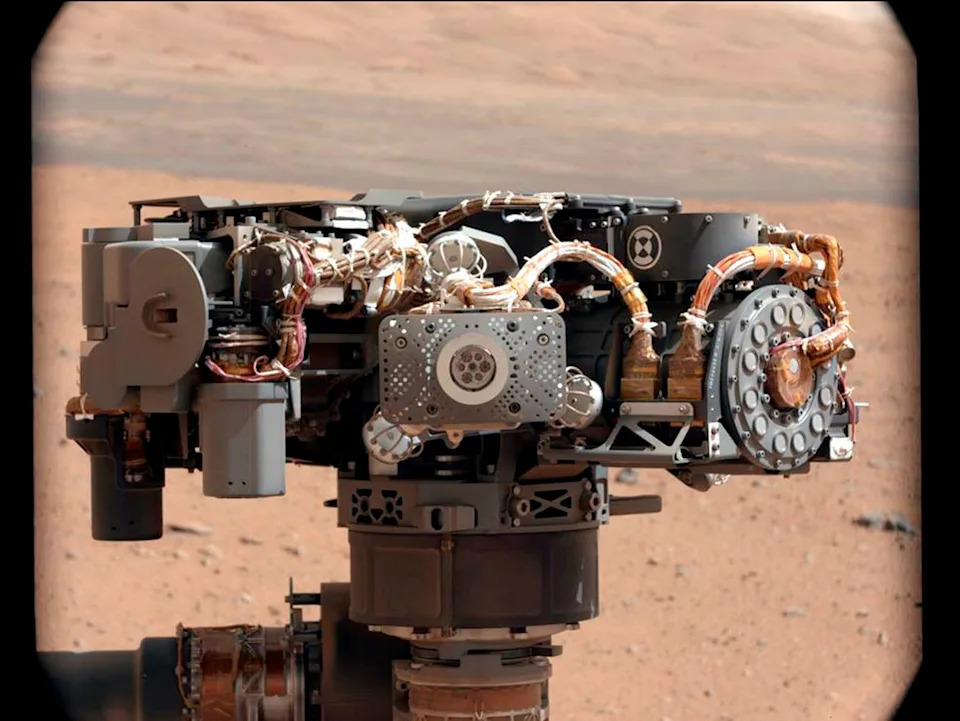
In this image taken by Curiosity's Mast Camera, the Alpha Particle X-Ray Spectrometer (APXS) on NASA's Curiosity rover is pictured, with the Martian landscape in the background on the 32nd Martian day, or sol, of operations on the surface on September 7, 2012, PDT or September 8, 2012, UTC. This image lets researchers know that the APXS instrument had not become caked with dust during Curiosity's dusty landing.
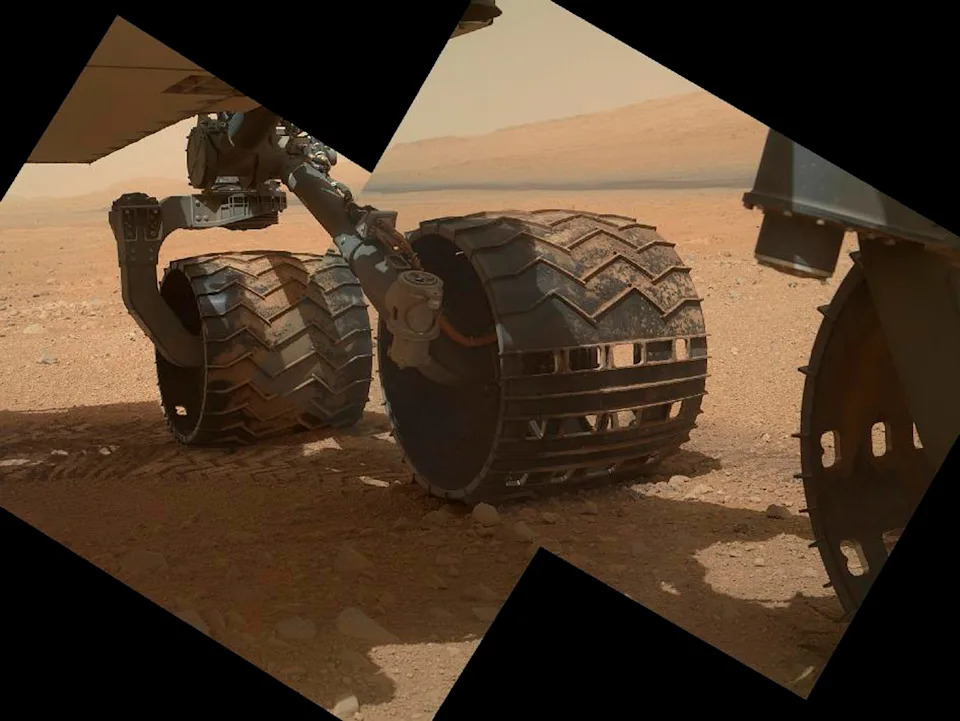
A NASA handout photo shows the three left wheels of NASA's Mars rover Curiosity combined in two images that were taken by the rover's Mars Hand Lens Imager (MAHLI) on September 9, 2012. In the distance is the lower slope of Mount Sharp.
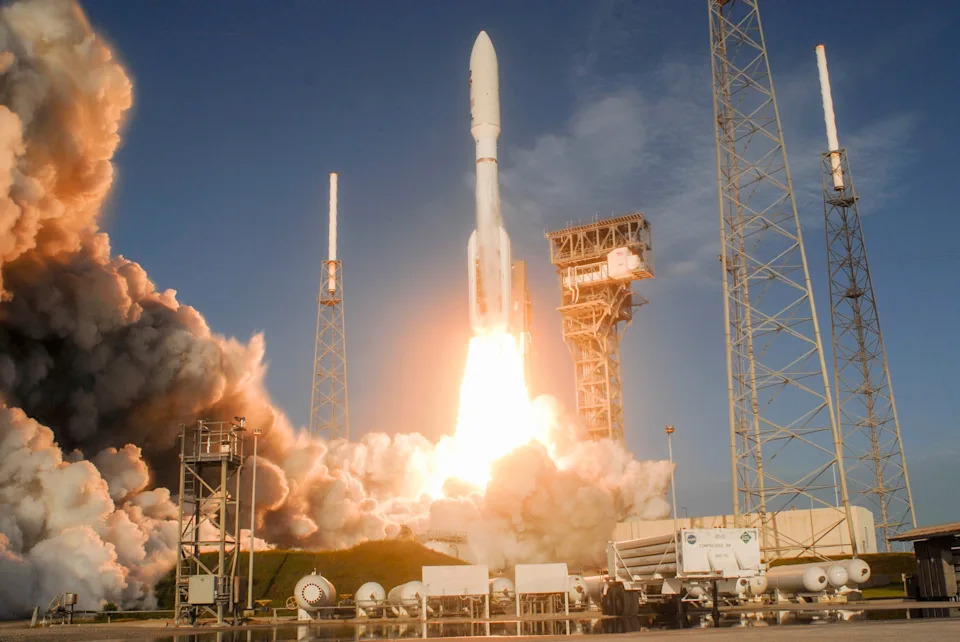
A United Launch Alliance Atlas V rocket lifts off from Cape Canaveral Space Force Station on Thursday, July 30, 2020, with NASA's Perseverance rover destined for Mars.
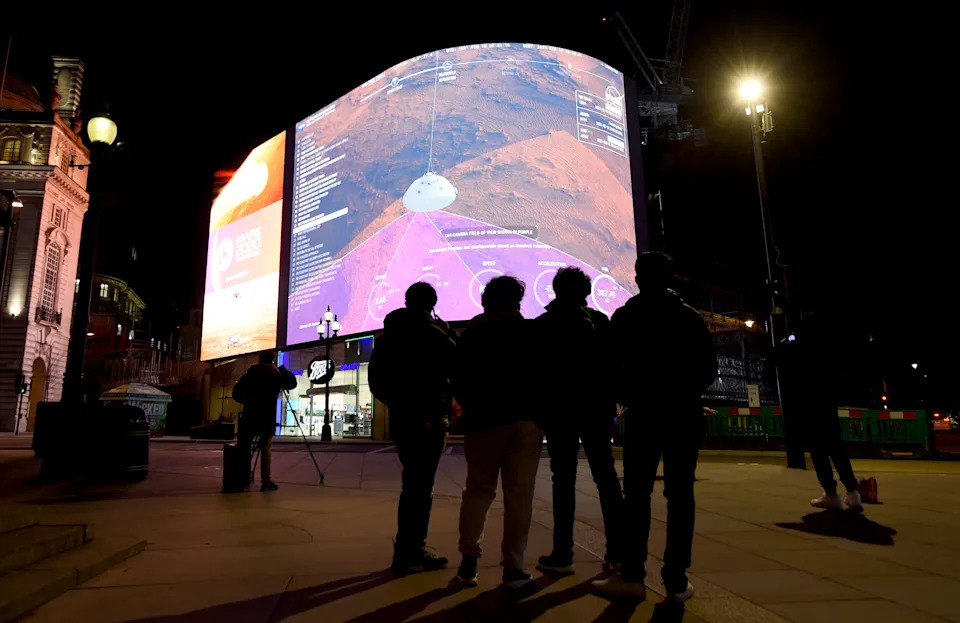
A general view of the live-stream landing of NASA's Perseverance on Mars at Piccadilly Circus on February 18, 2021 in London, England. The rover has been traveling through space since launching from Cape Canaveral at the end of July 2020.
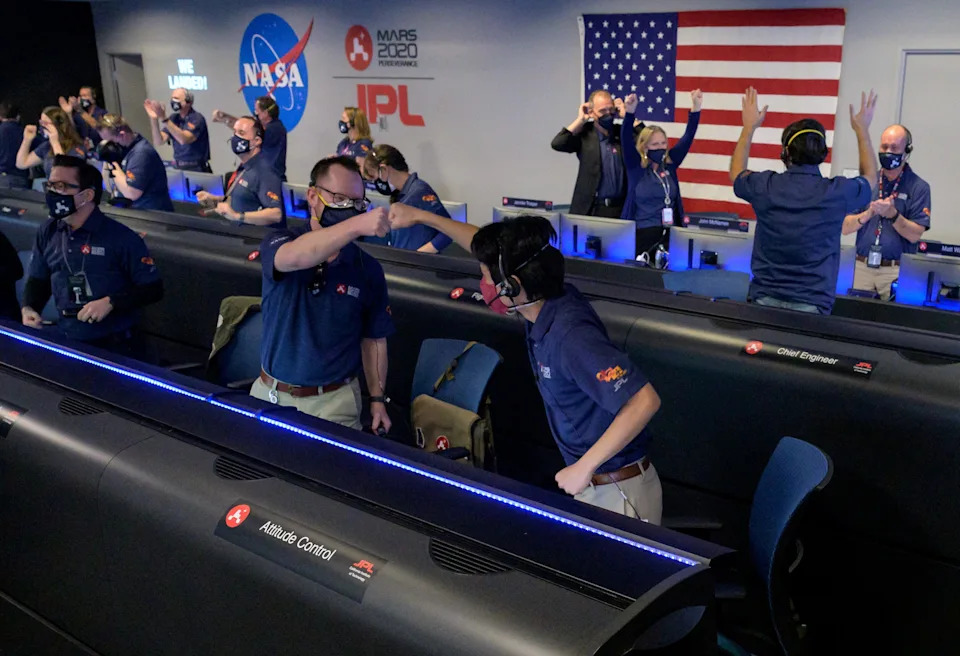
Members of NASAÕs Perseverance rover team react in mission control after receiving confirmation the spacecraft successfully touched down on Mars, at NASA's Jet Propulsion Laboratory in Pasadena, California, U.S. February 18, 2021. Picture taken February 18, 2021.
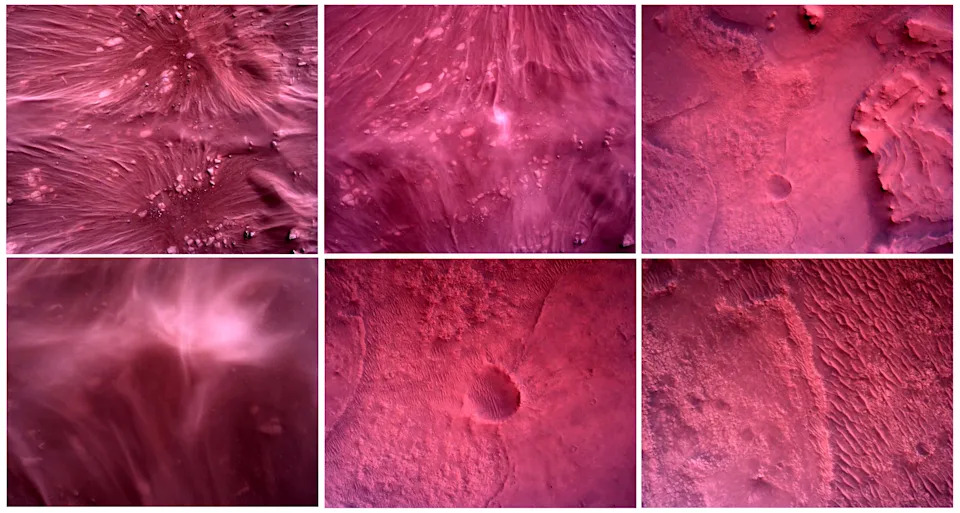
The surface of Mars directly below NASA's Mars Perseverance rover is seen using the Rover Down-Look Camera in a combination of images acquired February 22, 2021.
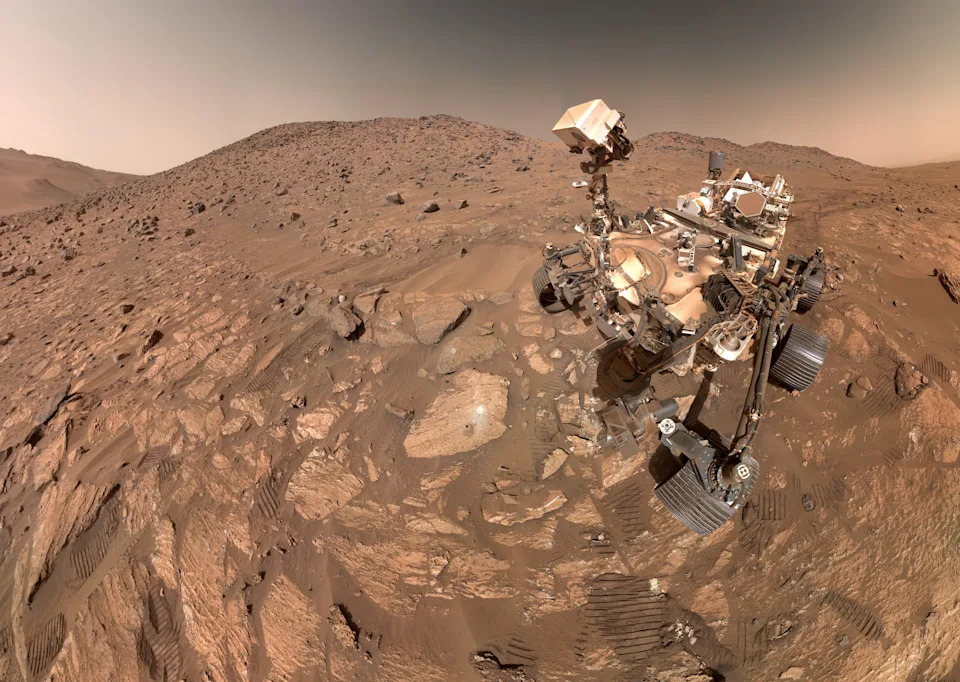
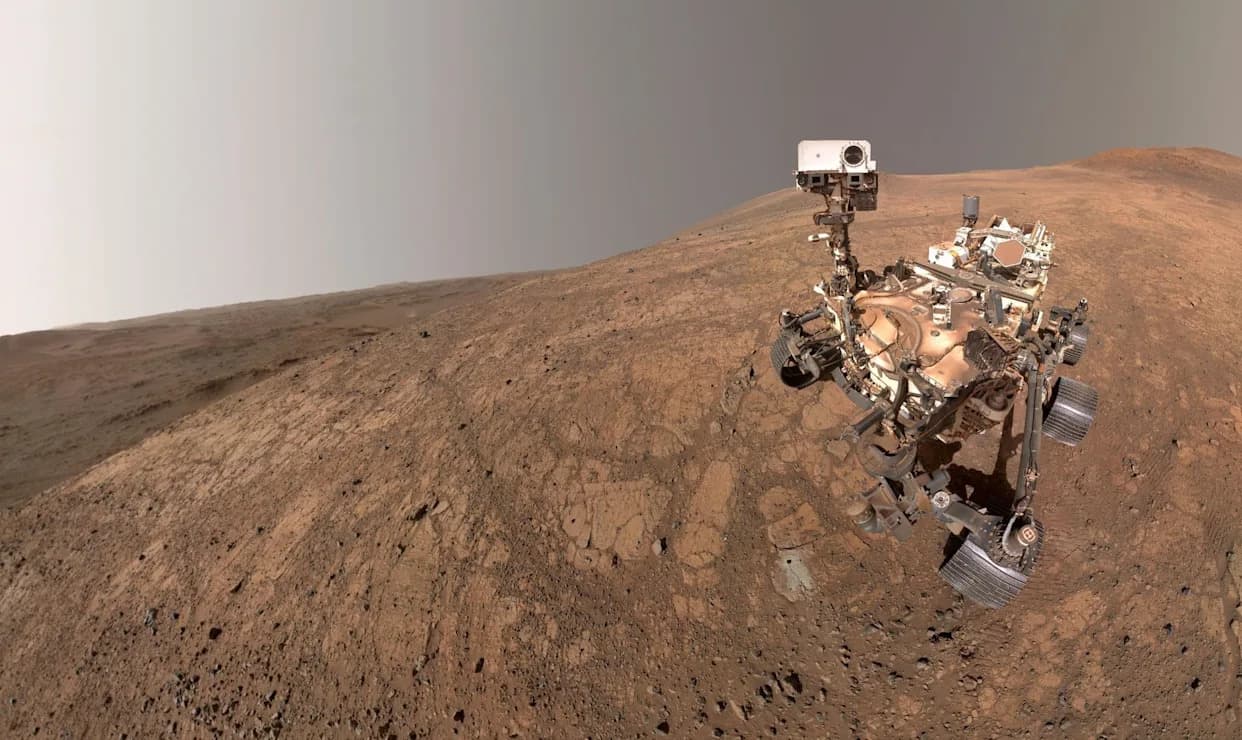
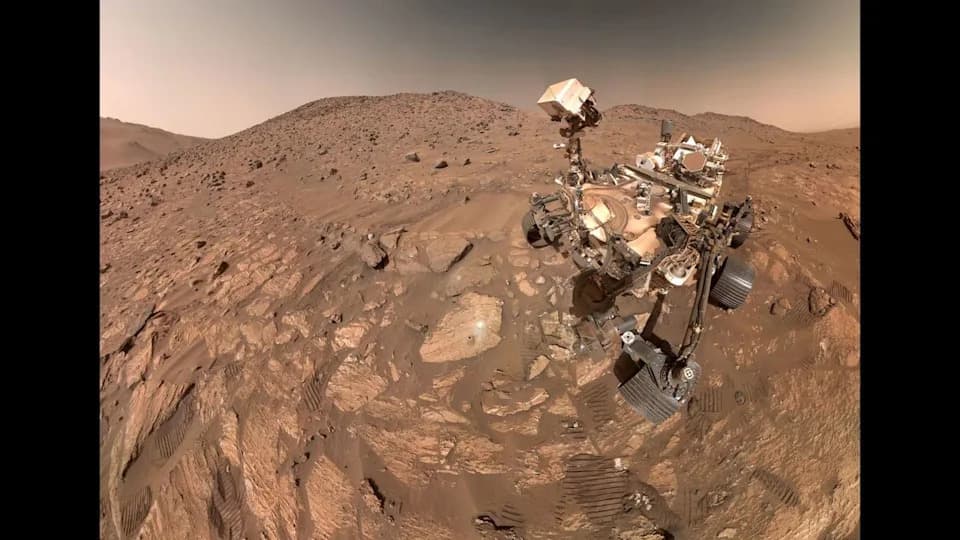
A "selfie" taken by NASA's Perseverance Mars rover, made up of 62 individual images, on July 23, in this image released on September 10, 2025. A rock nicknamed "Cheyava Falls," which has features that may bear on the question of whether the Red Planet was long ago home to microscopic life, is seen to the left of the rover near the center of the image.
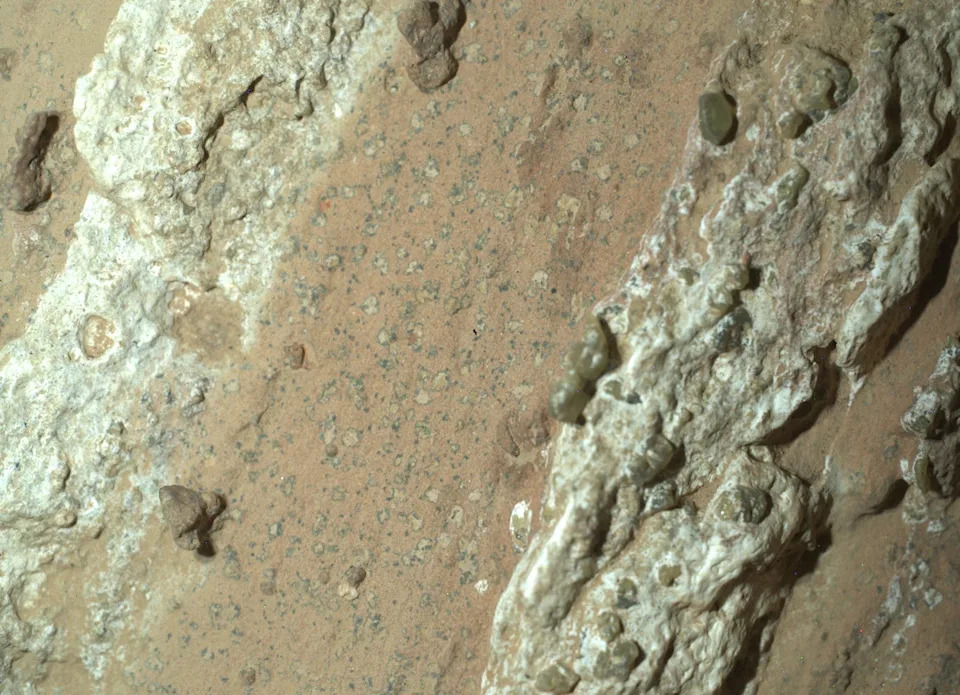
This handout photo obtained on September 10, 2025, from NASA/JPL-Caltech/MSSS shows an image taken by NASA's Perseverance rover that shows "leopard spots" on a reddish rock nicknamed "Cheyava Falls" in Mars' Jerezo Crater in July 2024 on Mars. Colorful, speckled rocks found on the surface of Mars have offered among the most encouraging evidence yet of ancient life on our neighboring planet, scientists at NASA announced on September 10, 2025. The Perseverance Mars rover collected the "Sapphire Canyon" rock samples in July 2024 from the bed of what's considered an ancient lake, and its poppyseed and leopard-esque spots pointed to potential chemical reactions that piqued the interest of researchers.
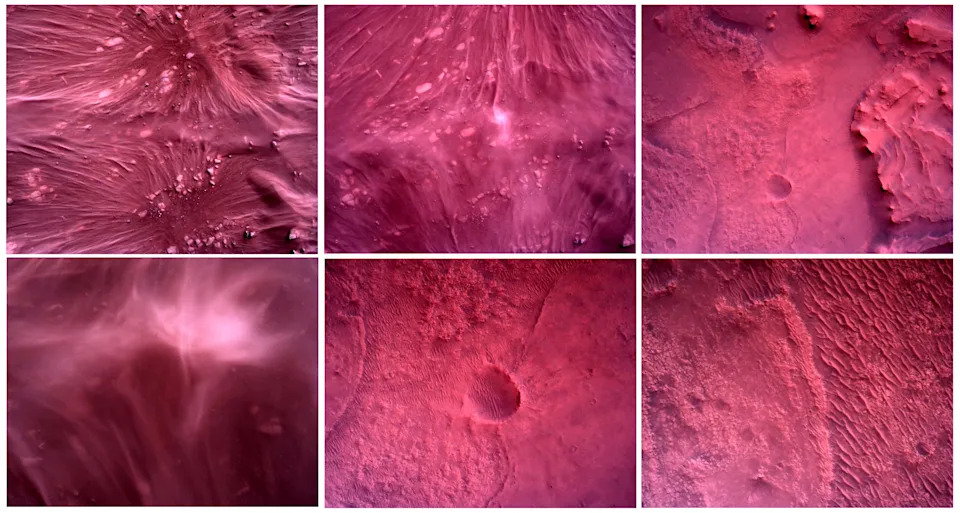
The surface of Mars directly below NASA's Mars Perseverance rover is seen using the Rover Down-Look Camera in a combination of images acquired February 22, 2021.
Help us improve.