
The Mars Sample Return campaign is a top scientific priority but faces political and budget pressures, with a joint NASA/ESA concept previously estimated at about $11 billion and a projected return around 2040. China is advancing Tianwen-3, aiming to return roughly 500 grams of Martian material by about 2031 using a 2 m drill, robotic arm, and possibly a sampling helicopter. Experts and recent National Academies guidance argue MSR should be expedited because returned samples are essential to confirm biosignatures, assess hazards for astronauts, and reduce risk for future human missions.
Race to Return Mars Rocks: Experts Urge U.S. to Accelerate Mars Sample Return Ahead of China

Could the future of NASA's Mars Sample Return program be doomed?. | Credit: NASA/JPL-Caltech
The Mars Sample Return (MSR) campaign — the effort to bring Martian rocks and soil back to Earth for detailed laboratory study — remains one of the highest scientific priorities for the United States, but it has been repeatedly delayed by cost, complexity, and political debate. With China advancing its Tianwen-3 sample-return concept and U.S. budget pressure mounting, many scientists and policymakers say the U.S. should accelerate its plans to retrieve Perseverance's cached, rocket-ready samples.
Why MSR Matters
Returned Martian samples would allow laboratory techniques far more sensitive than anything that can be done by rovers, enabling definitive tests for biosignatures and detailed assessments of any hazards for future human explorers. MSR would also demonstrate the critical capability of launching from the Martian surface or orbit and returning safely to Earth — a key risk reduction step for eventual crewed missions.
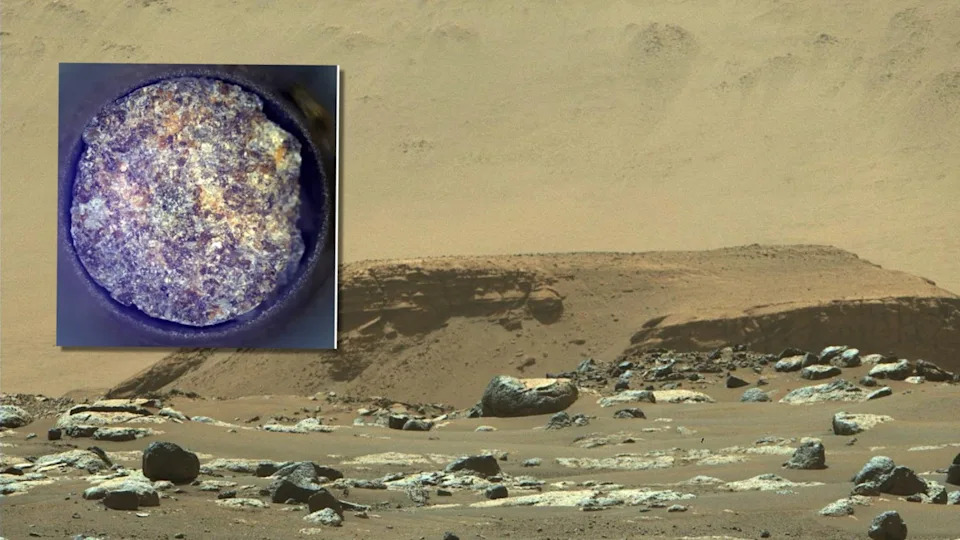
A sample of rock collected by the Perseverance rover (inset) and Mars' Jezero Crater, from where it was collected (background). | Credit: NASA/JPL-Caltech/ASU/MSSS/Ken Farley
Cost, Schedule, and Political Pressure
A joint NASA/European Space Agency MSR concept was once estimated at roughly $11 billion, with samples not expected to reach Earth until around 2040. That estimate triggered pushback and program re-evaluations. The White House 2026 Discretionary Funding Request singled out some programs as financially unsustainable, and language in the Commerce, Justice, Science, and Related Agencies Appropriations Act, 2026, has called for discontinuing the existing NASA/ESA MSR plan. These decisions have put additional pressure on planners to find cheaper, faster paths to accomplish the science.
China's Advance: Tianwen-3
China is actively developing a sample-return profile under the Tianwen-3 concept, targeting an ambitious timeline that could return roughly 500 grams of Mars material to Earth near 2031. Published Chinese studies and a June 2025 Nature paper by Zengqian Hou describe a mission architecture that includes a 2-meter drill for subsurface samples, a robotic arm to collect hundreds of grams of surface material, and possibly a robot-armed helicopter to access sites more than 100 meters from the lander. Chinese teams have reportedly reviewed dozens of candidate landing sites with an emphasis on regions likely to preserve biosignatures.
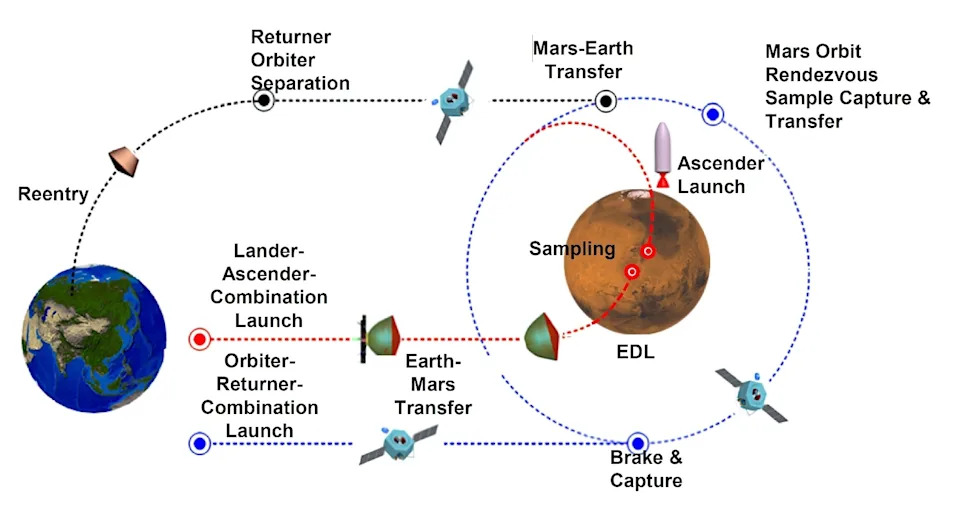
China's roadmap for a Mars Sample Return mission. | Credit: The University of Hong Kong/Zengqian Hou, et al.
U.S. Responses and Funding Proposals
In the U.S., Senator Ted Cruz proposed a Republican reconciliation directive in mid-2025 that would dedicate nearly $10 billion toward efforts to maintain U.S. leadership in space, including a $700 million allocation for a Mars Telecommunications Orbiter to support communications for MSR and future human missions. Meanwhile, NASA continues to study more affordable and quicker robotic approaches for sample return.
Science Strategy and Human Missions
The National Academies of Sciences, Engineering, and Medicine released A Science Strategy for the Human Exploration of Mars on December 9, 2025. Sponsored by NASA, the report ranks the search for life as the top scientific objective for the first human missions and outlines campaign options ranging from initial 30-sol surface campaigns to sustained 300-sol expeditions. Experts argue that robotic MSR both advances science and reduces risk for crewed missions by providing end-to-end operational experience and critical lab-based analysis.
G. Scott Hubbard: Based on Perseverance's in situ findings, there is a high likelihood that cached organics could show signatures of past life. An early MSR would also reduce the risk for future human missions and clarify any toxicity hazards.
Bruce Jakosky and other scientists emphasize that continued robotic precursor missions are needed now to shape scientific objectives and lower astronaut risks. Many observers warn that without timely action, human Mars missions risk becoming symbolic visits rather than scientifically fruitful endeavors.
Bottom Line
The MSR debate balances scientific urgency, budget realities, and geopolitical competition. With Perseverance holding curated, rocket-ready samples and China pushing an earlier return timeline, experts and some lawmakers are calling for a faster, more cost-effective U.S. plan to retrieve Martian material — both to answer fundamental questions about life beyond Earth and to prepare safely for human exploration.
Help us improve.


