The U.S. Senate approved a spending bill that restores much of NASA’s funding but explicitly declines to fund the Mars Sample Return (MSR) program, effectively shelving plans to retrieve Perseverance’s cached rocks. Perseverance has collected 30+ samples, including one NASA called "the clearest sign of life" on Mars. An independent review estimated MSR could cost about $11 billion with samples not returning until ~2040; NASA had considered two retrieval options costing roughly $5.8–$7.7 billion. The bill does allocate $110 million to preserve MSR-related technologies, and China’s Tianwen-3 aims to return samples by 2031.
Senate Restores NASA Funding but Cuts Mars Sample Return — China Could Lead the Race to Bring Mars Rocks Home

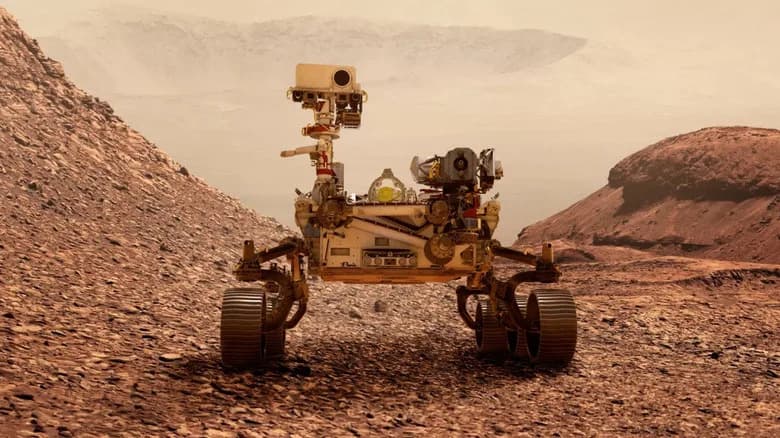
An illustration of different Mars Sample Return mission concepts. | Credit: NASA/ESA/JPL-Caltech
On Jan. 15 the U.S. Senate approved a spending bill that largely restores NASA funding after proposals to slash federal science budgets. However, lawmakers explicitly declined to fund NASA’s Mars Sample Return (MSR) program, effectively shelving the effort to bring Perseverance’s cached Martian rocks back to Earth.
Lawmakers made their position plain in an accompanying report published Jan. 6:
"The agreement does not support the existing Mars Sample Return (MSR) program."
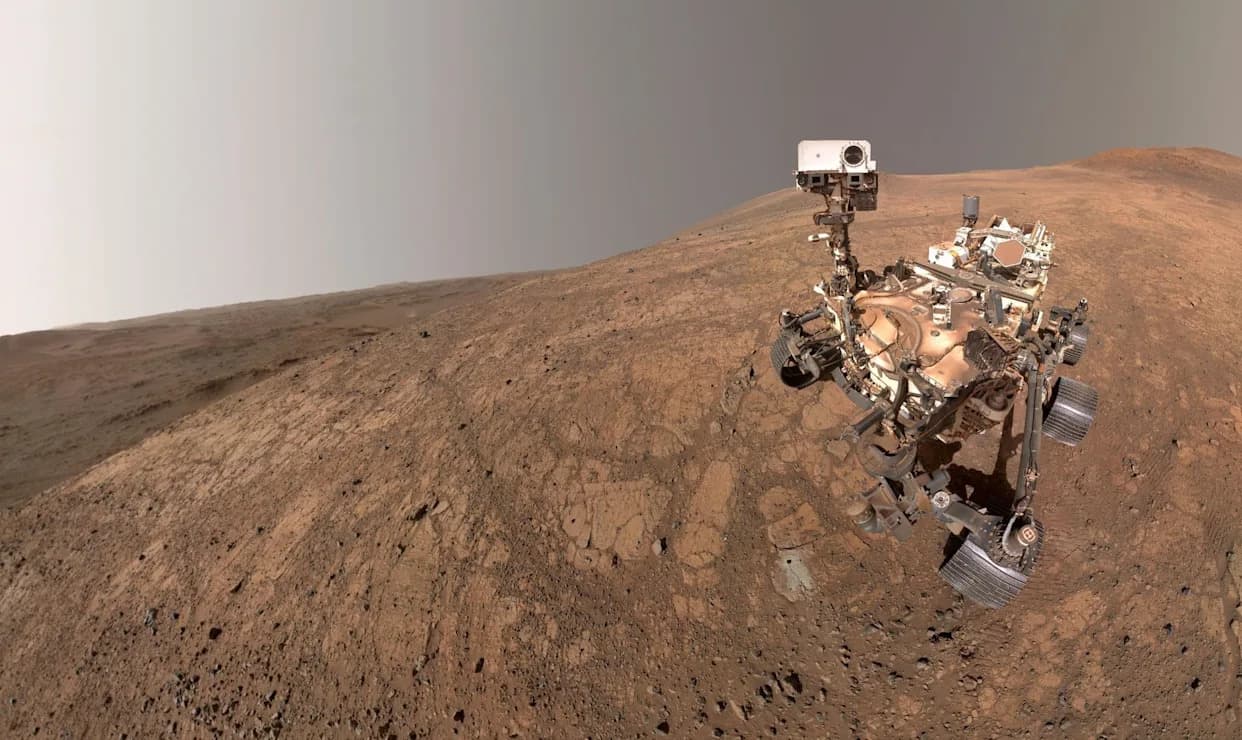
The decision is a major setback for scientists who hope the Perseverance rover’s more than 30 collected rock cores could reveal evidence of past life on Mars. NASA has described one of those samples as "the clearest sign of life" found on the Red Planet to date. If Martian life ever existed, those samples would be among our best chances to find definitive traces.
Returning samples from Mars was always expected to be expensive and technically demanding. An independent review board in January 2025 estimated the total cost of MSR could rise to roughly $11 billion, with returned samples unlikely before about 2040. The program has faced repeated delays and rising cost estimates.
NASA’s planned approaches included two main retrieval strategies after a program overhaul: a conventional landing architecture using a rocket-powered sky crane (estimated at $6.6–$7.7 billion), and a commercial option (estimated at $5.8–$7.1 billion). Agency managers expected to choose between those architectures in the latter half of 2026.
Although the Senate bill does not bankroll the full MSR mission, it preserves some development work. The legislation allocates $110 million to a Mars Future Missions line to support MSR-related technologies — radar, spectroscopy, entry/descent/landing systems and precursor technologies — that are considered important for future lunar and Mars exploration.
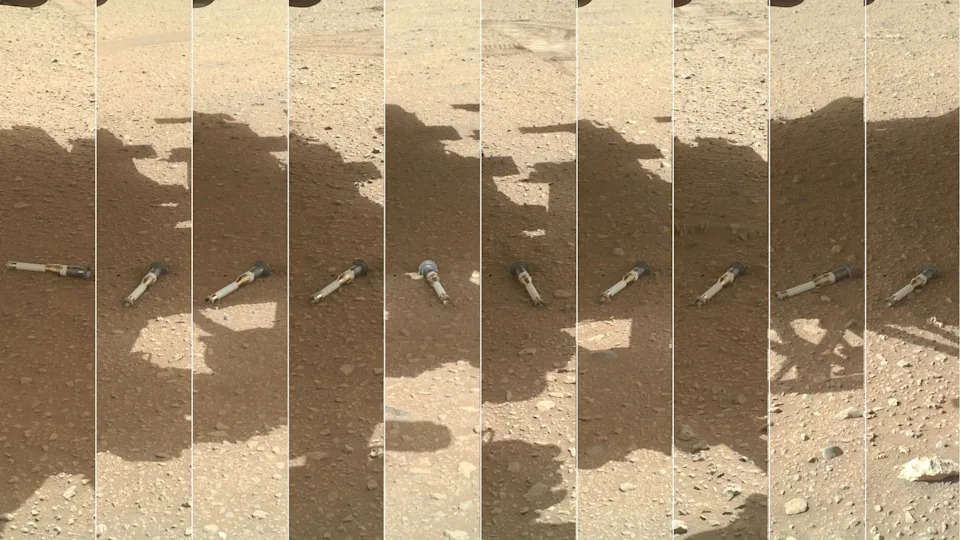
A photomontage of tubes containing Martian samples that NASA wants to bring back to Earth. | Credit: NASA/JPL-Caltech/MSSS
Advocacy groups welcomed the partial support. The Planetary Society said the $110 million keeps critical technologies progressing and leaves open the possibility of reviving a full sample-return mission later.
Broader NASA funding in the bill totals $24.4 billion, with $7.25 billion designated for the Science Mission Directorate — about a 1% reduction from the previous year and far smaller than earlier proposals to cut science funding dramatically. The agreement also includes $500 million for Dragonfly (the mission to Saturn’s moon Titan), $208 million for James Webb Space Telescope operations, and $300 million for the Nancy Grace Roman Space Telescope.
The bill was sent to the President for signature to become law.
What This Means Internationally
If the U.S. steps back from full MSR, China may face less competition. China’s Tianwen-3 mission aims to return Martian samples by collecting fewer specimens from a more accessible — though potentially less scientifically rich — site than Perseverance’s sampling locations. Tianwen-3 is scheduled to launch in 2028 and could return rocks in 2031, potentially beating a revived U.S. effort to Earth.
Victoria Hamilton, chair of the Mars Exploration Program Analysis Group (MEPAG), told Space.com on Jan. 12:
"It is difficult to understand how the cancellation of MSR is anything but an admission that returning samples from Mars is too hard for the United States."She added that the decision raises questions about the country’s readiness for even more ambitious Moon-to-Mars human exploration efforts.
Bottom line: The Senate bill preserves important technology development but halts the current plan to return Perseverance’s samples. The partial funding buys time for technology and research, but without a funded retrieval mission, the physical evidence cached on Mars could remain there — at least for now.
Help us improve.