
Astronomers directly imaged expanding dust clouds from massive collisions around the nearby star Fomalhaut in 2004 and 2023 — the first such detections beyond our Solar System. Each collider was estimated at roughly 37 miles (60 km) across, and the 2023 cloud is about 30% brighter and still visible as of August 2025. The observations reclassify the long-debated Fomalhaut b as a transient dust cloud, reveal a population of ~300 million similar planetesimals in the disk, and will be tracked with Hubble and JWST to learn how planets form.
Stellar Fireworks: First Direct Images of Massive Collisions Around Nearby Star Fomalhaut

Credit: Thomas Müller (MPIA)
Astronomers have captured the first direct images of gigantic collisions between planetesimals in the planetary system around the nearby star Fomalhaut, recording expanding dust plumes in 2004 and again in 2023. These observations — the first of kilometer-scale impacts imaged beyond our Solar System — offer a rare window into the violent processes that build planets and shape young planetary systems.
Fomalhaut lies about 25 light-years from Earth and is roughly 440 million years old. While that seems old on human timescales, it is young compared with our 4.6-billion-year-old Solar System. Systems at this age often host intense collisional activity as comets, asteroids and larger planetesimals smash into one another. Many impacts simply bounce debris away, but some lead to accretion and the gradual growth of planets and moons. The largest collisions are rare — perhaps occurring roughly every 100,000 years within a system during the hundreds of millions of years it takes to assemble a planetary system.
What the team saw
Team leader Paul Kalas (University of California, Berkeley) and colleagues did not image the colliding rock bodies themselves. Instead, they observed the bright, expanding clouds of debris the impacts produced. Photometry of the 2004 and 2023 events indicates each collider was on the order of ~37 miles (about 60 kilometers) across — at least roughly four times the estimated diameter of the Chicxulub impactor that struck Earth 66 million years ago.
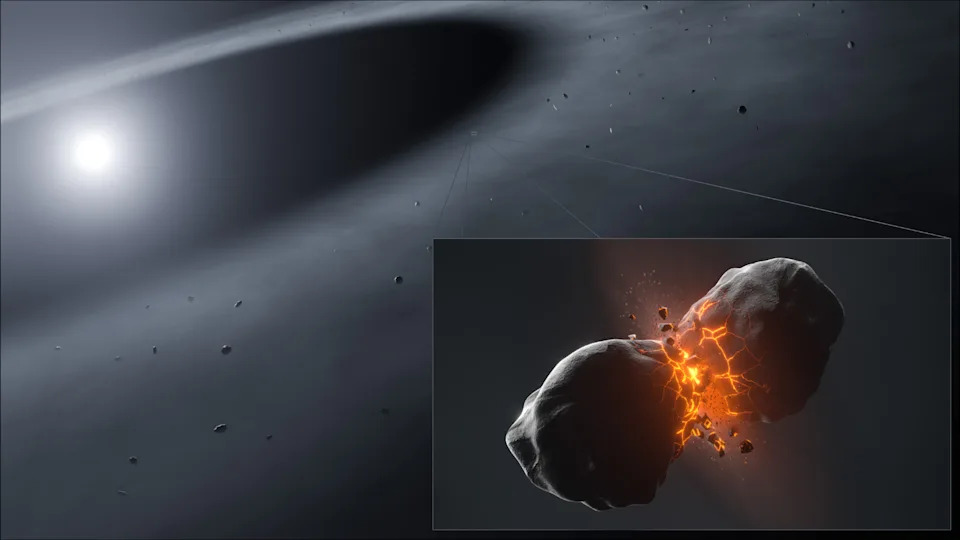
Illustration of the collision of two planetesimals in the circumstellar disc of the star Fomalhaut. | Credit: Thomas Müller (MPIA)
“We just witnessed the collision of two planetesimals and the dust cloud that gets spewed out of that violent event, which begins reflecting light from the host star,”
— Paul Kalas, University of California, Berkeley
The research team has monitored Fomalhaut since the 1990s. Using the Hubble Space Telescope they first revealed a debris disk around the star. In 2008 Kalas reported a persistent bright point in that disk — Fomalhaut b — once proposed as a planet. The new analysis reinterprets that object as a transient dust cloud produced when planetesimals collided in the disk; the point source brightened and then faded over years, mimicking a planet’s appearance.
Why this matters
These observations let astronomers estimate both the sizes of the colliding bodies and the population of similar objects in the region. From their data, the team infers there are on the order of 300 million planetesimals of comparable size orbiting in the studied part of the disk. Previous detections of carbon monoxide gas in the Fomalhaut system also suggest these bodies are rich in volatiles — ices and gases such as water, carbon monoxide, methane, hydrogen and nitrogen — making them analogous to the icy comets of our own Solar System.
Kalas compared the observed dust clouds to the debris produced in NASA’s 2022 DART experiment, when the spacecraft struck the moonlet Dimorphos to test kinetic deflection of its parent asteroid Didymos. Like the DART ejecta, the Fomalhaut dust clouds are visible because starlight scatters off freshly created debris.
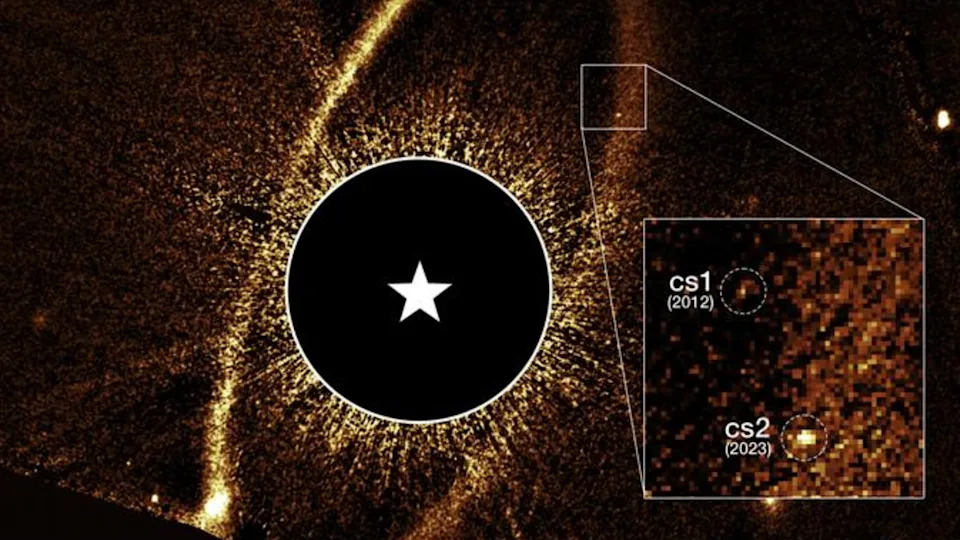
Hubble Space Telescope image shows the debris ring and dust clouds cs1 and cs2 around the star Fomalhaut. | Credit: NASA, ESA, Paul Kalas/UC Berkeley. Image Processing: Joseph DePasquale (STScI)
Next steps and caution
The team will continue monitoring Fomalhaut with Hubble and add infrared observations from the James Webb Space Telescope to follow the 2023 cloud’s evolution. The newer cloud is already about 30% brighter than the 2004 feature, and follow-up observations in August 2025 confirm it remains detectable. These multiwavelength observations will help track how the cloud expands, cools and disperses and will constrain the composition of the colliders.
Kalas warns astronomers to be cautious when interpreting faint point sources near stars: transient dust clouds can masquerade as planets. As future observatories such as the proposed Habitable Worlds Observatory begin searching for Earth-like exoplanets, distinguishing persistent planets from ephemeral dust will be essential.
The team’s findings were published on Dec. 18 in the journal Science.


