
Hubble has imaged IRAS 23077+6707, nicknamed 'Dracula’s Chivito,' a protoplanetary disk about 1,000 light-years away that appears unusually large and chaotic. The disk spans on the order of hundreds of billions of kilometers — roughly 40 times the scale of our Solar System — and shows asymmetric gas and dust lanes. Astronomers say the visible-light detail offers a unique laboratory for studying dynamic planet-formation processes. The nickname playfully honors team members' Transylvanian and Uruguayan roots.
Hubble Reveals ‘Dracula’s Chivito’: A Massive, Chaotic Protoplanetary Disk

Credit: NASA, ESA, STScI, Kristina Monsch (CfA); Image Processing: Joseph DePasquale (STScI)
Using the Hubble Space Telescope, astronomers have captured an especially dramatic view of a protoplanetary disk that appears unusually large and chaotic. The system, officially catalogued as IRAS 23077+6707 and nicknamed 'Dracula’s Chivito,' lies about 1,000 light-years from Earth.
Seen nearly edge-on, the disk resembles a cosmic bat in Hubble’s visible-light imagery. It stretches across an enormous zone of space — on the order of hundreds of billions of kilometers — roughly 40 times the scale of our own Solar System out to the Kuiper Belt. This makes the structure one of the largest and most complex planet-forming environments yet imaged in visible light.
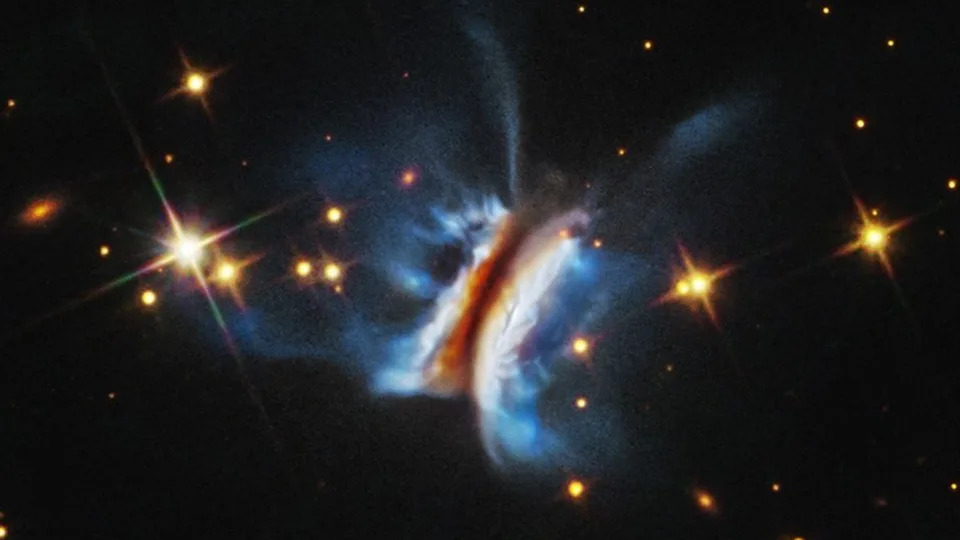
A Hubble image of Dracula’s Chivito, the largest protoplanetary disk ever seen | Credit: NASA, ESA, STScI, Kristina Monsch (CfA); Image Processing: Joseph DePasquale (STScI)
Unprecedented Detail and Asymmetry
The Hubble images reveal wispy upper layers and pronounced asymmetries in the disk's gas and dust lanes. Those unsymmetrical features suggest active, dynamic processes sculpting the disk — not a smooth, uniform formation. Team leader Kristina Monsch of the Center for Astrophysics | Harvard & Smithsonian (CfA) said the observation shows planet nurseries can be far more turbulent than previously appreciated.
'The level of detail we're seeing is rare in protoplanetary disk imaging,' Monsch said. 'We're seeing this disk nearly edge-on, and its wispy upper layers and asymmetric features are especially striking.'
Both Hubble and the James Webb Space Telescope (JWST) have revealed complex structures in other disks, but Dracula’s Chivito offers an exceptional vantage for tracing substructures in visible light. Team member Joshua Bennett Lovell (CfA) added that Hubble delivers a 'front row seat' to the chaotic processes that shape disks as they build new planets.
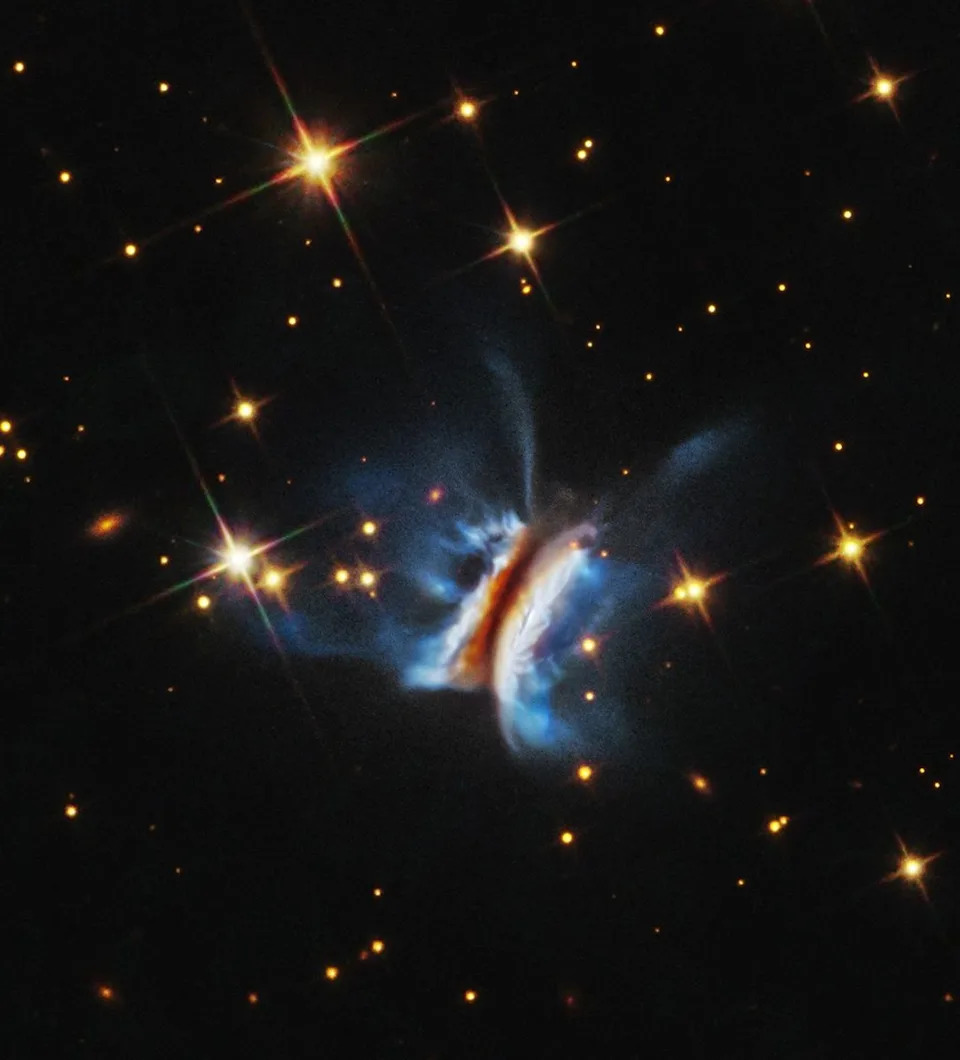
The full Hubble image of IRAS 23077+6707, appearing like a cosmic steak sandwich | Credit: NASA, ESA, STScI, Kristina Monsch (CfA); Image Processing: Joseph DePasquale (STScI)
Why This Matters
Studying this system gives astronomers a new laboratory for understanding how planets form across different environments and scales. Although IRAS 23077+6707 appears far larger than our early Solar System, the underlying physical processes — accretion, disk sculpting, and planetesimal formation — likely share common elements. Observations like these help refine models of planetary birth and the variety of possible planetary systems.
About the Nickname
The playful nickname combines personal nods from the research team: 'Dracula' refers to a team member's Transylvanian heritage, while 'Chivito' is a popular Uruguayan steak sandwich, honoring another scientist's roots. As the authors joke: don't worry, 'Chivito' here means steak, not stake.
The new Hubble images are a starting point for follow-up observations and analysis that will probe how such extreme, asymmetric disks evolve and whether they can spawn vast planetary systems.


