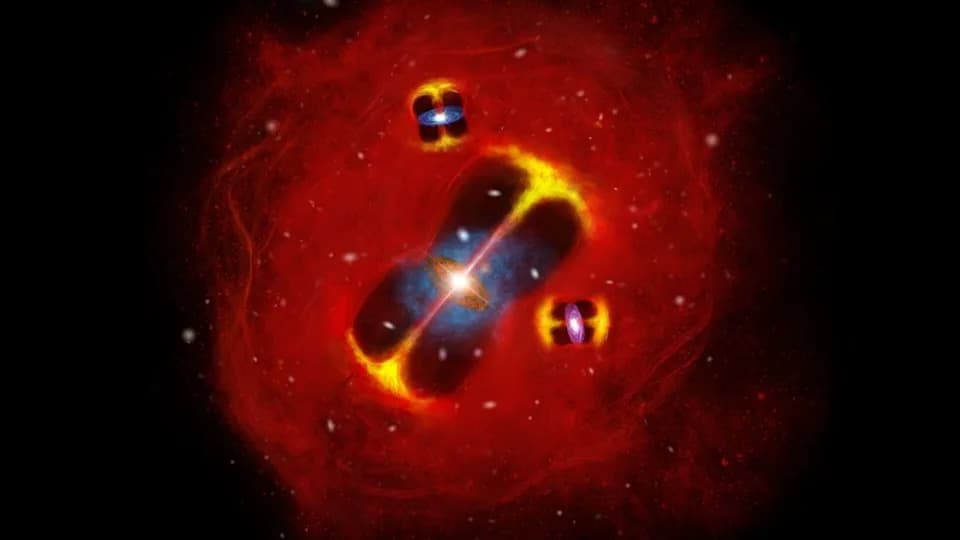
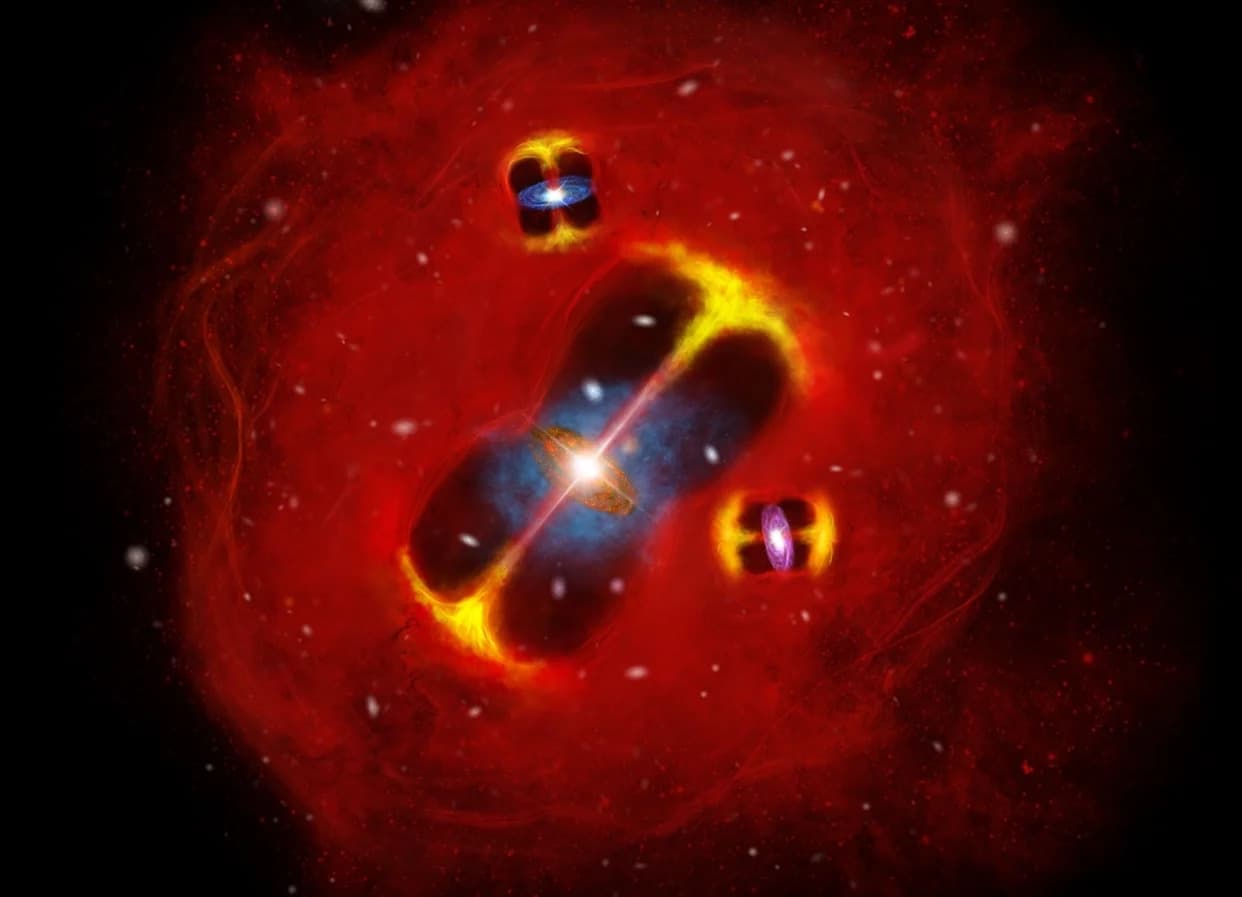
The Champagne Cluster (RM J130558.9+263048.4), discovered on New Year’s Eve 2020, appears in a new Chandra + optical composite that highlights superheated gas and galaxy clumps in purple. The elongated X-ray emission and two distinct galaxy concentrations suggest the system may be two clusters merging. Researchers describe two formation scenarios — a collision >2 billion years ago with a later return, or a single collision ~400 million years ago — and plan follow-up observations to test how dark matter behaves during these crashes.
Ring In 2026 With the “Champagne Cluster” — A Sparkling Pair of Merging Galaxy Clusters
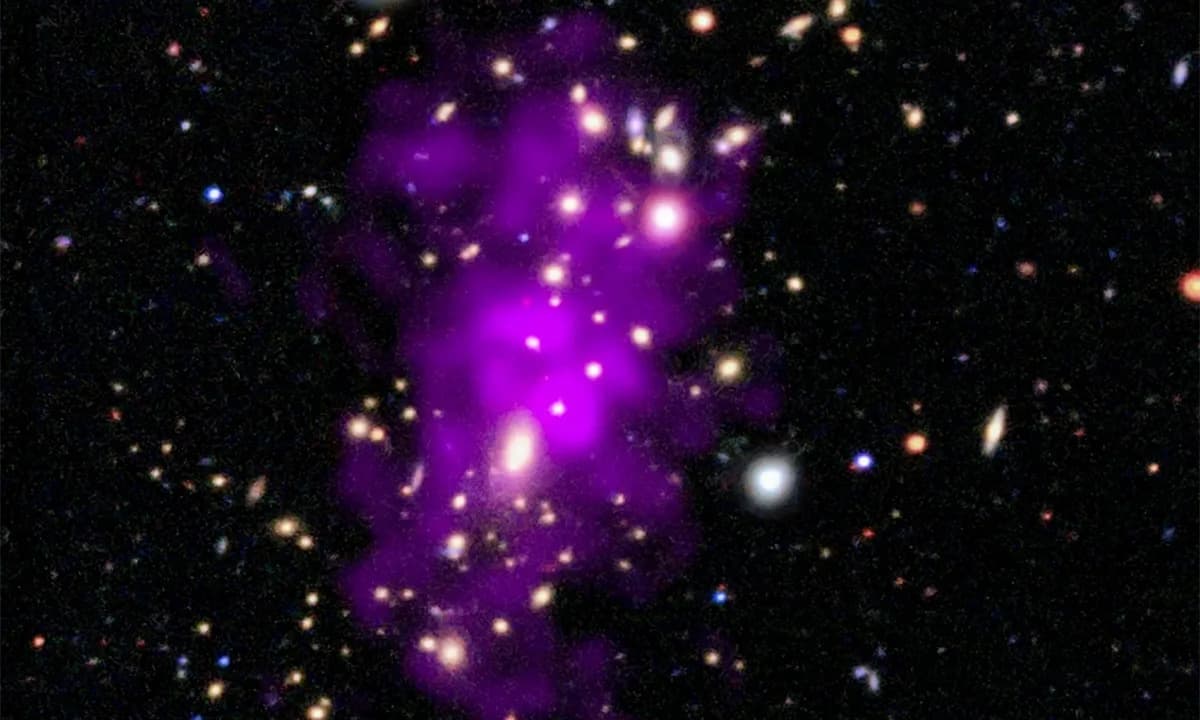
Lead image: NASA/CXC/SAO/P. Edmonds and L. Frattare
Before you raise a glass to welcome 2026, take a moment to admire a glittering assembly of galaxies nicknamed the “Champagne Cluster” (RM J130558.9+263048.4). Astronomers first identified it on New Year’s Eve 2020, and a newly released composite image from NASA’s Chandra X-ray Observatory and optical telescopes highlights superheated gas and galaxy concentrations in purple — a color applied by researchers to make those features stand out.
Galaxy clusters can contain up to thousands of galaxies held together by mutual gravity. They also harbor multimillion-degree gas and vast amounts of invisible dark matter, the elusive substance thought to comprise most of the universe’s mass. These cosmic metropolises host some of the largest galaxies known and provide crucial clues about how such giants form and evolve.
The composite image reveals that the Champagne Cluster’s hot X-ray–emitting gas is unusually elongated rather than the typical circular or oval shape. Along the top and through the center of the luminous region are two distinct clumps of galaxies, suggesting the system may actually be two galaxy clusters in the process of merging.
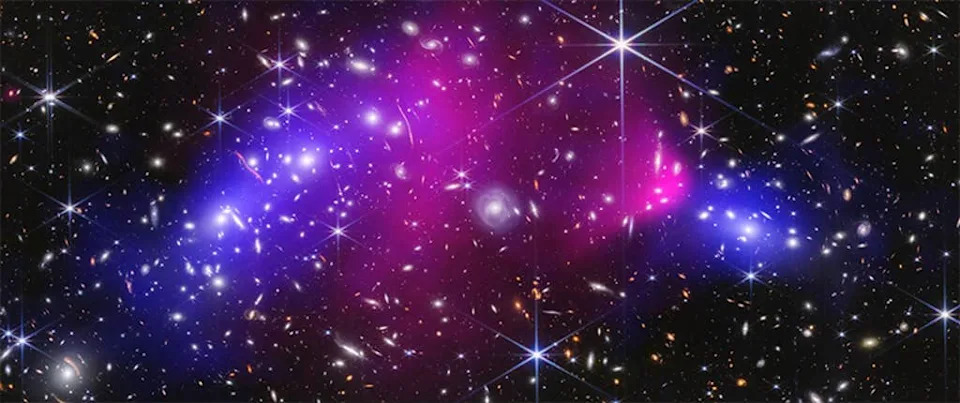
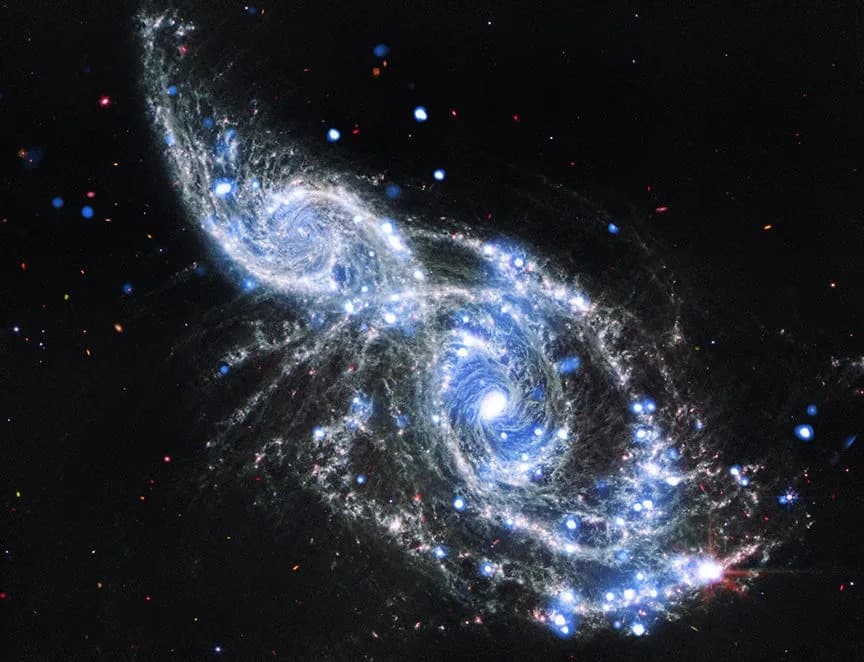
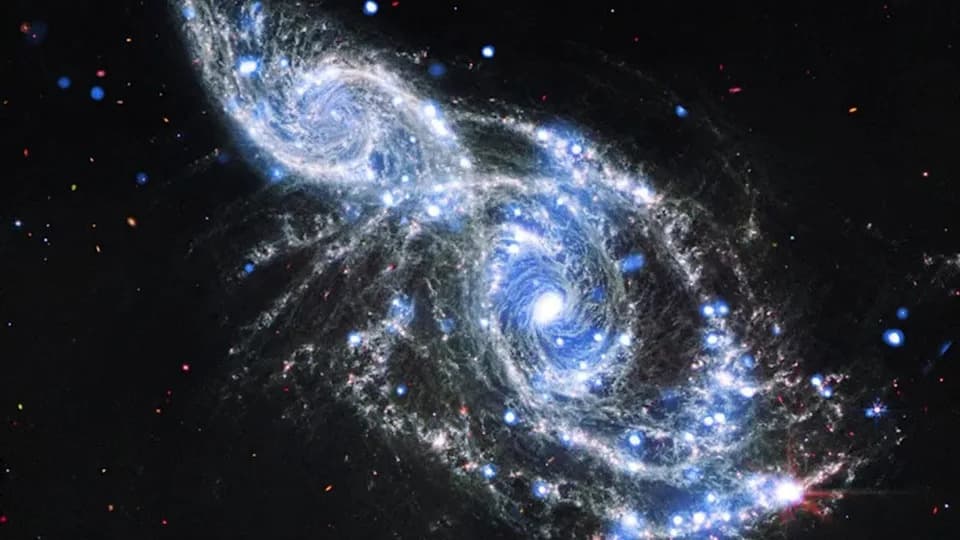
The Bullet Cluster provided some of the most intriguing evidence of dark matter yet.Credit: NASA, ESA, CSA, STScI, CXC; Science: James Jee (Yonsei University/UC Davis), Sangjun Cha (Yonsei University), Kyle Finner (IPAC at Caltech)
Elongated gas distributions are uncommon and have been seen in dramatic merging systems like the Bullet Cluster, which has recently been imaged in greater detail by NASA’s James Webb Space Telescope. Such shapes often indicate past high-speed collisions between clusters that can stretch and separate hot gas from the galaxies and dark matter.
In a paper published in The Astrophysical Journal, researchers outline two primary scenarios for the Champagne Cluster’s history. One possibility is that the two clusters collided more than two billion years ago, later fell back together under gravity, and may collide again. An alternative scenario posits a single collision roughly 400 million years ago, with the two components now moving apart.
Future observations aim to trace how dark matter behaves during these violent interactions. Collisions between galaxy clusters are especially valuable because they can reveal differences in the motion of hot gas, galaxies, and dark matter — the Bullet Cluster remains among the clearest astrophysical pieces of evidence supporting dark matter’s existence. Continued study of RM J130558.9+263048.4 should help refine models of dark matter and cluster formation.
Why it matters: Systems like the Champagne Cluster let astronomers test theories of dark matter, probe the physics of high-energy gas, and watch the assembly of the universe’s largest structures in action.
Help us improve.