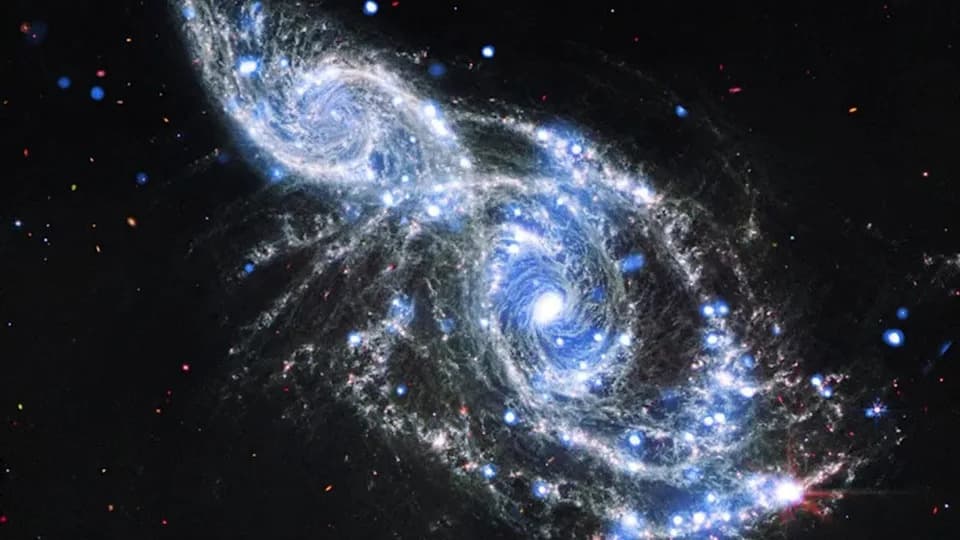
NASA released a composite image combining JWST infrared and Chandra X‑ray observations to reveal the interacting spiral galaxies IC 2163 and NGC 2207 with striking clarity. The systems lie about 120 million light‑years away; NGC 2207 is stripping material from its smaller companion as gravity drives their interaction. JWST highlights cool dust and star‑forming regions in white, gray and red, while Chandra’s X‑rays appear blue, marking high‑energy areas. Astronomers study such collisions because they can trigger bursts of star formation and teach us how galaxies evolve.
NASA Combines JWST and Chandra Images to Reveal Two Spiral Galaxies Colliding in Rich Detail
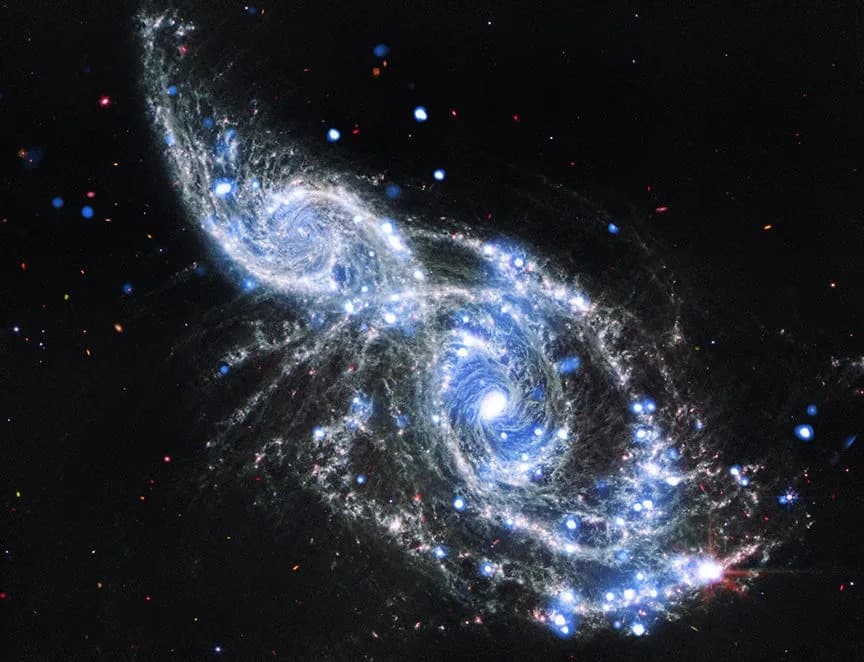
NASA this month released a striking composite image that blends infrared data from the James Webb Space Telescope (JWST) with X-ray observations from the Chandra X-ray Observatory to reveal two interacting spiral galaxies with unprecedented clarity.
IC 2163 (left) and NGC 2207 (right) lie roughly 120 million light‑years from Earth. The larger galaxy, NGC 2207, is gravitationally tugging on and stripping material from its smaller companion, producing dramatic tidal features and triggering pockets of intense star formation.
Why Two Telescopes Matter
JWST and Chandra observe very different slices of the electromagnetic spectrum from distinct vantage points: JWST orbits the Sun near the second Lagrange point and maps the universe in infrared light, which highlights cool dust and stellar nurseries. Chandra orbits Earth and detects high‑energy X-rays, which reveal energetic processes such as supernova remnants, accreting black holes, and the hottest gas in star‑forming regions. Combining these wavelengths gives astronomers a more complete picture of the physical processes shaping the galaxies.
What the Composite Shows
In the composite image, JWST's mid‑infrared data renders cooler dust and dense molecular material in white, gray, and red tones, outlining spiral arms and dusty filaments. Chandra's X-ray data is shown in blue, pinpointing high‑energy zones where massive stars are forming, exploding, or interacting with surrounding gas. Together the data highlight how gravitational interactions can both redistribute material and spark waves of new star birth.
Over the next several hundred million to billions of years, the pair will continue their gravitational dance and are expected to merge into a single, larger galaxy. Studies of systems like IC 2163 and NGC 2207 help astronomers understand how collisions drive galaxy evolution across cosmic time.
Key Fact: The two galaxies are about 120 million light‑years away, and the composite image demonstrates the power of multiwavelength astronomy to reveal complementary details of galactic interactions.
Help us improve.