
Using JWST, astronomers have identified a supernova candidate in a faint galaxy from about 730 million years after the Big Bang, linked to the gamma-ray burst GRB 250314A detected by SVOM. The GRB's afterglow had faded by JWST's observations, and the excess infrared light is most consistent with a supernova rather than an unusually old host galaxy. Two teams published their analyses in Astronomy & Astrophysics, and follow-up observations next year aim to separate the afterglow, transient supernova light, and host galaxy to confirm the finding.
JWST May Have Detected The Earliest Known Supernova — A Candidate From 730 Million Years After The Big Bang

The James Webb Space Telescope has spotted an eruption of energy in the early universe that may be the most distant supernova discovered to date. | Credit: NASA, ESA, CSA, STScI, A. Levan (IMAPP), Image Processing: A. Pagan (STScI)
Astronomers using the James Webb Space Telescope (JWST) may have identified the most distant supernova candidate observed to date, in a very faint galaxy that existed when the universe was roughly 730 million years old. The transient is associated with a bright gamma-ray burst, GRB 250314A, first detected in March by the Space Variable Objects Monitor (SVOM).
Discovery And Context
SVOM flagged the initial high-energy flash, and follow-up observations indicated the source lay deep in the early universe. Two independent research teams analyzed the event and published their results on Dec. 9 in the journal Astronomy & Astrophysics. The gamma-ray burst itself lasted about 10 seconds, placing it in the long-duration category typically linked to the collapse of massive stars.
How Scientists Reached A Supernova Interpretation
Gamma-ray bursts produce short-lived gamma-ray flashes followed by longer-lived afterglows at lower energies (X-ray, optical, infrared and radio). GRB 250314A showed an infrared and X-ray afterglow early on, but those signals had faded by the time JWST observed the location months later. The JWST data showed excess infrared light that could not be explained by the afterglow alone.
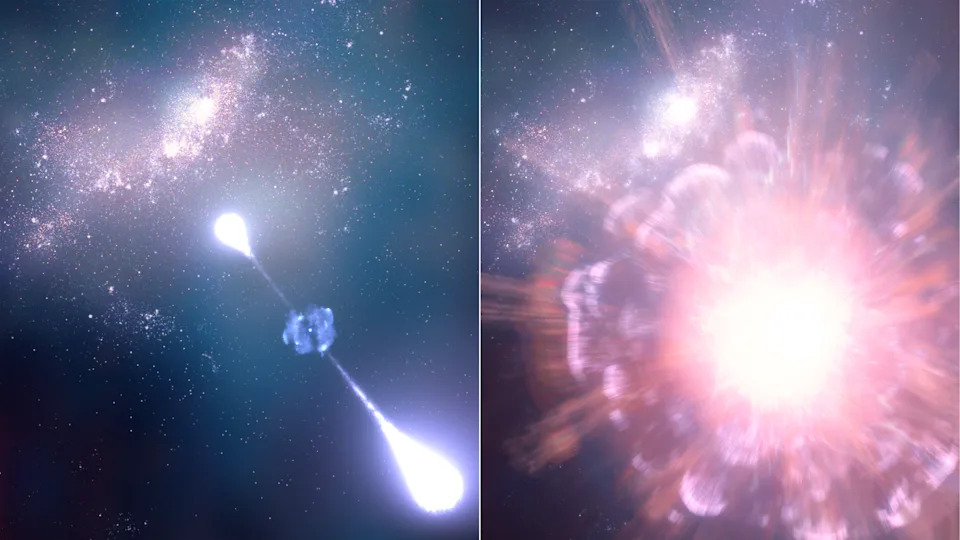
An illustration of supernova GRB 250314A as it was exploding (left) and then three months later, when Webb studied it (right). | Credit: NASA, ESA, CSA, STScI, L. Hustak (STScI);CC BY 4.0 INT
"We were amazed that our predictions worked so well, and that we had been able to demonstrate that JWST could see individual exploding stars at such extreme distances," said A. J. Levan, lead author on one of the papers.
The teams considered whether the excess light might instead come from an unusually compact, old host galaxy whose stars formed very early (around 200 million years after the Big Bang). They found that scenario unlikely or contrived, and concluded the simplest explanation for the excess emission is a supernova associated with GRB 250314A.
Implications For Early Stars
The observed brightness of a supernova depends on the amount of radioactive material ejected, which in turn reflects the exploding star's core mass. Some models predict that first-generation and early-universe stars had more massive cores than typical modern stars. Surprisingly, the candidate supernova's properties appear broadly similar to nearby, modern supernovae — though with only one object the result could be a statistical fluke.
What Comes Next
To confirm the supernova interpretation, researchers need to better separate the contributions from three sources: the fading afterglow, the transient supernova light, and the host galaxy. Planned follow-up observations next year, after the transient has faded further, should make it much easier to disentangle these components and provide a firmer verdict on whether JWST truly witnessed the earliest supernova yet observed.
Why This Matters: If confirmed, the detection would offer a rare direct probe of massive-star deaths and stellar populations within the first billion years of cosmic history, helping refine models of star formation and chemical enrichment in the early universe.


