A dramatic composite released Dec. 1, 2025, pairs James Webb's mid‑infrared view with Chandra's X‑ray observations to reveal the interacting spirals NGC 2207 and IC 2163, about 120 million light‑years away in Canis Major. Webb's mid‑infrared data (white/gray/red) highlights dust and cooler material, while Chandra's X‑rays (blue) expose high‑energy sources like binaries and supernova remnants. NASA says Webb's ability to probe galactic centers will sharpen models of how galaxies interact and merge. This image is one of four Chandra‑based composites released together.
Webb and Chandra Reveal an "Intricate Web of Chaos" in Colliding Galaxies NGC 2207 and IC 2163

Webb and Chandra spot a cosmic car crash | Credit: Credit: X-ray: NASA/CXC/SAO; Infrared: NASA/ESA/CSA/STScI/Webb; Image Processing: NASA/CXC/SAO/L. Frattare
A striking new composite image pairs infrared and X-ray observations to paint an autumnal portrait of two interacting spiral galaxies. The image, released Dec. 1, 2025, shows the larger NGC 2207 (lower right) and the smaller IC 2163 (upper left) as they slowly merge about 120 million light-years away in the constellation Canis Major.
Face-On View of a Slow Collision
Seen nearly face-on from our solar system, the two galaxies are tugging at each other's spiral arms. Tidal forces stretch streams of stars and gas and compress clouds of dust — conditions that can trigger waves of new star formation. The chaotic, filamentary structures in the image have been described as an "intricate web of chaos."
How the Composite Was Made
This layered portrait combines mid-infrared observations from the James Webb Space Telescope (JWST) with X-ray data from the Chandra X-ray Observatory. In the composite, Webb's mid-infrared signal is rendered in white, gray and red to emphasize dust and relatively cooler material in the galaxies' cores and arms. Chandra's X-rays are shown in blue, pinpointing high-energy sites such as compact binary systems, supernova remnants, and other energetic phenomena.
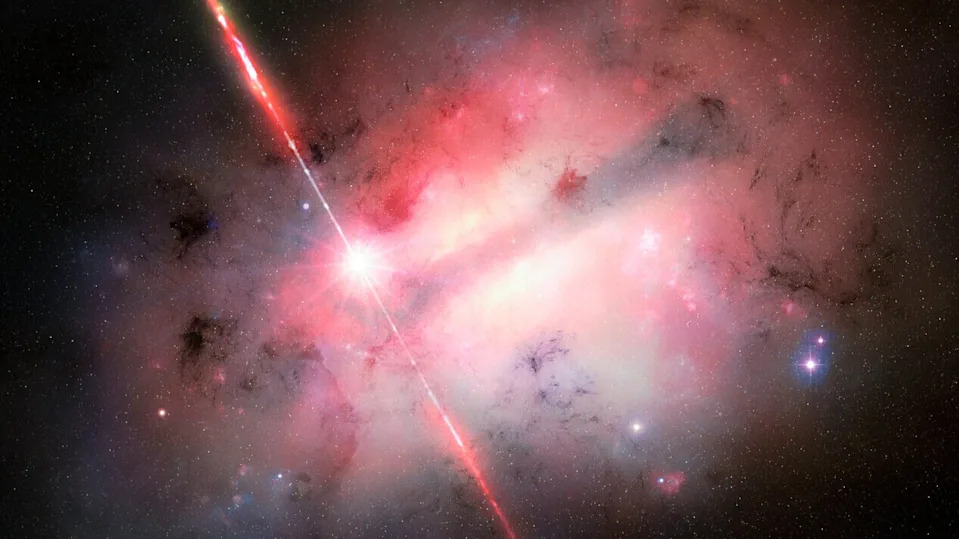
An artist's impression of GRB 250702B, a bright white orb with rays of light coming out among a white and pink cloud surrounded by the blackness of space.
Scientific Importance
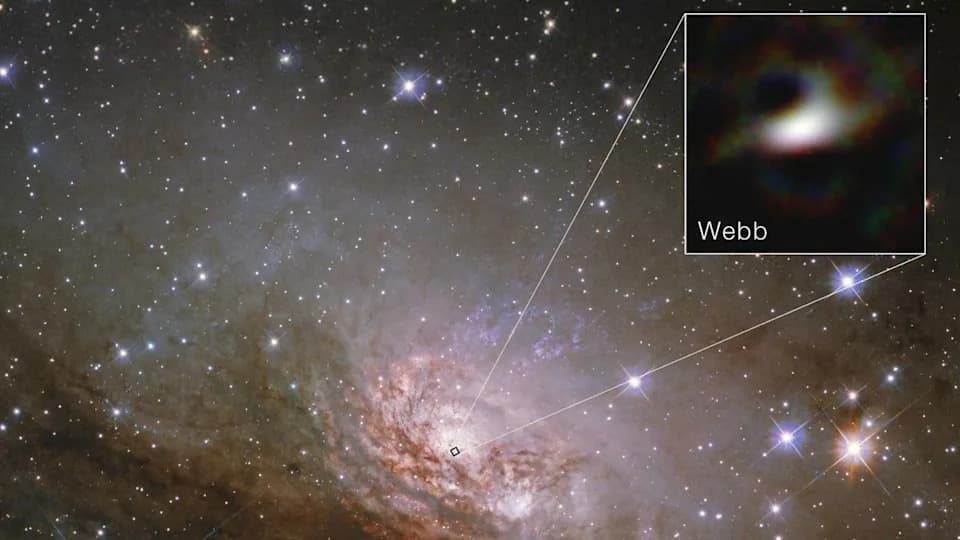
According to NASA, one of Webb's primary objectives is to peer into the centers of merging galaxies to help scientists build more accurate models of galactic interactions and mergers. Because NGC 2207 and IC 2163 present a near face-on view of a tidal encounter, they serve as excellent laboratories for studying how collisions reshape galaxies and ignite star formation.
Related Releases
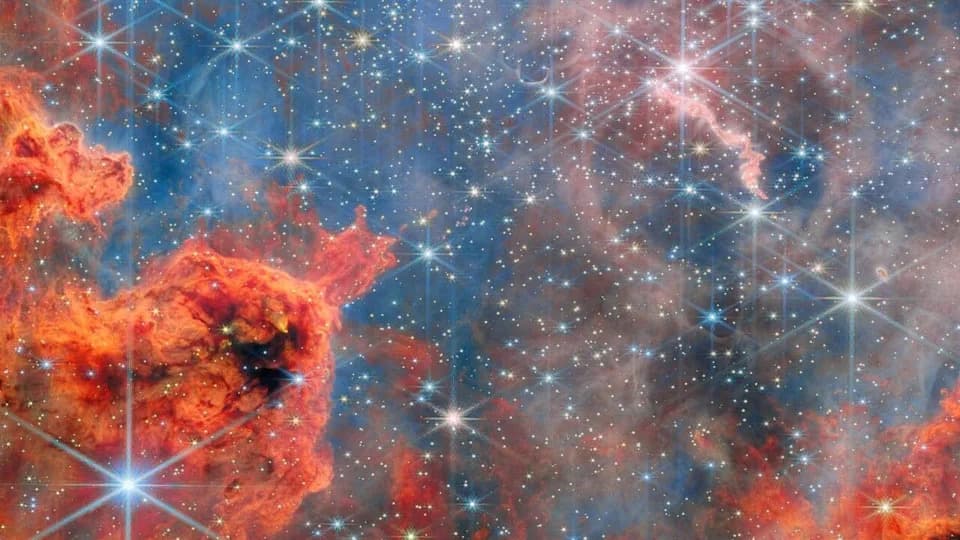
This image is one of four Chandra-based composites released together. The companion images highlight: NGC 6334 (a star-forming region with glowing gas and dust arcs); the supernova remnant G272.2-0.3 (an expanding X-ray–emitting shell); and R Aquarii (a binary where a white dwarf accretes material from a red giant).
Each composite blends Chandra's X-ray perspective with data from JWST (launched 2021), the Hubble Space Telescope (launched 1990), the Spitzer Space Telescope (operational 2003–2020) and several ground-based observatories, producing rich, multiwavelength views that reveal both cool dust structures and energetic high-energy phenomena.
For more dramatic imagery, see the Space Photo of the Week archives.
Help us improve.