Efrain Morales filmed the Hubble Space Telescope crossing the Sun from Aguadilla, Puerto Rico, on Dec. 15, 2025, capturing the telescope as a tiny silhouette against sunspot AR4308. The transit lasted just 1.01 seconds as Hubble moved at roughly 17,000 mph (27,000 kph). Morales used transit-prediction software and a high-frame-rate solar setup (Lunt LS50THa, CGX-L, ASI CMOS, Cemax 2x Barlows) to record the fleeting event. The telescope’s relatively small size—about 43 feet (13 meters), roughly ten times smaller than the ISS—makes such transits especially challenging to capture.
Hubble's Blink: Astrophotographer Captures 1.01-Second Transit Across the Sun
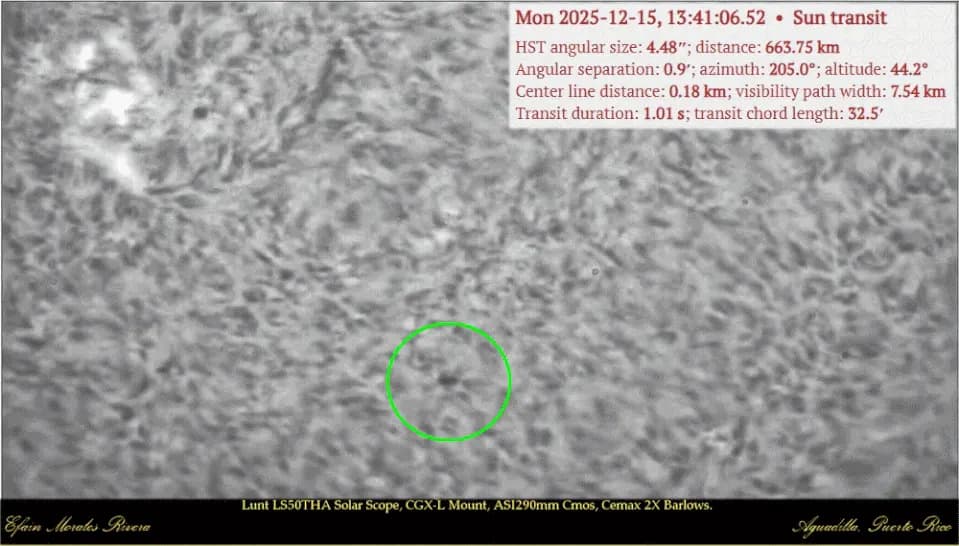
The Hubble Space Telescope appears as a small black dot zipping across the surface of the sun. | Credit: Efrain Morales
An astrophotographer in Puerto Rico recorded a dramatic, high-speed transit of the Hubble Space Telescope as it crossed the face of the Sun, appearing as a crisp dark silhouette against sunspot AR4308.
What happened: Efrain Morales filmed the event from Aguadilla on Dec. 15, 2025. In the clip, Hubble sweeps across sunspot AR4308 at roughly 17,000 mph (27,000 kph), producing a clearly defined, minute shadow on the solar disk. The entire passage lasted just 1.01 seconds, leaving virtually no margin for error.
Why it’s difficult to capture: Hubble orbits Earth at about 340 miles (547 kilometers) altitude and completes one circuit roughly every 95 minutes. The alignment for this transit was visible only inside a very narrow 4.68-mile-wide (7.54 km) ground corridor, so observers had to be located almost exactly in that path. From Morales’ vantage point the crossing took only 1.01 seconds—an encounter that can be missed without precise planning and fast imaging.
How it was recorded: Morales used transit-prediction software to calculate the telescope’s exact track across the Sun and then paired that timing with a high-frame-rate solar imaging setup. His rig included a Lunt LS50THa solar scope mounted on a CGX-L mount, an ASI CMOS camera, and Cemax 2x Barlows—equipment designed for safe, detailed solar observations where every frame counts. Never observe or photograph the Sun without specialized safety gear.
Hubble vs. ISS: Unlike the International Space Station, which is much larger and therefore easier to see during solar transits, Hubble is far more challenging to resolve. The telescope is about 43 feet (13 meters) long—roughly ten times smaller than the ISS—so it appears far tinier against the Sun’s brilliant surface.
Final note: This fleeting capture highlights the planning and technical skill required to photograph small spacecraft against the Sun. If you have astrophotos to share, send your images, comments, name and location to spacephotos@space.com.
Help us improve.