
Satellite megaconstellations are creating a new kind of light pollution: reflected sunlight from tens of thousands of satellites leaves bright streaks that spoil telescope images on the ground and in space. The satellite population has grown from about 2,000 to over 15,000 and could exceed 500,000 by the late 2030s, worsening the issue. Studies warn that up to ~33% of Hubble images could be contaminated by the mid-2030s and some observatories may see the majority of exposures affected. The IAU recommends reducing satellite reflectivity and adjusting orbits to reduce interference.
Swarms of Satellites Are Photobombing Telescopes — A Growing Threat to Astronomy

Graph detailing the projected impact of a growing number of satellites. Image: Nature
Our view of the cosmos is being increasingly degraded by a rapidly expanding cloud of commercial satellites in low Earth orbit. Reflected sunlight from these satellites leaves bright streaks across astronomical images, compromising observations taken from the ground and even from space.
What’s Happening
The problem stems from an explosion of so-called megaconstellations deployed by companies such as SpaceX, OneWeb and Amazon. Today more than 15,000 satellites orbit the Earth—up from roughly 2,000 just a few years ago—and industry plans could push that number to well over 500,000 by the late 2030s.
How Observations Are Affected
Long-exposure observations taken at twilight or dawn are especially vulnerable: as a satellite crosses a telescope’s field of view, reflected sunlight produces a bright line or “photobomb” that can erase or contaminate faint astronomical signals. These streaks now routinely mar images, undermining astronomers’ ability to collect clean data.
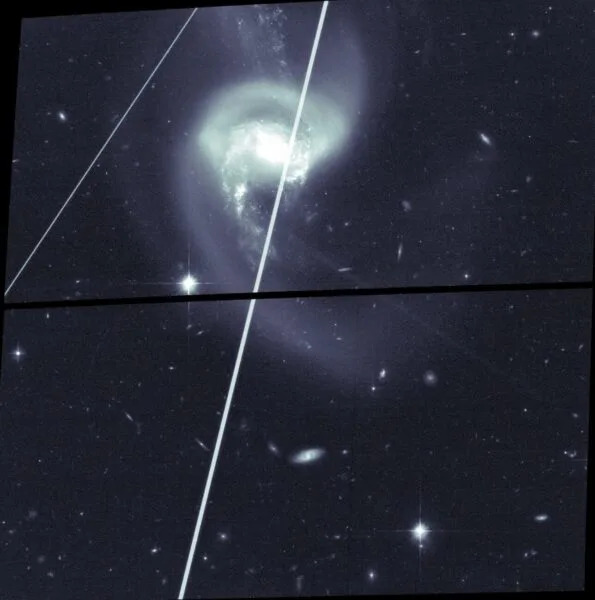
A contaminated Hubble space telescope exposure simulation. Image: NASA
“Until now, most light pollution came from cities and vehicles,” says Alejandro Borlaff of NASA. “Now telecommunication satellite constellations are rapidly affecting astronomical observatories worldwide.”
Impact On Space Telescopes
The issue is not limited to ground-based facilities. Space telescopes—including the Hubble Space Telescope—can also suffer streaks from satellite trails. If megaconstellations expand as planned, studies estimate that up to about 33% of Hubble’s images could be contaminated by the mid-2030s, while some ground-based observatories might experience contamination of more than 95% of their exposures during certain observing programs or times of the night.
Mitigation And Recommendations
Last year, the International Astronomical Union Centre for the Protection of the Dark and Quiet Sky issued recommendations for satellite operators to help preserve astronomical observations. Suggested measures include reducing satellite reflectivity (for example, by darkening surfaces), adjusting orbital altitudes and phasing to avoid the most heavily used observation zones, and coordinating launch schedules with observatories. Observatories are also developing software and data-processing techniques to detect and remove satellite trails from images, but these fixes cannot fully recover lost signal for many deep, long-exposure surveys.
Why It Matters
Protecting the night sky matters for scientific discovery—from mapping the faintest galaxies to tracking near-Earth asteroids—and for cultural and ecological reasons. Addressing the problem will require cooperation between satellite operators, the astronomical community, regulators and the public to balance connectivity needs with the preservation of the astronomical commons.


