Hubble has imaged a collision-like event around the bright, nearby star Fomalhaut, about 25 light-years away. An object first seen in 2008 faded and vanished by 2014, and a similar transient source reappeared in 2023, suggesting both were debris from massive impacts rather than planets. The frequency of these events challenges older models, and scientists plan to use JWST to analyze the dust for water ice and other clues to planetary formation.
Hubble Captures Repeating Cosmic Collisions Near Bright Star Fomalhaut

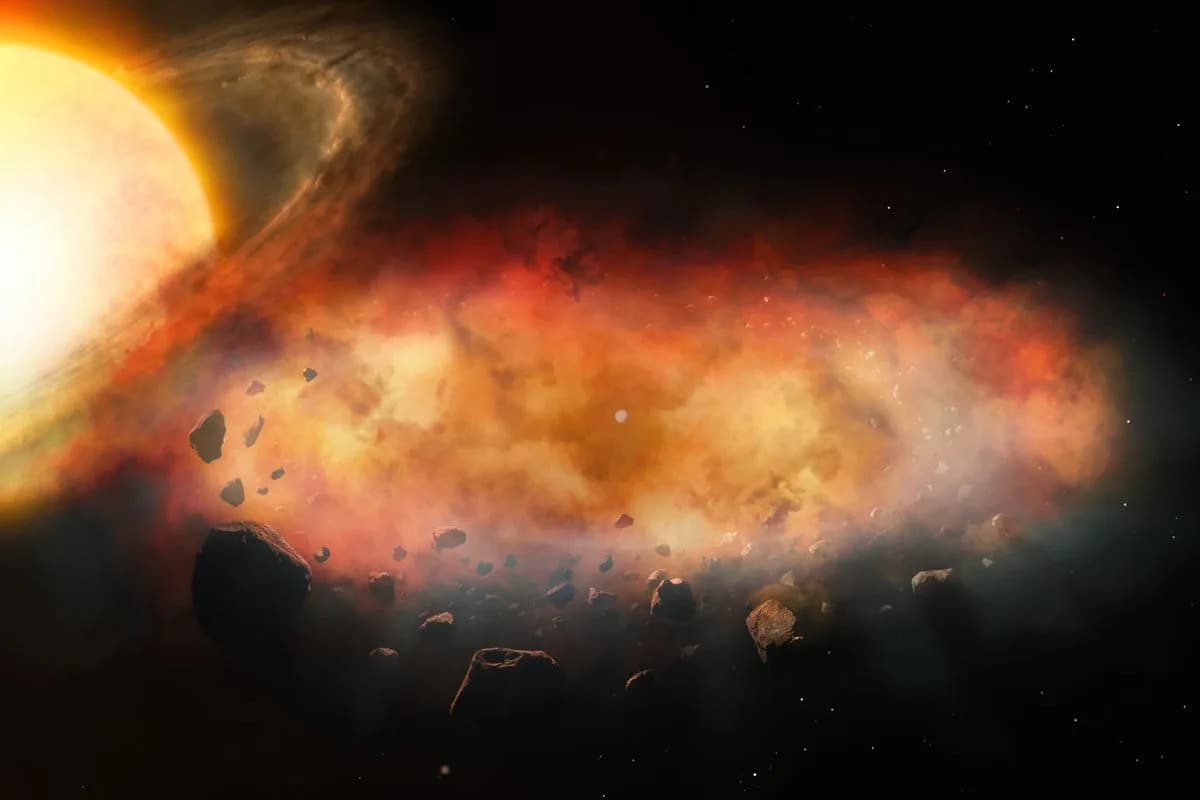
When our solar system was forming, frequent and violent collisions among rocky bodies helped build protoplanets, comets and asteroids. Now, NASA’s Hubble Space Telescope has imaged what appears to be a similar kind of smash-up around the nearby star Fomalhaut, about 25 light-years from Earth.
Fomalhaut is one of the night sky’s brightest stars and is surrounded by prominent rings and bands of dust and debris. Astronomers first reported a faint candidate near Fomalhaut in 2008; that object steadily dimmed and had disappeared by 2014, prompting debate over whether it was a bona fide planet or simply the glow of collision debris.
In a study published in Science, researchers report that a different but visually similar point of light was detected near Fomalhaut in 2023. The sudden reappearance of a comparable transient source, together with the earlier disappearance, supports the interpretation that both sightings were remnants of catastrophic collisions between large bodies rather than stable planets.
"Previous theory suggested that there should be one collision every 100,000 years, or longer. Here, in 20 years, we've seen two," said Paul Kalas, an astronomer at the University of California, Berkeley, and a co-author of the study. "If you had a movie of the last 3,000 years, and it was sped up so that every year was a fraction of a second, imagine how many flashes you'd see over that time. Fomalhaut's planetary system would be sparkling with these collisions."
These observations challenge older models that predicted very rare, isolated collisions in mature debris disks. The authors note, however, that conclusions remain tentative until more events are observed; small-number statistics can be misleading. Follow-up observations with the James Webb Space Telescope (JWST) aim to probe the composition of the collision dust — in particular to search for water ice and other volatiles that would shed light on the building blocks available during planet formation.
Continued monitoring of Fomalhaut’s debris field will help determine how common such high-energy impacts are and how they influence the assembly and evolution of planetary systems, including analogies to our own solar system’s violent youth.
Help us improve.