Reanalysis of Cassini data suggests Titan may not have a single buried global ocean but rather a deep interior of ice and slush with isolated pockets of liquid water. Models indicate an outer ice shell of ~100 miles (170 km) over slushy layers extending beyond 340 miles (550 km), and some pockets could be as warm as 68°F (20°C). A measured ~15-hour lag in Titan’s surface response to Saturn’s gravity supports the slushy-interior hypothesis, though some scientists remain skeptical. NASA’s Dragonfly mission should help settle the question.
New Analysis Suggests Titan May Lack a Global Buried Ocean — Instead a Deep, Slushy Interior

FILE - This image made by the Cassini spacecraft and provided by NASA on March 12, 2006, shows two of Saturn's moons, the small Epimetheus and smog-enshrouded Titan, with Saturn's A and F rings stretching across the frame. (NASA via AP)(ASSOCIATED PRESS)
New analysis of archival data from NASA’s Cassini spacecraft suggests that Saturn’s giant moon Titan may not host a single, global subsurface ocean as long believed. Instead, researchers now propose an interior made of thick ice and slush punctuated by isolated pockets of liquid water that could — in principle — offer habitable niches.
What the Study Found
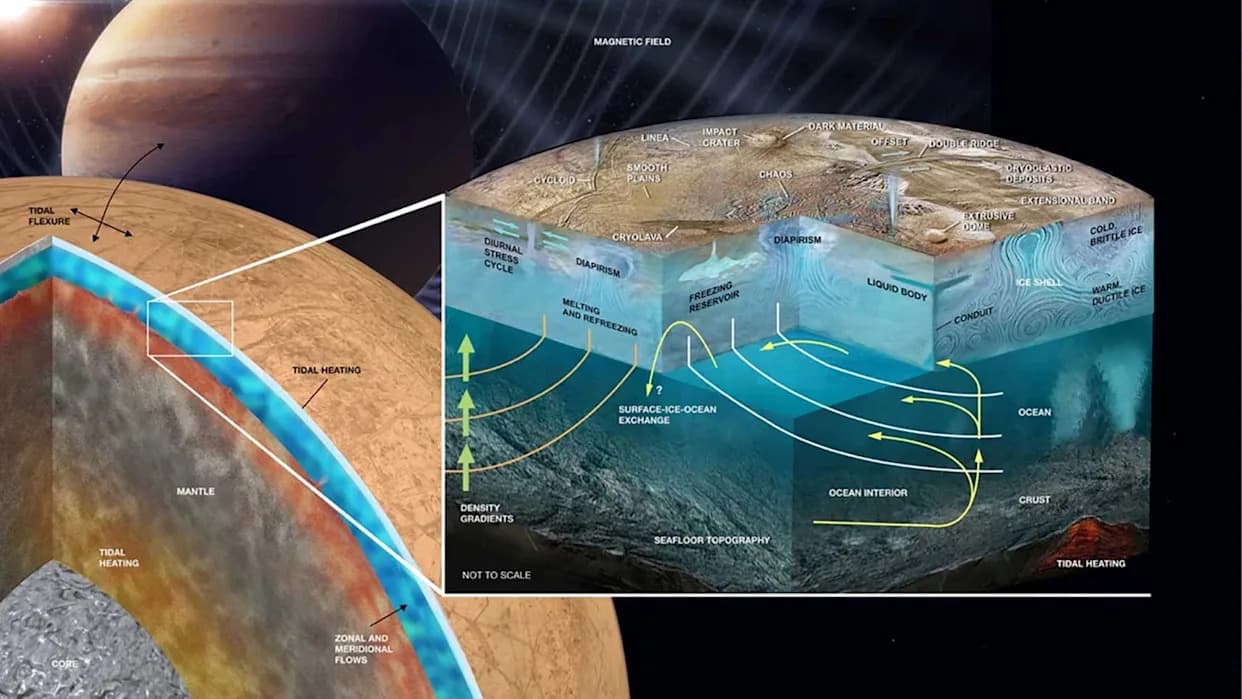
Scientists at NASA’s Jet Propulsion Laboratory reprocessed Cassini observations and combined them with computer models to probe Titan’s internal structure. The team measured a roughly 15-hour lag between the peak gravitational tug from Saturn and the corresponding rise of Titan’s surface. If a global liquid ocean lay beneath the shell, those peaks would align closely; the delay is more consistent with a slushy, viscous interior containing localized reservoirs of water.
Model results indicate an outer ice shell about 100 miles (170 kilometers) thick overlying layers of slush and isolated liquid pockets that could extend more than 340 miles (550 kilometers) beneath the surface. Some modeled liquid pockets could reach temperatures near 68°F (20°C), warm enough to be of astrobiological interest.
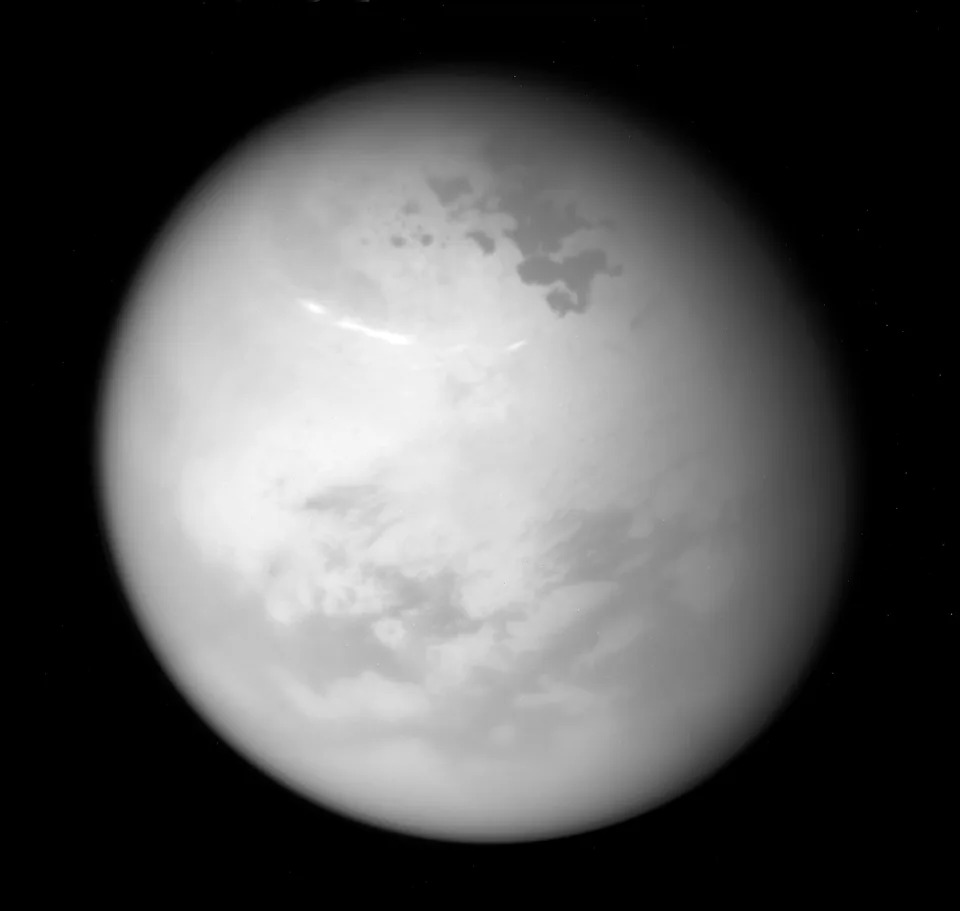
FILE - This image provided by NASA shows bright methane clouds drifting in the summer skies of Saturn's moon Titan, along with dark hydrocarbon lakes and seas clustered around the north pole, as seen from the Cassini spacecraft, June 9, 2017. (NASA/JPL-Caltech/Space Science Institute via AP, File)(ASSOCIATED PRESS)
Why This Matters
Researchers caution that no signs of life have been detected at Titan. Still, a near-melting, slushy environment with isolated warm pockets broadens the kinds of habitats scientists might consider when assessing Titan’s potential habitability. As University of Washington scientist Baptiste Journaux, a co-author of the paper in Nature, wrote, “there is strong justification for continued optimism regarding the potential for extraterrestrial life.”
“Nature has repeatedly demonstrated far greater creativity than the most imaginative scientists,” Journaux added, noting any life would likely be microbial and highly specialized.
Different Views Remain
Not all experts are convinced. Luciano Iess (Sapienza University of Rome), whose earlier Cassini analyses supported a global hidden ocean, said the new results are intriguing but not yet decisive. The scientific debate underscores the limits of remote-sensing data and the value of follow-up missions.
Looking Ahead
NASA’s planned Dragonfly mission — a rotorcraft lander scheduled to launch later this decade — is expected to deliver more detailed measurements of Titan’s surface and near-subsurface environment and help test competing interior models. Cassini, launched in 1997 and arriving at Saturn in 2004, provided the data set underpinning both the previous and current interpretations before its deliberate end in 2017.
Context: Titan is the solar system’s second-largest moon (about 3,200 miles / 5,150 kilometers across) and features lakes of liquid methane on its frigid surface. Saturn’s gravity deforms Titan, creating surface bulges up to roughly 30 feet (10 meters) when the moon and planet are closest.
Help us improve.