MIT researchers Wanying Kang and Jiaru Shi used a two-dimensional surface fluid model to explain why Jupiter and Saturn host different polar storm configurations. Their simulations show that the way surface vortices couple to deeper layers—controlled by vertical stratification, internal forcing, and frictional dissipation—determines whether storms merge into a single giant cyclone (as on Saturn) or remain as multiple vortices (as on Jupiter). The study, published in PNAS, suggests polar storm patterns could provide clues to deep atmospheric structure and composition.
How Jupiter and Saturn’s Polar Storms Reveal Deep Atmospheric Differences
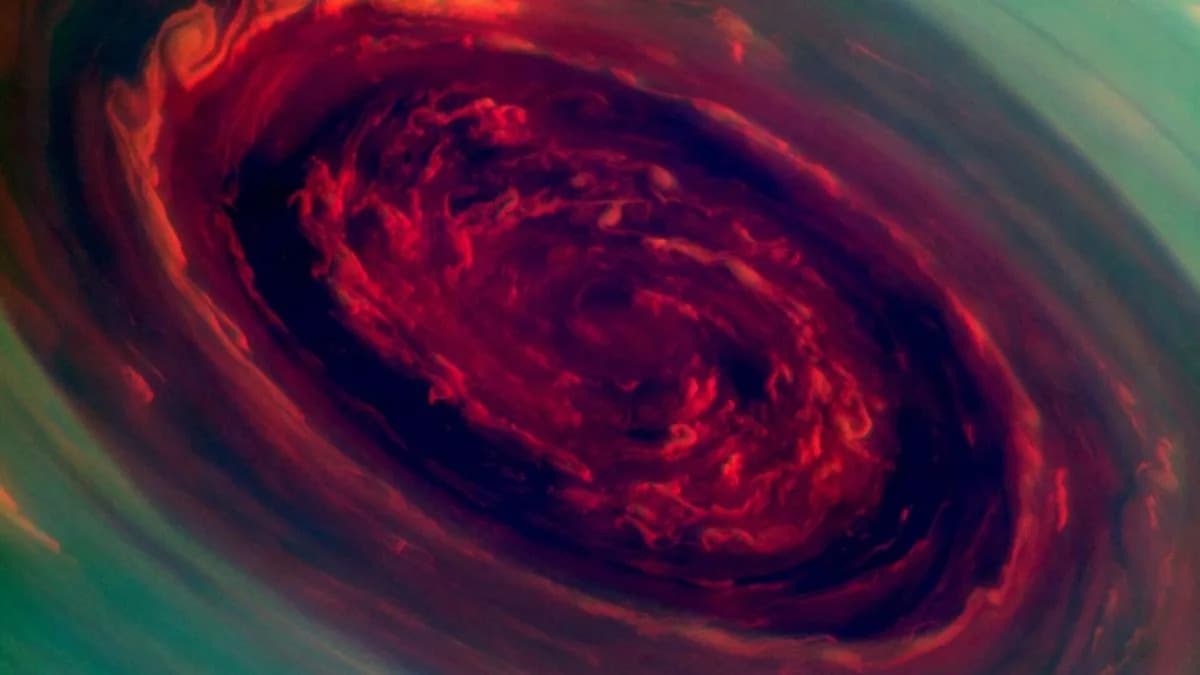
Polar Storms on Jupiter And Saturn Reveal Deep Atmospheric Differences
The two largest planets in the Solar System—Jupiter and Saturn—share many bulk properties: similar composition (mostly hydrogen and helium), comparable rotation rates, and comparable internal heat output. Yet their polar weather looks strikingly different. New research from MIT scientists Wanying Kang and Jiaru Shi suggests those differences trace back to how surface storms couple to deeper atmospheric layers.
Using spacecraft observations from Cassini (Saturn) and Juno (Jupiter) as motivation, Kang and Shi built a simplified but powerful two-dimensional model of surface fluid dynamics that captures the dominant vortex patterns observed at the poles of both planets.
What the Model Shows
The team reduced the complex three-dimensional problem to an efficient two-dimensional representation by exploiting the tendency of fluid motion in fast-rotating systems to align along the rotation axis. This allowed them to run many simulations and explore how a few key parameters determine the final vortex structure.
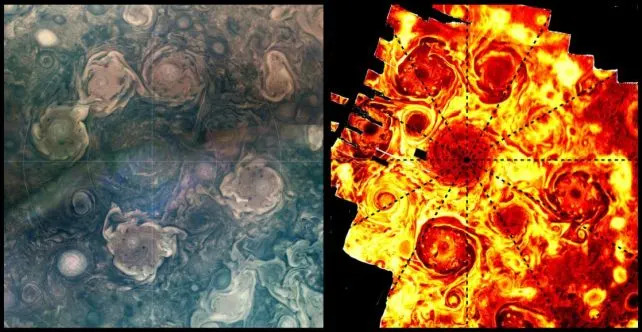
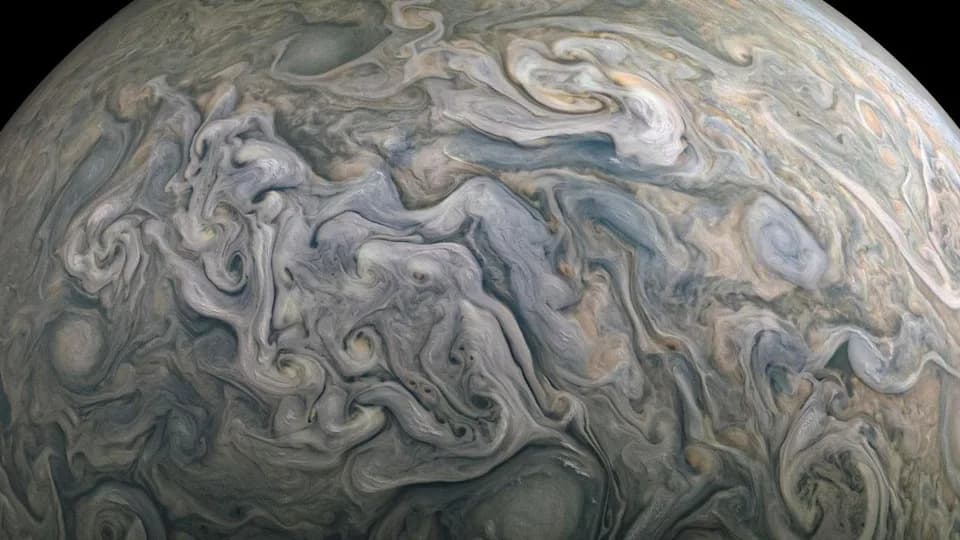
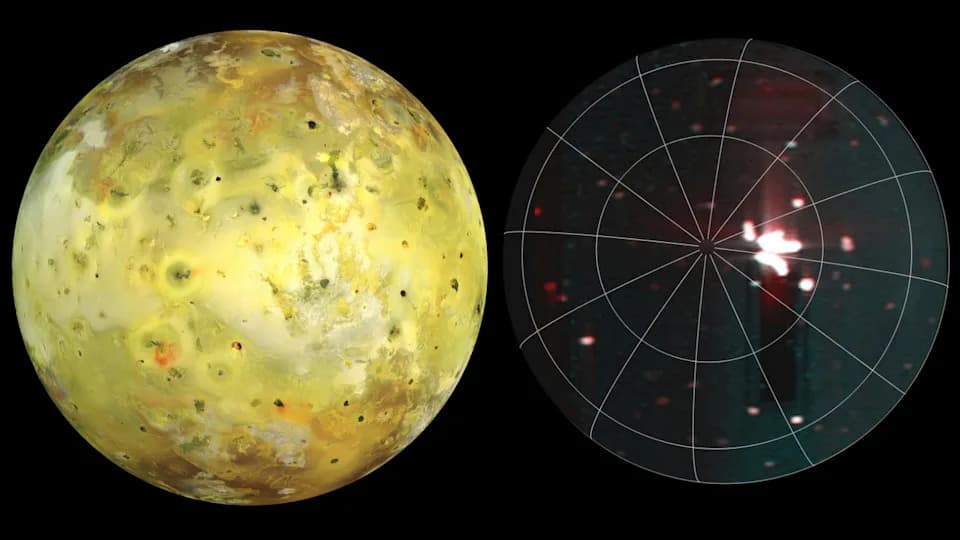
Jupiter's northern polar storm circle in visible (left) and infrared (right) light. (NASA)
Key Physical Controls
The model identifies three main controls on vortex growth and merger:
- Vertical Stratification (Layering Depth) — Stronger stratification (a "harder" or more buoyant bottom) tends to confine vortices and can allow them to merge into larger cyclones.
- Internal Forcing — How much energy is injected by deep convection and internal heat. Stronger forcing produces more vigorous turbulence and many separate vortices.
- Frictional Dissipation — The rate at which kinetic energy is removed. Higher dissipation favors vortex merger into a single dominant cyclone.
"Depending on the interior properties and the softness of the bottom of the vortex, this will influence the kind of fluid pattern you observe at the surface," says Wanying Kang (MIT).
The order and relative strength of these limits matter. If multiple vortices form but turbulence or other effects prevent them from coalescing, the surface ends up dotted with several discrete storms. If barriers to merger are weak or absent, the small vortices can combine into one large polar cyclone.
Applying the Model to Jupiter and Saturn
According to the simulations, Jupiter’s polar pattern—one large central vortex surrounded by several smaller cyclones—arises when vertical stratification is weaker, internal forcing from the deep interior is stronger, and friction drains energy relatively slowly. Those conditions favor the persistence of multiple, separate vortices at the visible surface.

Audition now for ScienceAlert's Casting Call
Saturn, in contrast, is best reproduced when the atmosphere has stronger effective stratification (a “harder” bottom), weaker relative forcing, or greater frictional dissipation. Under those conditions, smaller vortices readily merge into a single dominant polar storm at each pole.
"What we see from the surface—the fluid pattern on Jupiter and Saturn—may tell us something about the interior, like how soft the bottom is," says Jiaru Shi (MIT).
Implications and Next Steps
While the results are not definitive proof of specific interior compositions, they offer a plausible and testable link between observable surface patterns and deep-planet properties such as stratification and composition. Future observations, more detailed three-dimensional models, and comparisons with additional data from Juno, Cassini legacy analyses, and future missions could help confirm whether polar vortex patterns truly record interior structure.
The research appears in the Proceedings of the National Academy of Sciences (PNAS).
Help us improve.