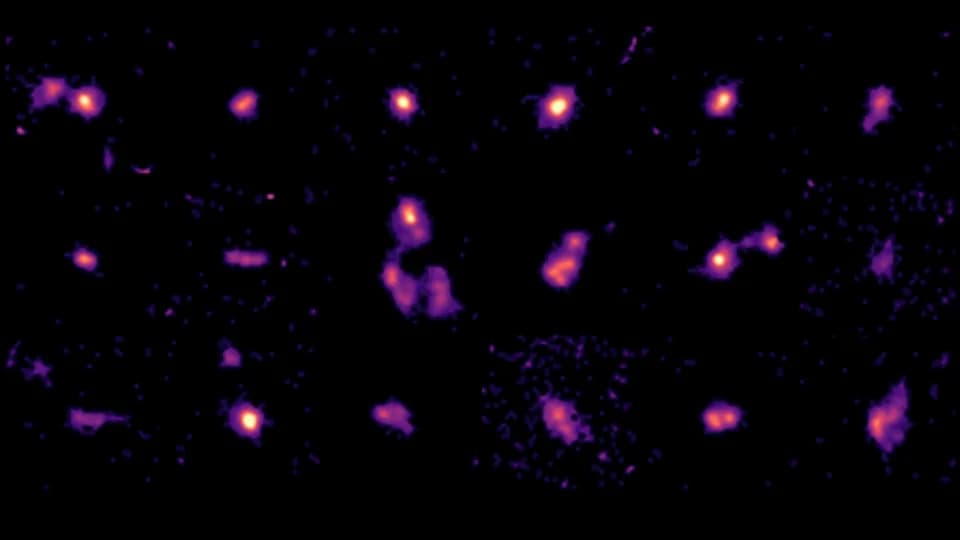
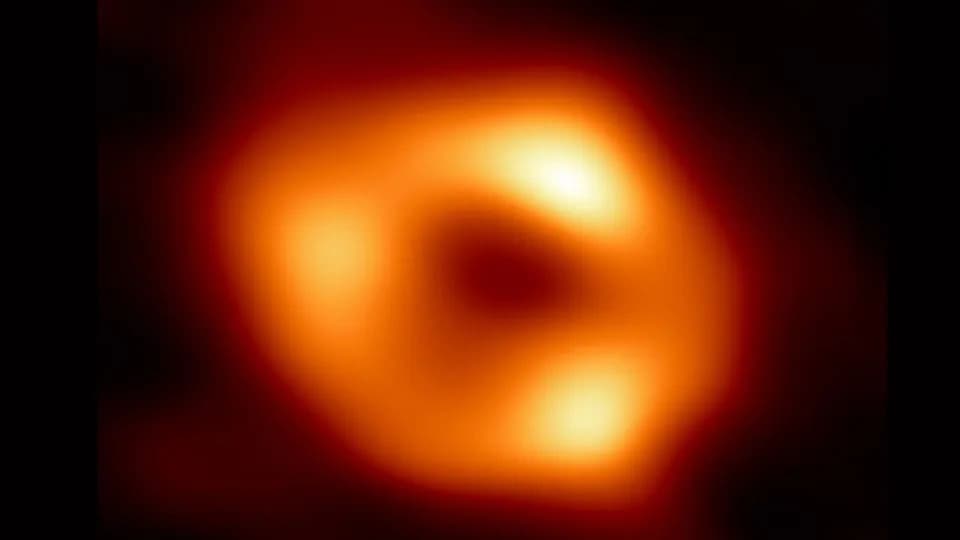
University of Utah researchers analyzed Chandra X-ray observations of more than 1,600 galaxies collected over two decades and found that roughly 30% of dwarf galaxies likely host supermassive black holes, compared with over 90% of massive, Milky Way–sized galaxies. The team searched for X-ray signatures of accretion to identify active central black holes. Published in The Astrophysical Journal, the results suggest large black holes may be rarer in low-mass galaxies, with implications for theories of black-hole seeding and early growth.
Utah Study Finds Far Fewer Supermassive Black Holes In Dwarf Galaxies Than Expected

Utah astronomers uncover shortage of black holes in dwarf galaxies
SALT LAKE CITY — New analysis of more than two decades of NASA Chandra X-ray Observatory data suggests supermassive black holes are much less common in low-mass galaxies than previously thought.
Researchers at the University of Utah examined observations of over 1,600 galaxies collected across more than 20 years. By searching the archive for X-ray signatures produced when gas and dust fall onto black holes, the team assessed how often galaxies of different masses host actively accreting central black holes.
“This result is a little surprising to me, because a lot of my other work has found that small galaxies, at least sometimes, have central supermassive black holes,” said University of Utah professor Anil Seth, a co-author on the paper.
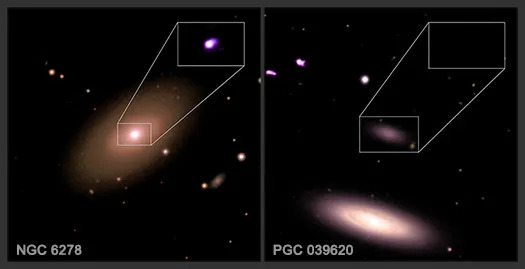
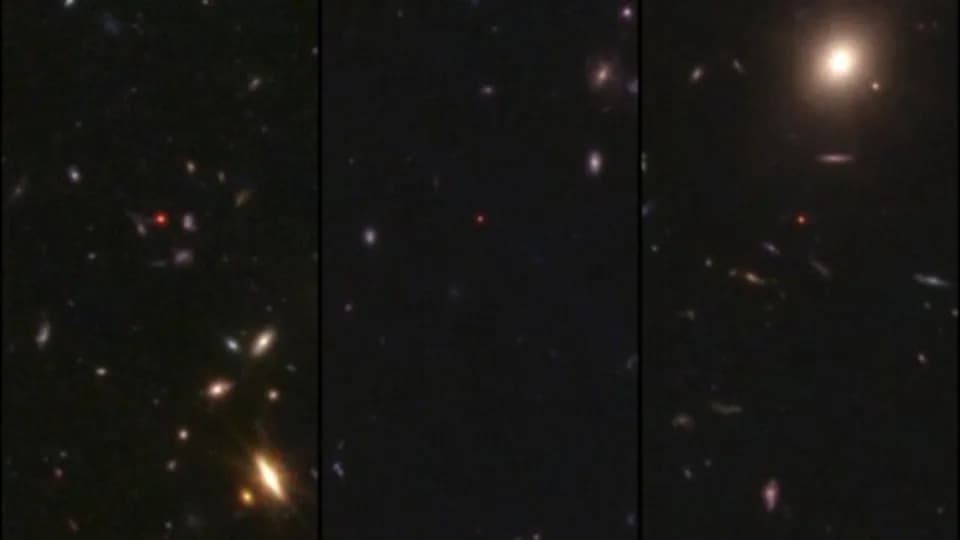
Bright X-rays in the centers of galaxies like NGC 6278 (left) is a signature of a supermassive black hole. However, most smaller galaxies in the study, including PGC 039620 (right), did not have these signals. (Courtesy//NASA/CXC/SAO/F. Zou et al)
The study reports that roughly 30% of dwarf galaxies are likely to contain central supermassive black holes, while more than 90% of massive, Milky Way–sized galaxies show X-ray evidence of central black holes. David Ohlson, a University of Utah doctoral student and co-author, helped build the team’s “massive catalog” of galactic measurements used in the analysis.
How The Team Reached Their Conclusion
The researchers used X-ray detections as a tracer of accretion: when matter falls onto a black hole, it emits high-energy radiation that Chandra can detect. The absence of detectable X-ray signatures in many dwarf galaxies suggests either a true lack of central supermassive black holes or a population of black holes that are dormant or accreting at rates too low to be seen with current observations.
“The formation of big black holes is expected to be rarer, so that would explain why we don’t find black holes in all the smaller galaxies,” Seth added.
Published in The Astrophysical Journal, the findings have implications for theoretical models of how the first massive black holes formed and how they grew over cosmic time. If large black holes are indeed rarer in low-mass galaxies, that could reshape scenarios for seed black hole formation and early galaxy evolution.
What’s next: Future observations with more sensitive instruments and complementary techniques (for example, radio or infrared searches, dynamical measurements, and deeper X-ray exposures) will help distinguish between truly missing black holes and ones that are simply too faint to detect today.
Help us improve.