The SWOT satellite captured high-resolution data of the July 29, 2025 M8.8 tsunami off Kamchatka about 70 minutes after the quake, revealing a leading wave followed by a dispersive wavetrain rather than a single coherent front. Researchers say the observations challenge conventional non-dispersive models and could improve tsunami forecasting and early-warning systems. The discovery highlights SWOT's capabilities even as reporting warns of internal disruption and proposed budget cuts that could threaten dozens of planned NASA missions.
NASA Satellite Captures Tsunami "Wavetrain," Forcing A Rethink Of How These Waves Behave

An unexpected satellite pass over the Pacific has given scientists a rare, high-resolution view of a tsunami in motion — and the images challenge long-standing assumptions about how these deadly waves travel.
Rare Data From SWOT
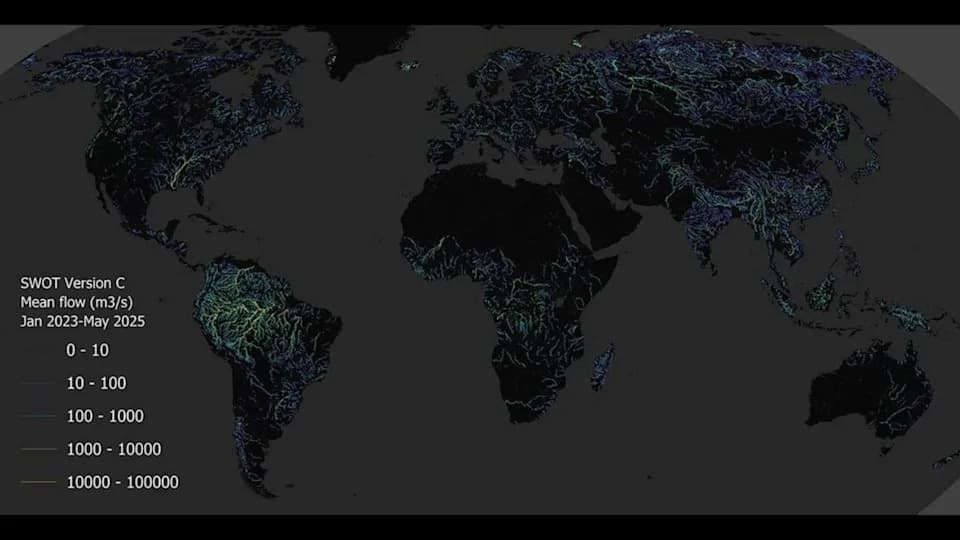
The observations come from the Surface Water and Ocean Topography (SWOT) mission, a joint NASA–CNES effort equipped with a radar interferometer, GPS, a laser retroreflector, and a two-beam microwave radiometer, among other instruments. SWOT maps ocean surface heights with unprecedented precision.
On July 29, 2025, an undersea earthquake off Russia's Kamchatka Peninsula registered magnitude 8.8. About 70 minutes after the quake, SWOT passed over the affected region and recorded the tsunami while it was still propagating. The satellite's high-resolution measurements captured a pattern scientists had not previously seen in such detail.
Dispersive Wavetrain vs. Traditional Model
For decades, tsunamis have often been modeled as largely non-dispersive: a single, coherent wavefront traveling together. SWOT's data, however, fit a dispersive model much better — the leading wave was followed by a wavetrain, a sequence of smaller waves trailing the main front. This signal was clear enough in the new measurements to prompt researchers to reconsider aspects of tsunami physics and how those waves evolve over time and distance.
"The power of SWOT's broad, paintbrush-like strokes over the ocean is in providing crucial real-world validation, unlocking new physics, and marking a leap towards more accurate early warnings and safer futures," said Nadya Vinogradova Shiffer, Earth lead and SWOT scientist, in a NASA statement.
Implications For Forecasting And Safety
Recognizing dispersive behavior in tsunamis could improve how models simulate wave propagation, energy distribution, and arrival timing at distant coastlines. Better models can sharpen early-warning systems, guide evacuation planning, and refine risk assessments for vulnerable communities.
Broader Scientific And Institutional Context
These tsunami observations arrive amid other international satellite advances: recently, partnerships involving U.S. and Indian teams produced clearer radar images of Earth's surface that have utility for disaster monitoring and response.
At the same time, reporting from NPR and The Planetary Society has highlighted internal disruption at NASA and proposed budget reductions — reporting estimates include proposals to cut roughly 47% of some funding lines and the potential cancellation or delay of dozens of missions (reporting has cited about 41 projects at risk). The agency has also announced the planned retirement of the International Space Station later this decade, with a transition toward commercially operated platforms.
What Comes Next
SWOT's surprise snapshot has opened new avenues for research: scientists will incorporate the satellite's measurements into models, conduct follow-up analyses, and look for similar signatures in other events. If replicated, the finding could materially improve tsunami forecasting and coastal preparedness worldwide.
Help us improve.