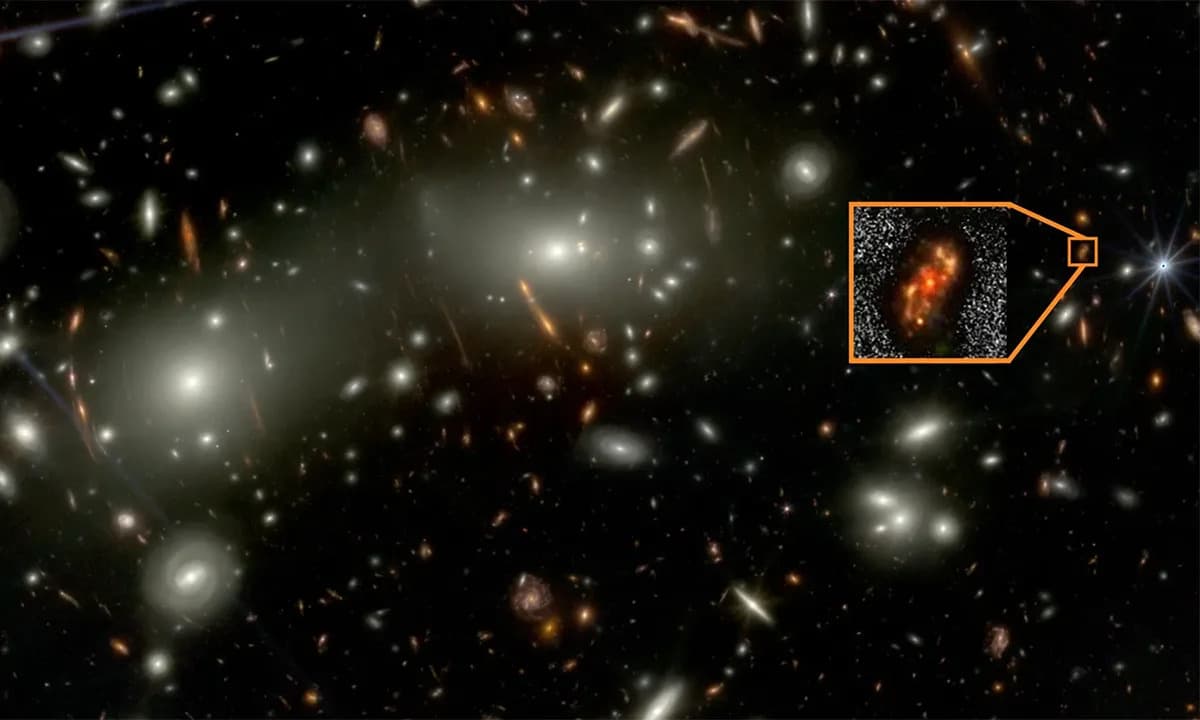
A rotating gas filament about 140 million light-years away stretches roughly 5.5 million light-years long and about 117,000 light-years wide, and contains 14 hydrogen-rich galaxies aligned along its length. Observations with the MeerKAT array as part of the MIGHTEE survey indicate the filament spins at ~68 miles per second (110 km/s), with most embedded galaxies rotating in the same direction. The finding — described in Monthly Notices of the Royal Astronomical Society — supports the idea that cosmic filaments help impart angular momentum to forming galaxies. Researchers expect deeper surveys and next-generation observatories to reveal more such structures.
Giant Rotating Cosmic Thread With 14 Galaxies May Be the Largest Spinning Object Known

Astronomers have detected a vast, rotating filament of gas some 140 million light-years from Earth that may be the largest spinning structure yet observed. The threadlike filament stretches roughly 5.5 million light-years long and about 117,000 light-years across — wider than the Milky Way — and hosts 14 hydrogen-rich galaxies arranged along its length.
The discovery, described in a paper published Dec. 3 in Monthly Notices of the Royal Astronomical Society, was made using MeerKAT, a South African array of 64 radio dishes as part of the MIGHTEE (MeerKAT International GHz Tiered Extragalactic Exploration) survey. Study co-lead author Lyla Jung of the University of Oxford said the team first noticed a striking alignment of galaxies that appeared to lie at the same distance.
"The initial discovery itself was a surprise. We noticed a striking alignment of galaxies glowing at the same distance," Jung said.
Detailed measurements indicate the gaseous filament is rotating at about 68 miles per second (110 kilometers per second). Most of the galaxies embedded in the thread also show rotation, with the majority spinning in the same direction as the filament. That shared motion supports the idea that large-scale structures in the cosmic web can influence how galaxies acquire angular momentum — affecting both the speed and orientation of galactic spins during their formation.
Madalina Tudorache, a member of the research team at the University of Oxford, called the filament "probably the largest spinning object" discovered so far. Rotating filaments have long been predicted by cosmological simulations, but direct detections were limited until radio telescopes reached the sensitivity needed to see faint hydrogen gas at large scales.
Many such filaments are thought to interconnect within the vast cosmic web, channeling gas and dark matter into forming galaxies and galaxy clusters. The team expects more examples to emerge as surveys probe deeper and instruments improve. Additional MIGHTEE observations may clarify the filament's dynamics and uncover other rotating threads, and forthcoming facilities such as the Vera C. Rubin Observatory could help extend these studies.
"I think it's really helping us understand the universe," Tudorache said.
Lead investigator Matt Jarvis of the University of Oxford oversees the MIGHTEE survey, which continues to collect data that may reveal more about how these enormous structures shape galaxy evolution.
Help us improve.