Researchers have discovered asteroid 2025 MN45, about 2,329 feet (710 m) across, that spins once every 1.88 minutes — the fastest-known rotation for an object larger than 1,640 feet. Its extreme spin implies a strong internal structure rather than a rubble pile. The object was one of nearly 2,000 asteroids detected in Vera C. Rubin Observatory "First Look" data; among them were 16 super-fast and 3 ultra-fast rotators. Rubin’s upcoming decade-long LSST program will expand such discoveries.
Record-Breaking Asteroid 2025 MN45 — Nearly Eight Football Fields Wide, Spins Every 1.88 Minutes
Scientists find ‘record-breaking’ asteroid nearly the size of eight football fields. Is it close to Earth?
Researchers have identified a record-breaking asteroid, designated 2025 MN45, that measures roughly 2,329 feet (about 710 meters) across — nearly the length of eight American football fields laid end to end — and completes a rotation in just 1.88 minutes.
That rapid spin makes 2025 MN45 the fastest-spinning object larger than 1,640 feet (500 meters) discovered so far. Its rotation period is about 112.8 seconds, a rate that tells astronomers the body must be made of unusually strong material rather than a loose aggregate of fragments.
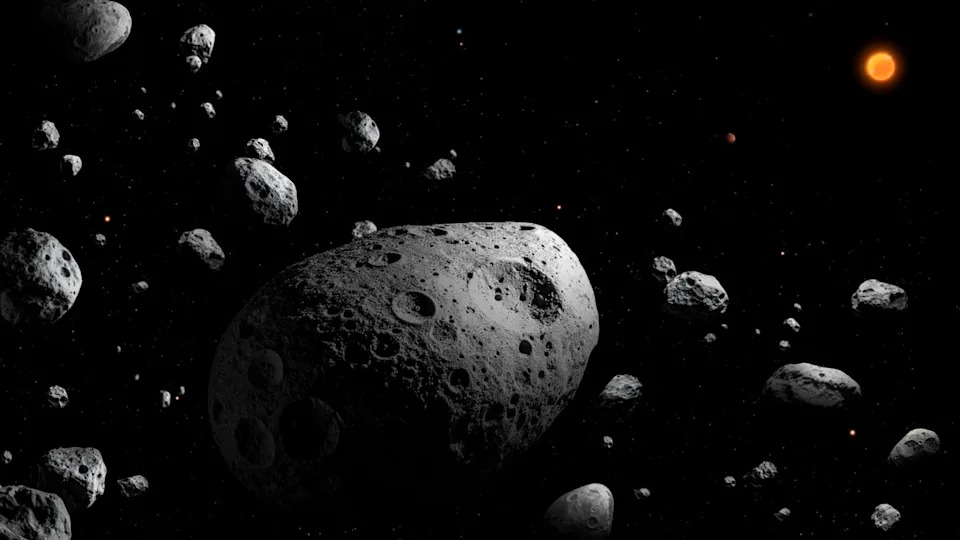
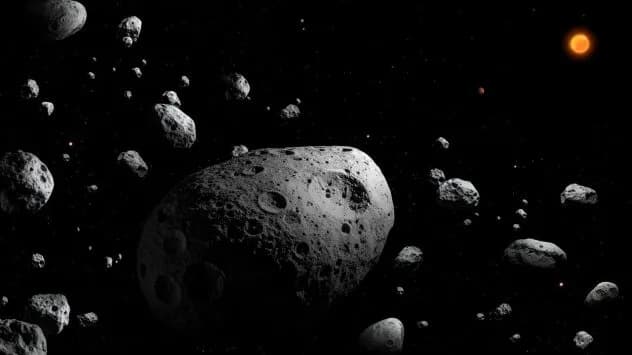
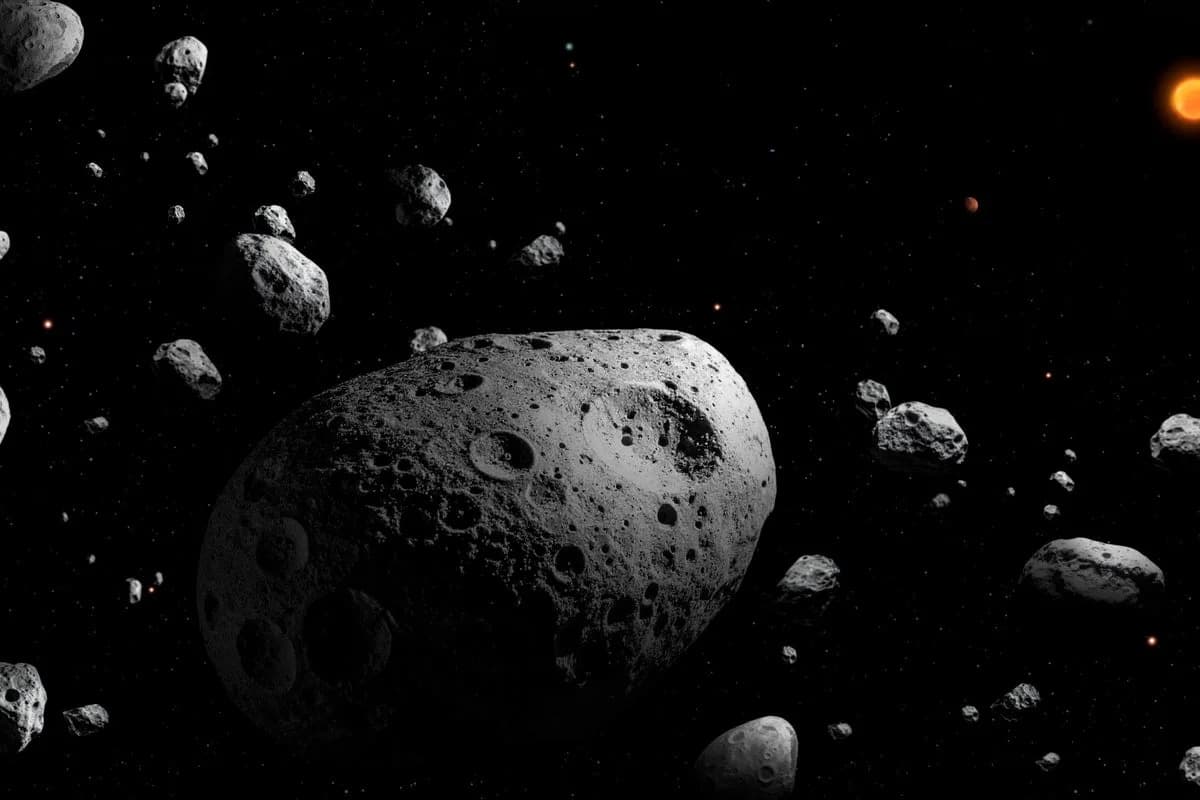
Scientists have discovered the fastest-spinning asteroid with a diameter over 1,640 feet thus far (NSF–DOE Vera C. Rubin Observatory/NOIRLab/SLAC/AURA/P. Marenfeld)
Where It Lives
2025 MN45 orbits the Sun within the main asteroid belt, the region between Mars and Jupiter that contains millions of rocky bodies. Depending on orbital positions, the main belt lies at distances of hundreds of millions of miles from Earth — typically on the order of roughly 300 million miles.
Why the Spin Matters
Most asteroids either rotate steadily or tumble. Rotation speeds are influenced by factors such as solar heating, past collisions and internal composition. For main-belt objects, the so-called fast-rotation limit to avoid gravitational fragmentation is about 2.2 hours. Objects that spin faster than this must have internal strength to stay intact; the faster and larger the object, the stronger its required material.
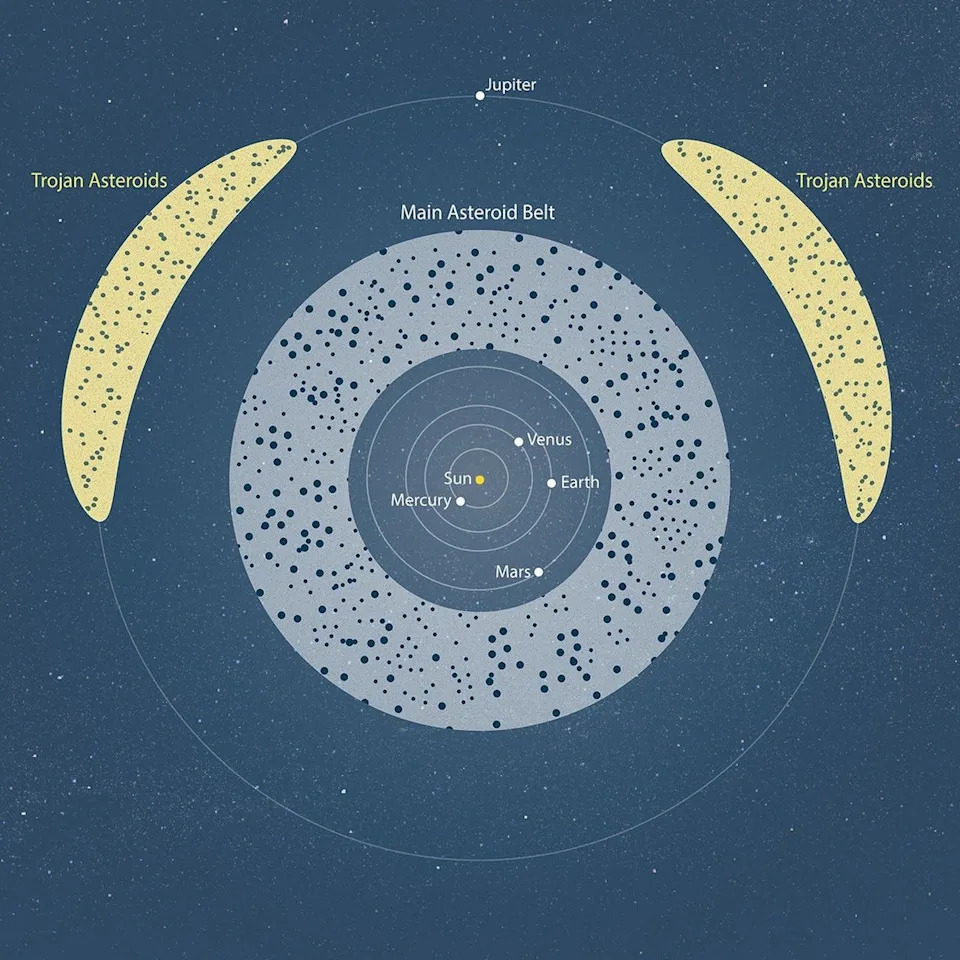
The main asteroid belt lies is shown on this illustration between between Mars and Jupiter, surrounding Earth, Mercury, Mars, Venus and the sun (NASA, ESA, Joseph Olmsted (STScI))
“For objects in the main asteroid belt, the fast-rotation limit to avoid being fragmented is 2.2 hours; asteroids spinning faster than this must be structurally strong to remain intact,” said the collaborating agencies in a statement.
How It Was Found
2025 MN45 was one of nearly 2,000 asteroids detected using observations from the Vera C. Rubin Observatory in Chile, a facility supported by the National Science Foundation and the Department of Energy and equipped with the world’s largest digital camera.
The detections came from a seven-day observing run in April and May during the observatory’s early "First Look" campaign. From roughly 1,900 newly identified asteroids, researchers flagged 16 super-fast rotators (spin periods between about 13 minutes and 2.2 hours) and 3 ultra-fast rotators (spin periods under five minutes), including 2025 MN45. All 19 exceed the length of a football field.
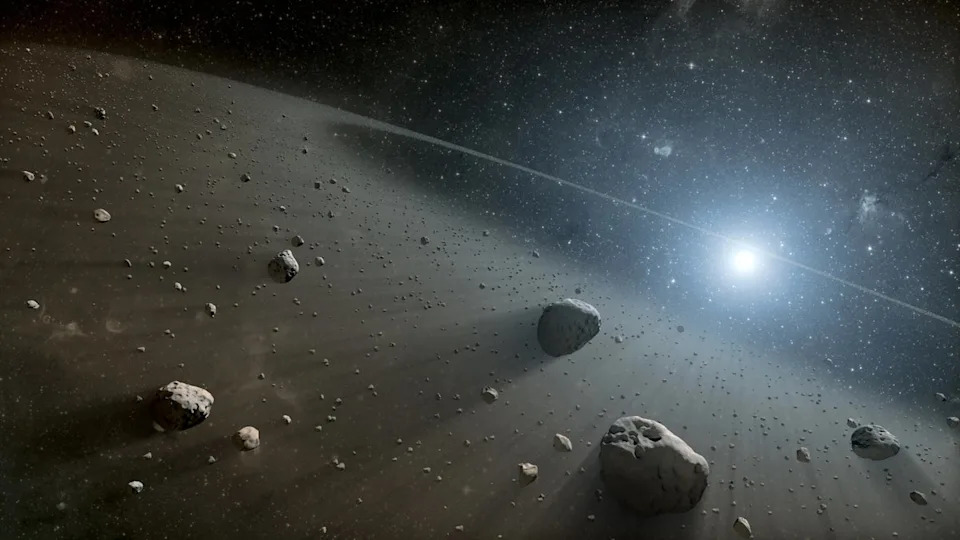
This NASA illustration shows the main asteroid belt orbiting the sun between Mars and Jupiter (NASA)
Is It A Threat?
Most fast rotators previously discovered have been near-Earth objects, which pass within about 30 million miles of Earth’s orbit. Objects that come within 0.05 AU (approximately 4.6 million miles) of Earth’s orbit are classed as potentially hazardous based on proximity; however, NASA says it is highly unlikely that an asteroid large enough to cause widespread damage will impact Earth within the next 100 years or more.
The discovery of several fast-rotating bodies in the main belt — all but one of the newly identified fast rotators were in that region — highlights Rubin’s ability to spot distant, small, rapidly spinning asteroids that were previously difficult to detect.
In the coming months, Rubin will begin its full survey, the Legacy Survey of Space and Time (LSST), a decade-long program to repeatedly image the Southern Hemisphere night sky and dramatically expand our inventory of solar system objects.
“NSF–DOE Rubin Observatory will find things that no one even knew to look for,” said Luca Rizzi, an NSF program director for research infrastructure.
Help us improve.