A Nature study warns that if all current satellite plans proceed, about 560,000 satellites could be in orbit by the late 2030s, and their reflected light would spoil most images for several space telescopes. Simulations suggest roughly 96% of exposures for wide-field missions like SPHEREx, ARRAKIHS and Xuntian could be affected, while Hubble might see contamination in about one third of exposures. Researchers urge greater operator transparency, coordinated planning and fewer launches to protect astronomical observations.
560,000 Satellites Could Contaminate Most Space-Telescope Images, NASA Study Warns

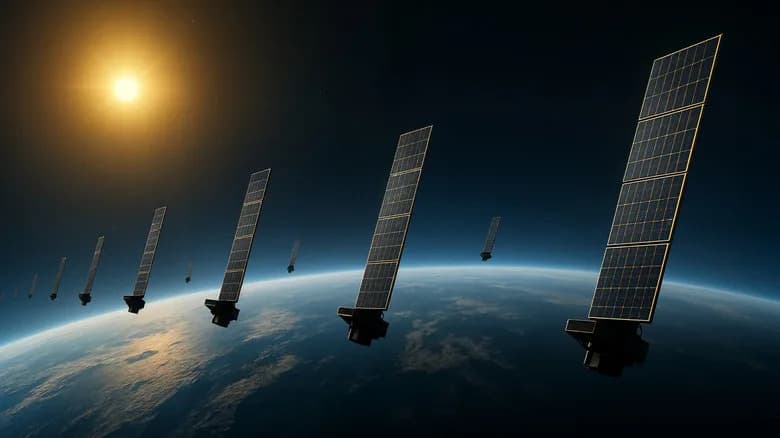
A new study published in Nature warns that if all current satellite filings proceed, roughly 560,000 satellites could be orbiting Earth by the late 2030s—and their reflected sunlight may contaminate a large share of observations made by several space telescopes.
Key findings
Researchers simulated how an enormous future satellite population would intersect the fields of view of four space telescopes. They report that reflected light from such a fleet would spoil about 96% of exposures for missions with wide fields of view—specifically NASA's planned SPHEREx, the European ARRAKIHS concept, and China's Xuntian observatory. The Hubble Space Telescope, which images smaller sky patches at a time, would still see contamination in roughly one third of its exposures.
Why this matters
Contamination from satellite streaks can degrade data quality and complicate or bias scientific analyses. For example, fast-moving asteroids can resemble satellite streaks, making it harder to identify potentially hazardous objects. Many astronomical programs—surveys of faint galaxies, transient searches, and small-body tracking—rely on clean images and could be seriously affected.
Underlying trends
The study notes the low-Earth-orbit satellite population has grown from about 2,000 in 2019 to roughly 15,000 today. Much of that growth has been driven by large internet-constellation deployments, and filings with regulators suggest the total could expand by an order of magnitude in coming years as new operators and AI-driven data demands push for more capacity.
Satellite brightness and size
Alejandro Borlaff of NASA's Ames Research Center, the study's lead author, highlights another concern: a satellite with ~100 square metres of reflective surface can appear "as bright as the brightest star" to the naked eye. Proposed platforms of thousands of square metres—envisioned to meet growing communications and AI data needs—could be visible at levels comparable to bright planets.
Possible mitigations and trade-offs
- Lowering satellites to orbits beneath space telescopes could reduce direct contamination, but the study warns such changes may accelerate atmospheric drag and chemical effects that could harm the ozone layer.
- Reducing the total number of launches is the simplest technical fix, but commercial competition and rising data demands make deep cuts unlikely.
- Near-term mitigation includes operators sharing precise orbital positions, orientations and color/reflectivity information so telescope teams can predict, mask or avoid streaks in scheduled observations.
Recommendations and outlook
"This represents a very severe threat to space-based astronomy," Borlaff says. "Operator transparency and coordinated planning are essential to limit the damage to scientific observations."
Other missions that operate far from low-Earth orbit—for example the James Webb Space Telescope at the second Lagrange point (L2), about 1.5 million kilometres from Earth—are much less vulnerable to streaks from low-Earth-orbit satellites.
Protecting the scientific value of space telescopes will likely require a combination of industry cooperation, smarter constellation design, and regulatory attention that balances commercial needs against long-term scientific and environmental impacts.
Help us improve.