Orbital debris worsened in 2025, culminating in a dangerous near-miss when microscopic debris cracked a viewport on China's Shenzhou-20 and forced an emergency uncrewed launch. Experts warn nearly 130 million pieces of debris and the rapid growth of megaconstellations are raising collision risks and undermining confidence in orbital safety. Calls from specialists and the UN stress the need for better tracking, transparency, and coordinated international stewardship to prevent cascading collisions and protect both operations and the atmosphere.
Space Debris Triggered an Orbital Emergency in 2025 — Will It Force Global Action?

An illustration of space debris in orbit. | Credit: Mark Garlick/Science Photo Library/Getty Images
Earth is encircled by a growing cloud of human-made debris, and 2025 brought fresh evidence that the problem is becoming urgent. Experts now estimate nearly 130 million pieces of orbital junk — fragments from rocket explosions, defunct satellites, deployment hardware, and debris from anti-satellite tests — are circling the planet at high speed.
A Near Miss That Exposed Bigger Gaps
On Nov. 5, 2025, the crew of China's Shenzhou-20 discovered microscopic cracks in a viewport while preparing to undock from the country's space station. Engineers determined the damage was caused by an external impact of orbital debris, rendering that spacecraft unsafe for a crewed return.
China responded with its first emergency mission in the human spaceflight program: an uncrewed, cargo-carrying Shenzhou-22 launched on Nov. 25. The situation concluded without injury when the astronauts returned safely to Earth aboard the Shenzhou-21 spacecraft — the first time the country activated an alternate re-entry procedure for its space station program.
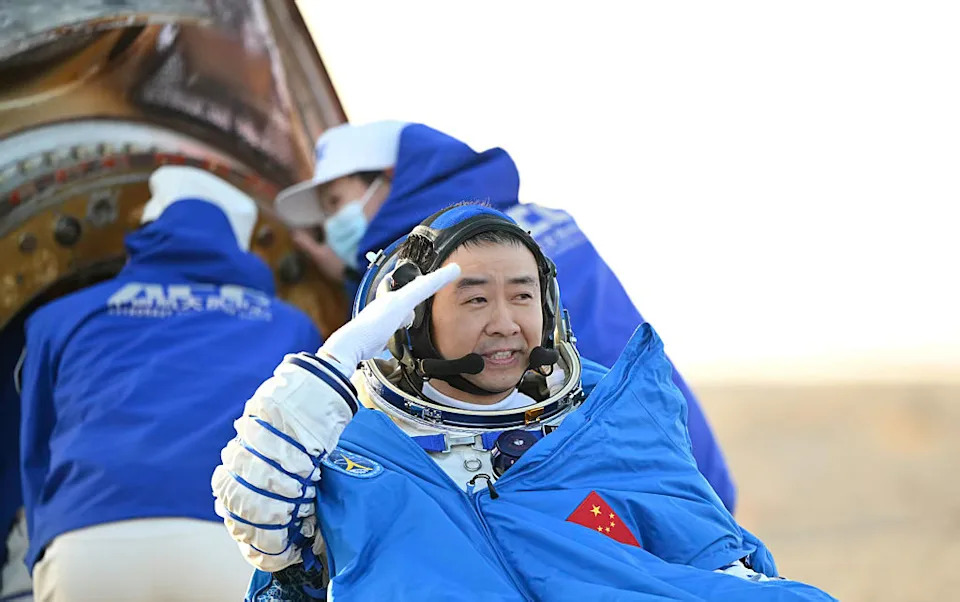
China's Shenzhou-20 commander Chen Dong salutes a crowd. | Credit: VCG/Getty Images
Why This Matters
This incident is more than a procedural footnote. It highlights how fragmented global knowledge about orbiting objects can force conservative, costly decisions. As Moriba Jah, a space debris expert and professor at the University of Texas at Austin, put it:
"A crew return was postponed because microscopic debris compromised a spacecraft window. That decision, to delay and substitute vehicles, reflects responsible risk management grounded in incomplete knowledge. It also exposes the deeper issue: our collective inability to maintain continuous, verifiable understanding of what moves through orbit."
Jah warns that each fragment left in orbit "adds to a rising tide of uncertainty." He calls that uncertainty epistemic: when uncertainty grows faster than our ability to renew knowledge, safety margins shrink. He urges the international community to adopt auditable stewardship measures — common baselines for situational awareness, interoperable information systems, and certification that favors missions reducing risk.
2025 Trends: Constellations, Abandoned Rocket Bodies, and Policy Gaps
Darren McKnight, a senior technical fellow at LeoLabs, highlighted two pressing problems this year: the rapid proliferation of large satellite constellations and the accumulation of abandoned rocket stages at high altitudes. While operators such as Starlink, Iridium, and OneWeb have taken responsible steps, other deployments — including China's "Thousand Sails" and "Guowang" payloads, according to McKnight — have added objects without sufficient coordination or transparency.
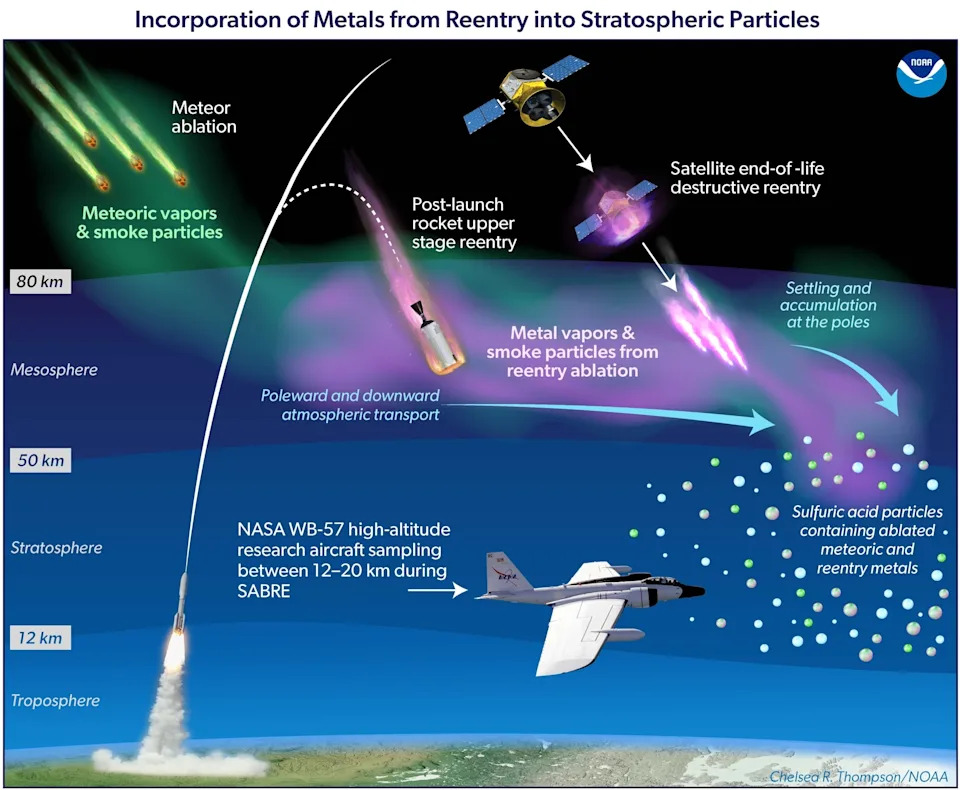
In an era of increasing global launch rates, heightened by the buckshot approach to tossing mega-satellite constellations into Earth orbit, there’s also escalating anxiety about the ramifications from reentry of defunct space hardware. | Credit: Chelsea Thompson/NOAA
McKnight noted that removing the top 10 statistically most concerning objects in low Earth orbit (LEO) could reduce the debris-generating potential there by about 30%. Yet rocket bodies continue to be left in orbits that will remain hazardous for decades, a short-term convenience that increases long-term risk. "Some operators in low Earth orbit are ignoring known long-term effects of behavior for short-term gain," he said.
Environmental Concerns and International Warnings
The United Nations Environment Programme (UNEP) has also raised alarms. In its report Safeguarding Space: Environmental Issues, Risks And Responsibilities, UNEP calls the sector's rapid growth — more than 12,000 spacecraft deployed in the past decade — an environmental challenge across atmospheric layers. The report flags concerns including launch emissions, spacecraft emissions in the stratosphere, and the atmospheric effects of debris re-entries, with potential implications for climate and stratospheric ozone.
UNEP concludes that a multilateral, interdisciplinary approach is needed to understand and manage these risks while preserving the societal benefits of space services.
What Needs To Change
Experts in 2025 called for concrete steps: better, more transparent tracking; shared, auditable situational awareness baselines; certification and incentives for debris removal and responsible behavior; and governance that aligns engineering, policy, and information ethics. Without these changes, routine near-misses could become the precursors to cascading collisions — the Kessler syndrome described by Donald Kessler and Burton Cour-Palais in 1978.
The Shenzhou-20 episode should be a wake-up call: safety in orbit depends on honesty about what we know and the will to renew and share that knowledge faster than uncertainty grows.
Help us improve.