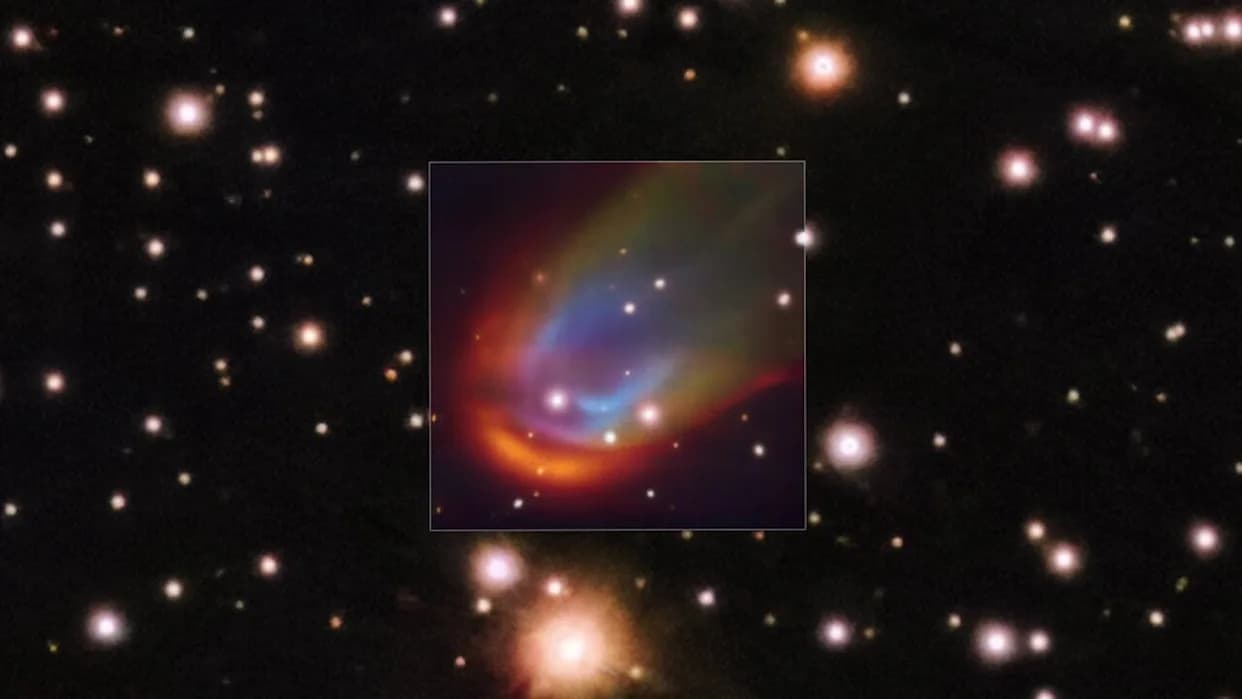
Researchers used an orbital X-ray telescope to peer into EX Hydrae, a magnetic 'vampire' white dwarf, and detected accretion columns about 2,000 miles (≈3,200 km) high and heated to millions of degrees. The columns — roughly half the star’s radius — emit X-rays that let scientists refine models of how gas is funneled onto magnetic poles in intermediate polars. The team will study other systems; understanding these accretion processes may help explain how some white dwarfs later trigger thermonuclear (Type Ia) supernovae used to measure cosmic distances.
Scientists Map 2,000-Mile X-Ray Columns Above a 'Vampire' White Dwarf

Astronomers using an orbital X-ray telescope have, for the first time, obtained a close look into the energetic heart of EX Hydrae — a magnetic “vampire” white dwarf that siphons gas from a companion star. The observations reveal towering columns of million-degree gas rising roughly 2,000 miles (~3,200 km) above the star’s magnetic poles, a structure about half the white dwarf’s radius.
White dwarfs pack roughly the Sun’s mass into a volume similar to Earth’s, producing extreme densities and powerful gravity. In binary systems where a white dwarf pulls material from a companion (called cataclysmic variables), that inflowing matter normally forms an accretion disk. When the white dwarf also has a strong magnetic field, the system becomes an intermediate polar: the magnetic field channels gas from the disk directly onto the star’s magnetic poles, producing narrow, intense accretion columns.
"If you were able to stand somewhat close to the white dwarf's pole, you would see a column of gas stretching 2,000 miles into the sky, and then fanning outward," said Sean Gunderson, a postdoctoral researcher at the Massachusetts Institute of Technology. That fountain of incandescent material is far larger than previous estimates and reaches temperatures of millions of degrees Fahrenheit, causing the curtain of plasma to emit strong X-rays.
By analyzing the X-ray emission, researchers refined physical models of how matter funnels, heats and radiates in magnetic accretion columns. The detailed measurements constrain the column’s height, temperature and geometry, improving our understanding of accretion physics in intermediate polars and other compact binaries.
"There comes a point where so much material is falling onto the white dwarf from a companion star that the white dwarf can't hold it anymore; the whole thing collapses and produces a thermonuclear supernova," said MIT astrophysicist Herman Marshall. Such supernovae (Type Ia) are bright and visible across cosmic distances and help astronomers measure the size of the universe.
Going forward, the team plans to survey other magnetic white dwarfs to see whether similarly large accretion columns are common. These observations not only illuminate the exotic environments around dying stars but may also help link accretion behavior to the conditions that trigger supernovae used as cosmic distance markers.
Help us improve.