JWST spectroscopy suggests the galaxy GHZ2 may host a supermassive black hole seen as it was about 350 million years after the Big Bang. A prominent C IV λ1548 emission line — from triply ionized carbon — is difficult to explain with stars alone and points to an active galactic nucleus (AGN). The result, posted to arXiv on Nov. 4, is preliminary and not yet peer-reviewed; follow-up JWST and ALMA observations are planned to confirm the finding.
James Webb May Have Spotted the Earliest Supermassive Black Hole — Inside Galaxy GHZ2

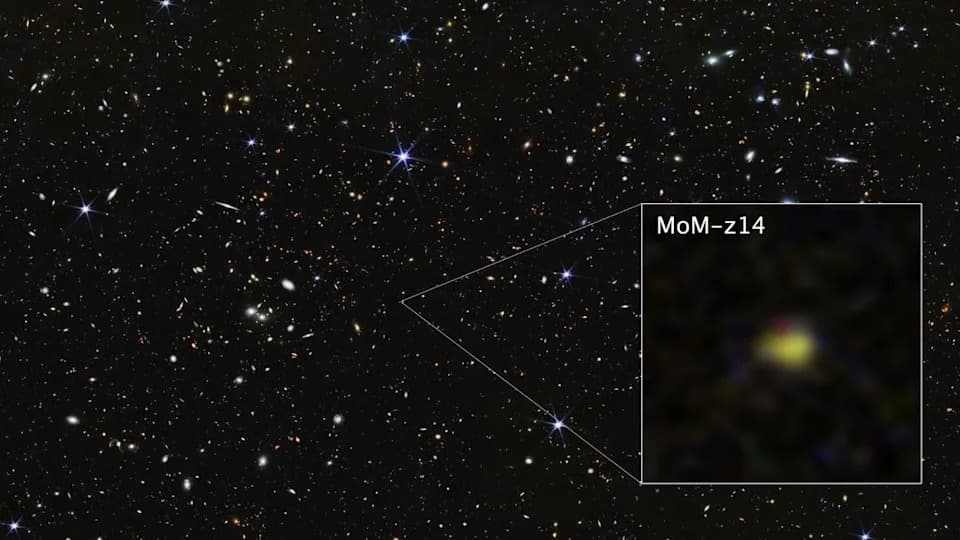
A team using the James Webb Space Telescope (JWST) reports evidence that the galaxy GHZ2 may host the most distant supermassive black hole yet observed, seen as it was roughly 350 million years after the Big Bang. The findings appear in a preprint uploaded to arXiv on Nov. 4 and have not yet completed peer review.
How the discovery was made
The authors analyzed spectroscopy from JWST's Near-Infrared Spectrograph (NIRSpec) and the Mid-Infrared Instrument (MIRI). These instruments capture a wide range of wavelengths, allowing astronomers to record ultraviolet and optical light originally emitted by GHZ2 that has been stretched into the infrared by cosmic expansion.
What points to a black hole
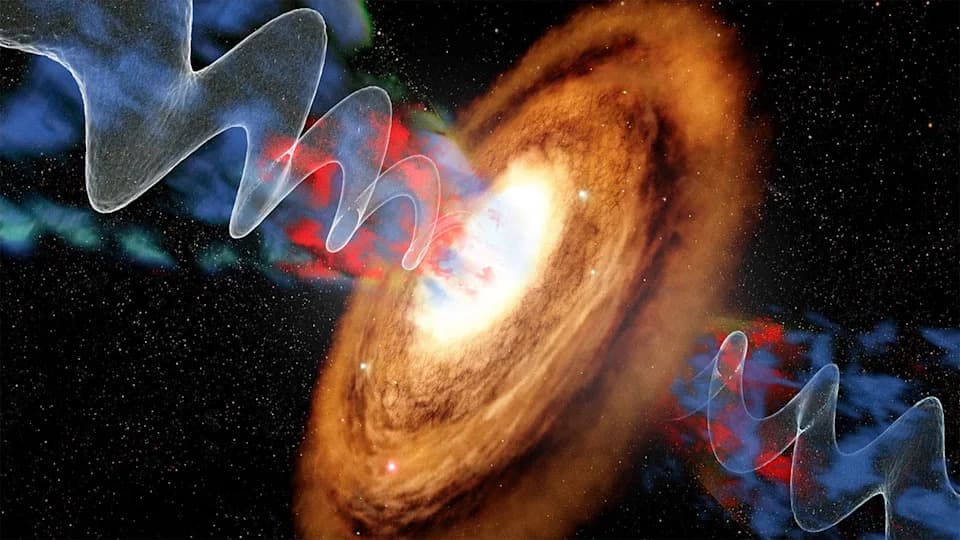
A key signature in the spectrum is a strong C IV λ1548 emission line, produced by triply ionized carbon (carbon atoms that have lost three electrons). Triply ionized carbon requires a very intense radiation field; the level of ionization observed is difficult to achieve with normal stellar populations alone and is often associated with active galactic nuclei (AGN), where radiation from an accreting supermassive black hole generates high-energy photons.
"Removing three electrons requires an extremely intense radiation field, which is very difficult to achieve with stars alone," said Oscar Chavez Ortiz, lead author and a doctoral candidate in the Department of Astronomy at the University of Texas at Austin.
Co-author Jorge Zavala, an assistant professor of astronomy at the University of Massachusetts Amherst, added that the spectrum shows pronounced high-ionization lines whose relative strengths are characteristic of AGN rather than ordinary star-forming regions.
Models and alternative explanations
Because GHZ2's emission-line pattern is unusual, the team developed detailed physical models to separate the contributions of stars and a potential AGN. Their analysis found that while many visible-light lines can be reproduced by intense star formation, the extraordinarily strong C IV line requires an additional, hard-ionizing source consistent with an AGN. That implies some fraction of GHZ2's light likely originates from a rapidly accreting supermassive black hole.
However, GHZ2 does not show every classic AGN indicator. The authors emphasize alternative interpretations remain possible: the galaxy might be dominated by very massive, atypical stars (hundreds to thousands of times the Sun's mass), or by a mixture of normal stars and exotic objects such as supermassive stars, with only a faint AGN contribution.
Why this matters
Detecting AGN activity in a galaxy observed just a few hundred million years after the Big Bang would provide a rare laboratory for testing competing theories of early black hole formation. Two broad scenarios are under consideration: "light seeds" — small initial black holes that grow extremely quickly — and "heavy seeds" — massive initial seeds that give black holes a head start.
Next steps
The team plans follow-up observations to test the AGN interpretation. Higher-resolution JWST spectra targeting selected emission lines would refine ionization diagnostics, and complementary observations with the Atacama Large Millimeter/submillimeter Array (ALMA) covering far-infrared lines could provide independent constraints and improved sensitivity.
If confirmed, GHZ2 would host the most distant known supermassive black hole, offering direct insight into how black holes and galaxies formed and grew in the universe's first few hundred million years.
Help us improve.