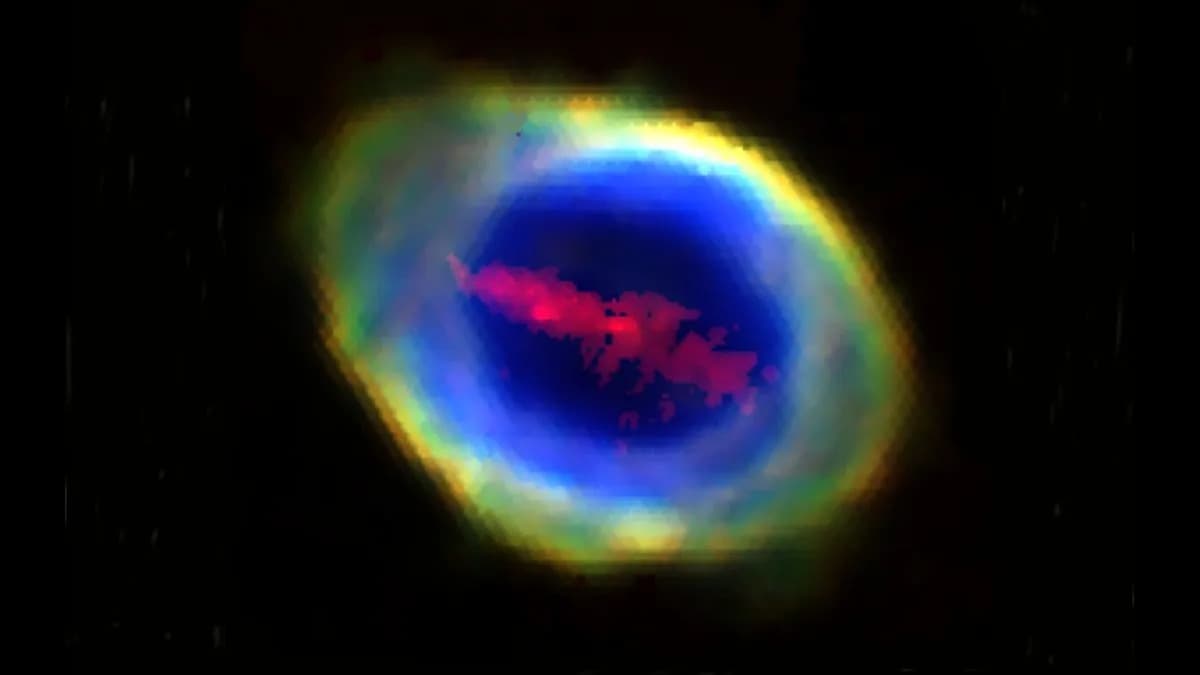
A luminous 20‑light‑year‑wide ring of ionized carbon has been identified about 4,500 light‑years away in the Cygnus X region. Shared on Nov. 17, 2025, the structure formed when a massive star inflated a bubble inside a flattened molecular cloud; the bubble is roughly 400,000 years old. The bright "diamond" visible on the loop is an unrelated object several hundred light‑years closer and only aligned by chance. The image comes from NASA's SOFIA infrared archive, which continues to produce discoveries after the observatory's 2022 retirement.
Giant 'Diamond Ring' of Ionized Carbon Shimmers 4,500 Light‑Years Away in Cygnus

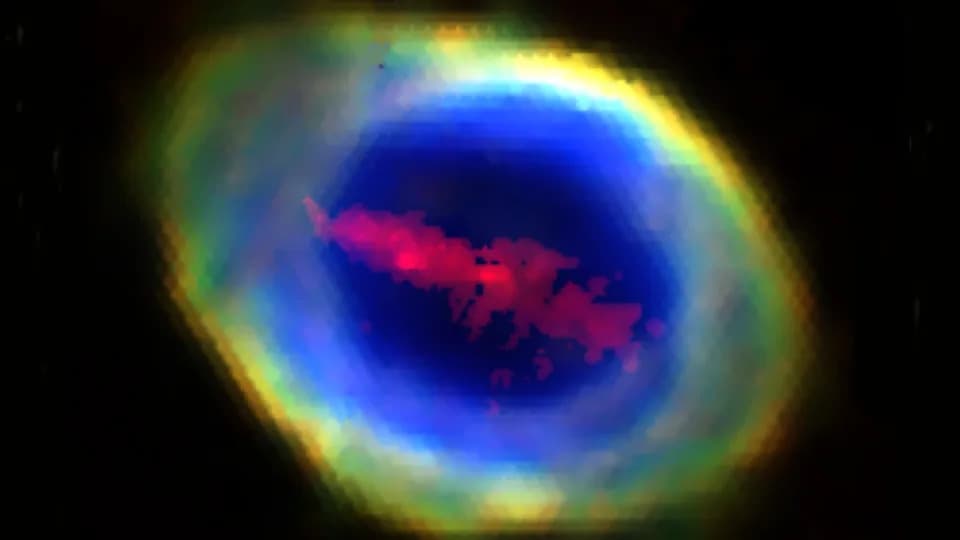
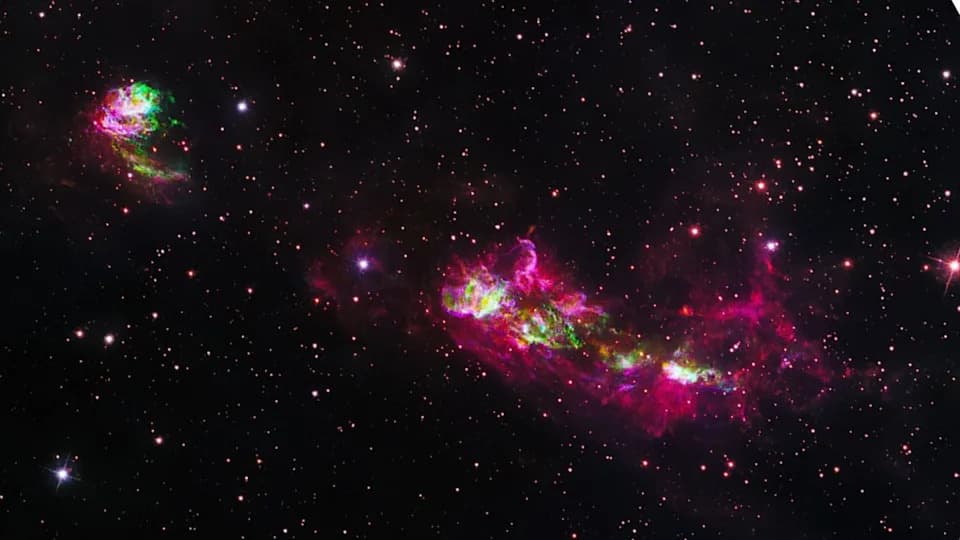
This striking infrared image reveals a luminous loop of gas and dust — nicknamed a "diamond ring" — about 4,500 light‑years away in the Cygnus X star‑forming region. Spanning roughly 20 light‑years across, the structure is the remnant of an expanding bubble of ionized carbon carved by a hot, massive star. The image and analysis were shared on Nov. 17, 2025.
What we're seeing
The loop appears as a circular shell with a bright clump on one side that looks, at first glance, like a gemstone set into a band. In reality, the bright "diamond" is an unrelated compact object lying a few hundred light‑years closer to us; its alignment with the ring is a chance projection along the line of sight.
How the ring formed
The ring is about 400,000 years old — very young compared with the multi‑million‑year lifetimes of massive stars. It originated when intense ultraviolet radiation and strong stellar winds from a massive, hot star pushed outward, ionizing carbon and inflating a bubble inside a flattened molecular cloud. Because the bubble expanded within a flattened, dense cloud rather than a uniform medium, it lost perfect spherical symmetry and eventually ruptured, producing the irregular ring shape we now observe.
Why it matters
Structures like this illustrate how a single massive star can sculpt its surroundings across tens of light‑years, affecting where and how new stars form in the parent cloud. Observing such early feedback helps astronomers connect stellar activity to the broader evolution of star‑forming regions in our galaxy.
"The 'diamond ring' is a prime example of how enormous the influence of individual stars can be on entire cloud complexes," said Nicola Schneider, co‑author of the study published Nov. 17, 2025, in Astronomy and Astrophysics. "Such processes are crucial for understanding the formation of stars in our Milky Way."
About the image
The photograph comes from the archive of NASA's Stratospheric Observatory for Infrared Astronomy (SOFIA), a 2.7‑meter (106‑inch) telescope mounted in a Boeing 747SP that flew at roughly 45,000 feet (13,700 meters) — above about 99% of Earth's atmosphere — to capture infrared wavelengths inaccessible from the ground. SOFIA operated from 2010 until its retirement in September 2022; its extensive infrared archive continues to yield new discoveries as astronomers reexamine the data.
Though astronomers also use the phrase "diamond ring" to describe a brief sunlight flash during a total solar eclipse, the resemblance here is purely visual: the physical processes behind the cosmic ring and the eclipse event are entirely different.
For observers and enthusiasts, this image is a vivid reminder of the scale at which stars shape their birth environments and a valuable data point for understanding star formation across the Milky Way.
Help us improve.