Star J0705+0612, about 3,000 light-years away, dimmed by a factor of 40 for nine months after being occulted by a cloud roughly 120 million miles across. Spectroscopy with Gemini South's GHOST instrument shows the cloud is composed of vaporized metals such as iron and calcium and is gravitationally bound to an unseen companion of at least several Jupiter masses. The gas motions were mapped in three dimensions — the first such measurement for a disk around a secondary object — and the cloud may have formed from a catastrophic planetary collision. Results published Jan. 21 in The Astronomical Journal.
120-Million-Mile Cloud Of Vaporized Metals Tied To An Unseen Massive Companion
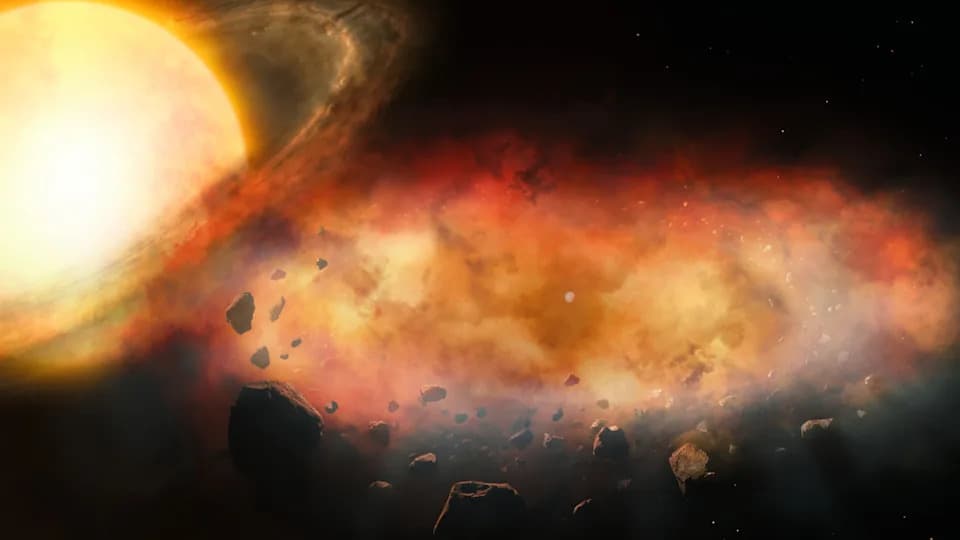
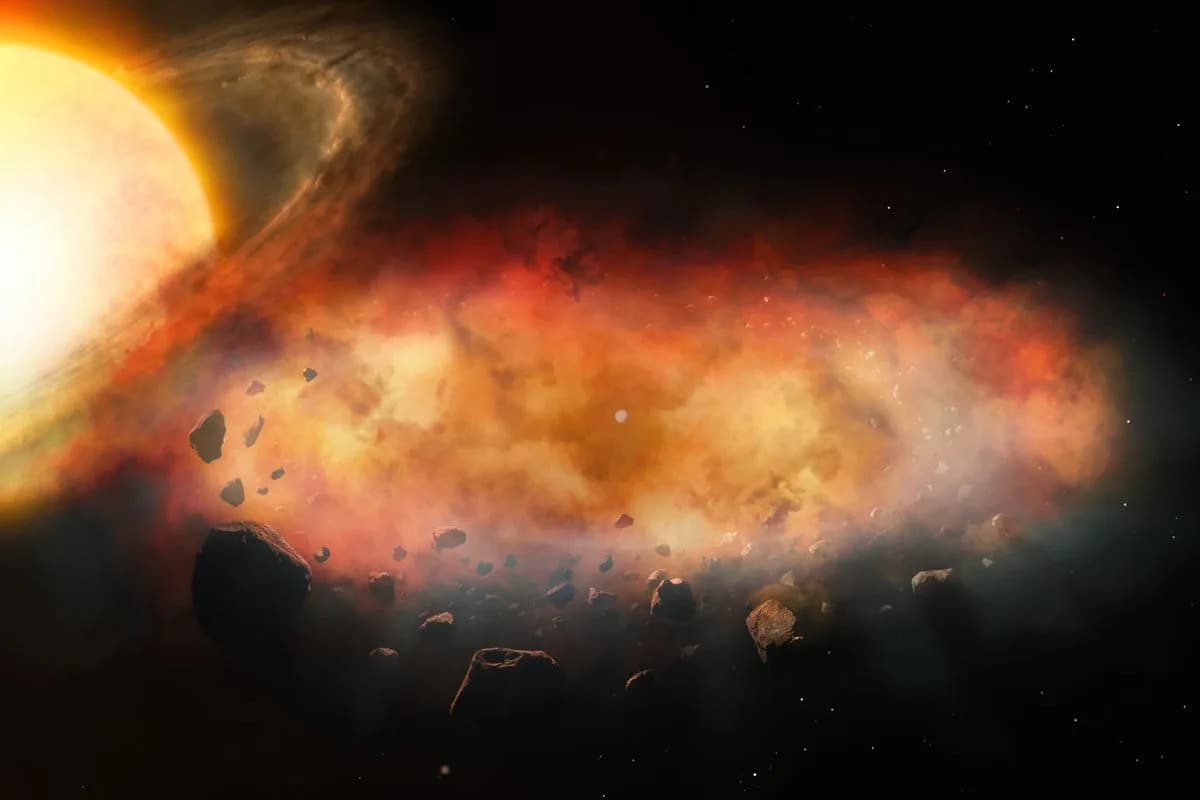
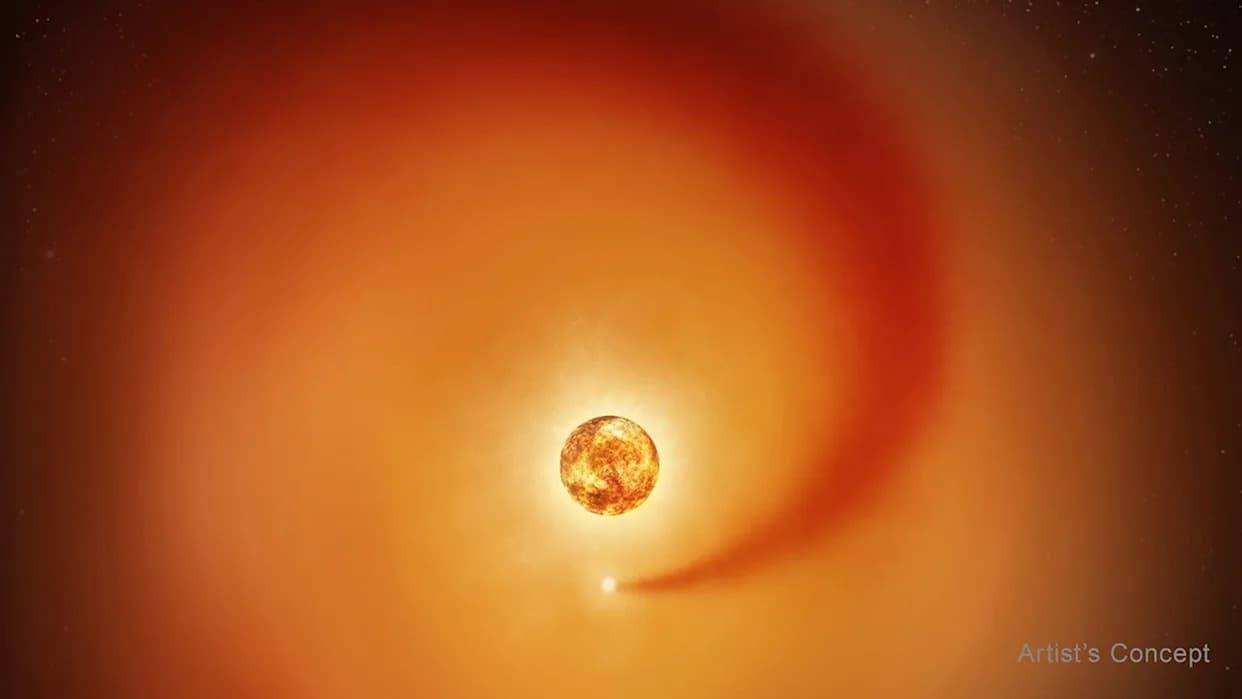
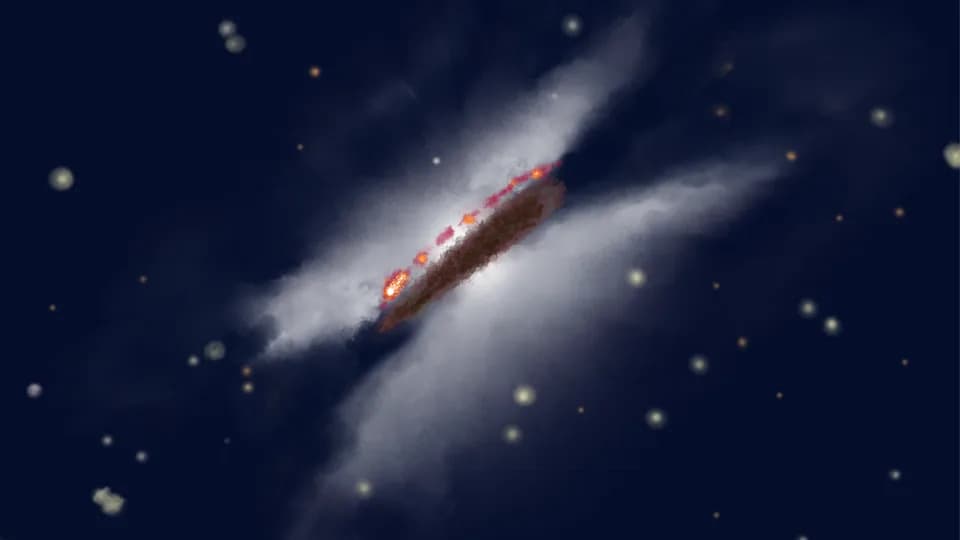
Illustration shows a disk of planetary debris and its shroud of gas and dust passing in front of a star. | Credit: International Gemini Observatory/NOIRLab/NSF/AURA/P. Marenfeld & M. Zamani
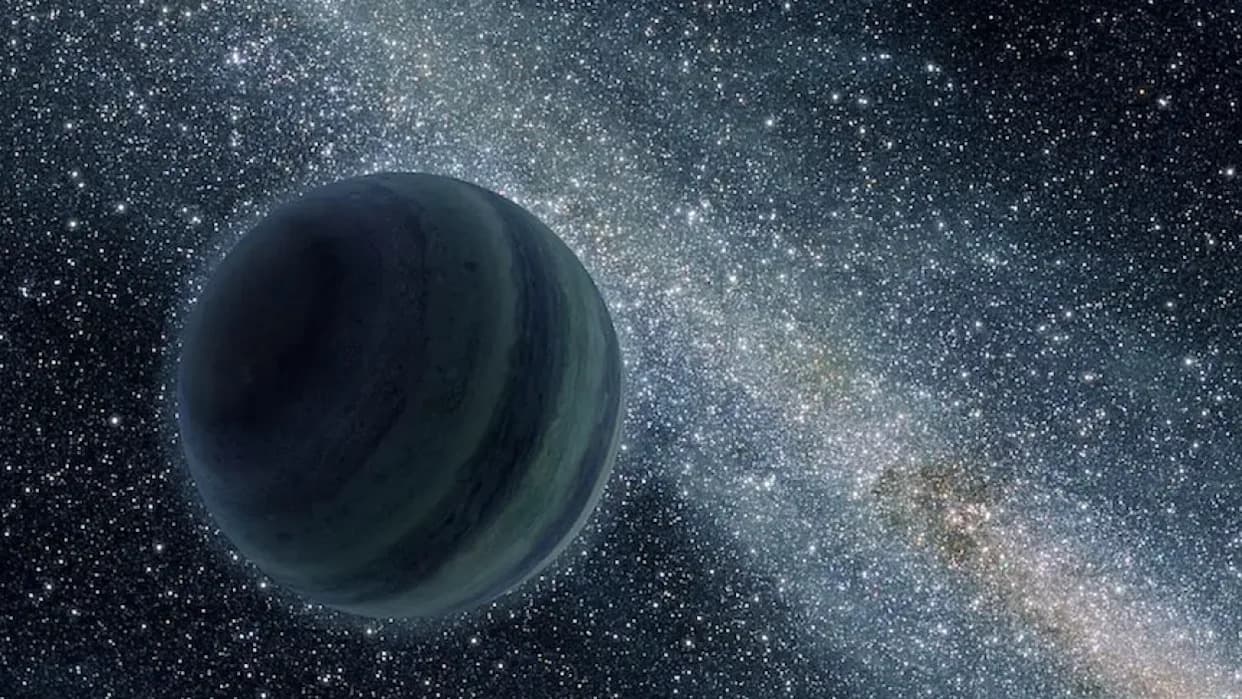
A huge, slow-moving cloud of vaporized metals temporarily blocked the light from a distant sun-like star, and astronomers have now discovered that the cloud is gravitationally bound to an unseen, very massive companion — either a giant planet or a low-mass star.
The star, designated J0705+0612 and located roughly 3,000 light-years away, dimmed by about a factor of 40 in September 2024 and remained faint for nine months before returning to normal brightness in May 2025. Such dramatic, long-lasting occultations are extremely rare and immediately caught the attention of researchers.
Observations and Size
Using new observations from Gemini South on Cerro Pachón (Chile), the Apache Point Observatory 3.5-meter telescope, the 6.5-meter Magellan Telescopes, and archival data, the team concluded that J0705+0612 had been occulted by a vast cloud of gas and dust. The cloud's diameter is estimated at roughly 120 million miles (about 200 million kilometers) — roughly 15,000 times the diameter of Earth. When it caused the dimming, the cloud was located about 1.2 billion miles (2 billion kilometers) from the star, a distance of roughly 13 astronomical units (AU).
A Mystery Companion
Analysis shows the cloud is gravitationally bound to another object orbiting the same star. To keep such a large cloud intact, that companion must have at least several times the mass of Jupiter; it could be substantially more massive, making it either a low-mass star with a circumsecondary disk or a massive planet with a circumplanetary disk. Observing either type of disk occult a star is exceptionally uncommon.
Chemical Makeup And Motion
To determine the cloud’s composition, the researchers used the Gemini High-resolution Optical Spectrograph (GHOST) on Gemini South and obtained two hours of spectroscopy while the cloud was in front of the star. The spectra revealed the cloud is rich in elements heavier than hydrogen and helium — astronomers' so-called "metals" — including iron and calcium.
"When I started observing the occultation with spectroscopy, I was hoping to learn something about the chemical composition of the cloud," said Johns Hopkins astronomer Nadia Zakamska. "The result exceeded all my expectations."
Thanks to GHOST's sensitivity, the team was able to map the metallic gas flows in three dimensions and measure internal gas motions — the first time astronomers have measured these detailed velocity structures in a disk bound to a secondary object such as a planet or low-mass star. The measured velocities show the cloud moves independently of the primary star, strengthening the conclusion that it orbits a secondary companion in the outer system.
Origin Hypotheses
The researchers suggest the cloud may have formed when two planets in the system collided, vaporizing and scattering rock, dust and gas. While giant impacts are common in young, chaotic systems, they are unexpected in a system estimated to be about 2 billion years old. If confirmed, this event demonstrates that large-scale collisions — and their dramatic consequences — can still occur in mature planetary systems.
Publication: The team's results were published on Jan. 21 in The Astronomical Journal.
Help us improve.