Using JWST and Chandra, astronomers have identified JADES‑ID1, a protocluster seen less than a billion years after the Big Bang that hosts at least 66 young galaxies and an X‑ray–bright intracluster medium. The system’s mass is estimated at about 2 × 10¹³ solar masses, mostly dark matter. Its early X‑ray signature appears roughly two billion years earlier than the previous record, challenging standard formation models. Scientists call for more detections and next‑generation X‑ray telescopes to determine whether theory needs revision.
Astronomers Spot 'Baby' Galaxy Cluster JADES‑ID1 — A Cosmic Puzzle Less Than 1 Billion Years After the Big Bang
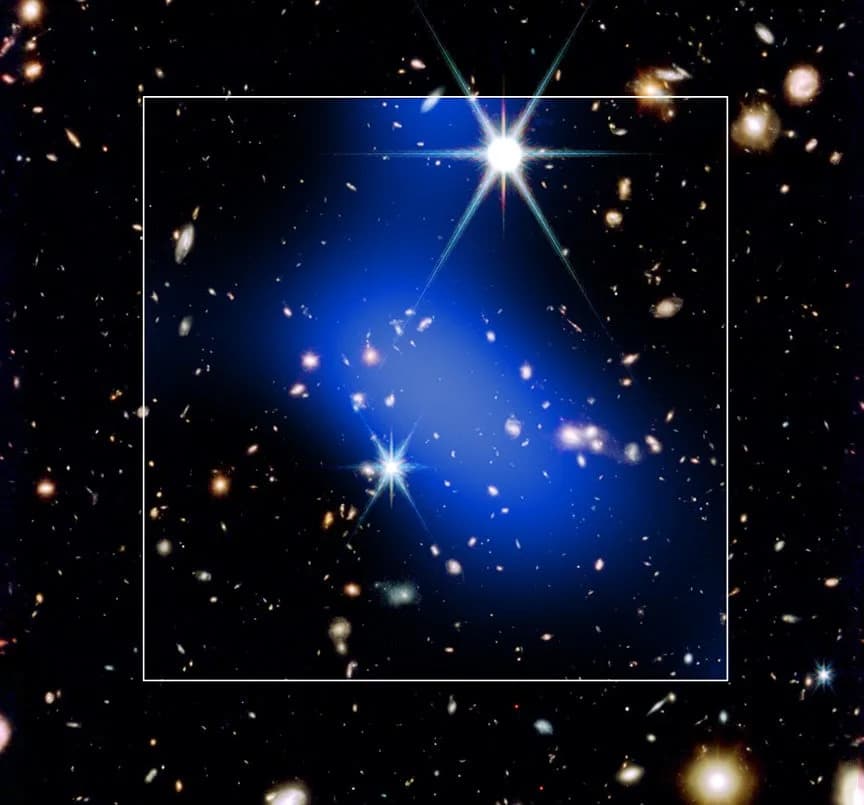
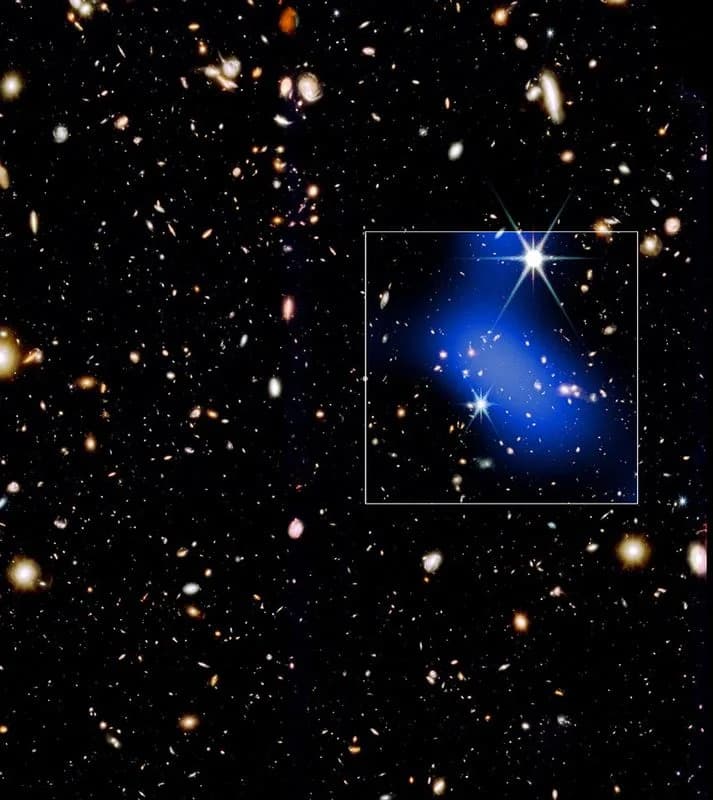
A composite infrared and x-ray image of JADES-ID1, a growing protocluster of galaxies seen about a billion years after the big bang. The white box shows the view of the Chandra X-ray Observatory (blue) overlaid on an infrared image from the James Webb Space Telescope.(X-ray: NASA/CXC/CfA/Á Bogdán; Infrared: NASA/ESA/CSA/STScI; Image Processing: NASA/CXC/SAO/P. Edmonds and L. Frattare)
Astronomers have identified an unusually mature "baby" galaxy cluster, called JADES‑ID1, in the very early universe — less than a billion years after the Big Bang. Combining deep imaging from the James Webb Space Telescope (JWST) with X‑ray observations from NASA’s Chandra X‑ray Observatory, researchers report a compact protocluster that is larger and more developed at this epoch than most standard models readily predict. The results were published last week in Nature.
What Was Observed
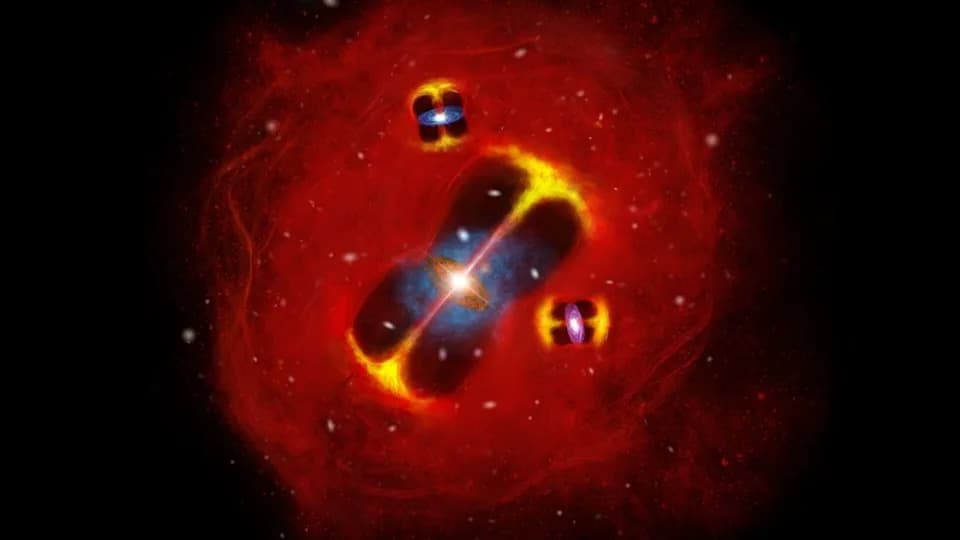
JWST data show the region contains at least 66 young galaxies, while the new analysis estimates the system’s total mass at roughly 2 × 10¹³ solar masses (about 20 trillion times the mass of the Sun), most of which is dark matter. Crucially, Chandra detected an extended, X‑ray–bright cloud of hot gas — the intracluster medium — which is normally associated with more mature, gravitationally relaxed galaxy clusters.
“JADES‑ID1 is really the youngest cluster with an X‑ray‑emitting atmosphere,” says lead author Ákos Bogdán of the Center for Astrophysics | Harvard & Smithsonian.
Why This Matters
A hot, X‑ray‑emitting intracluster medium usually signals a well‑established gravitational well where infalling gas is shock‑heated to millions of degrees. Finding this signature so early — about two billion years earlier than the previous record for an X‑ray‑bright protocluster — challenges expectations from many structure‑formation models. If JADES‑ID1 continued to grow at the inferred rate, it might evolve into an unusually massive cluster in the present‑day universe.
However, theorists urge caution. Simulations from recent years show that some protoclusters can develop X‑ray atmospheres early but then slow their growth as they exhaust nearby gas reservoirs. That scenario would make JADES‑ID1 less anomalous. Other experts note that detecting such faint, distant X‑ray emission pushes Chandra to its limits, and better sensitivity will help confirm these findings.
Next Steps
Researchers emphasize the need for more examples and larger samples of early protoclusters to determine whether JADES‑ID1 is a rare outlier or evidence of a gap in current theory. Future X‑ray missions combining Chandra‑like angular resolution with substantially greater sensitivity will be key to resolving the puzzle.
Bottom line: JADES‑ID1 is a compelling, well‑documented early‑universe protocluster whose X‑ray and JWST signatures push the frontier of observed structure formation. Whether it forces major revisions to cosmological models remains an open question that future observations must address.
Help us improve.