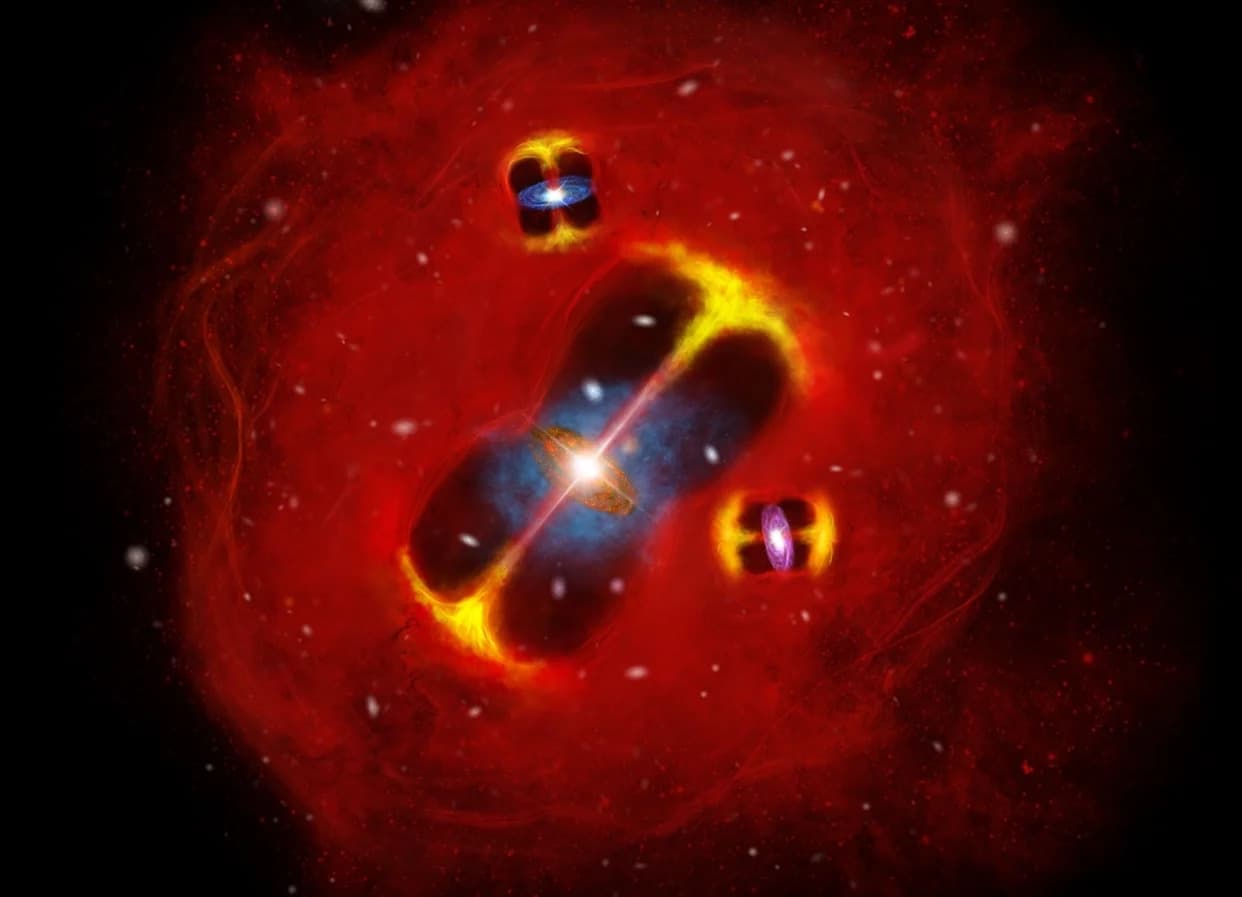
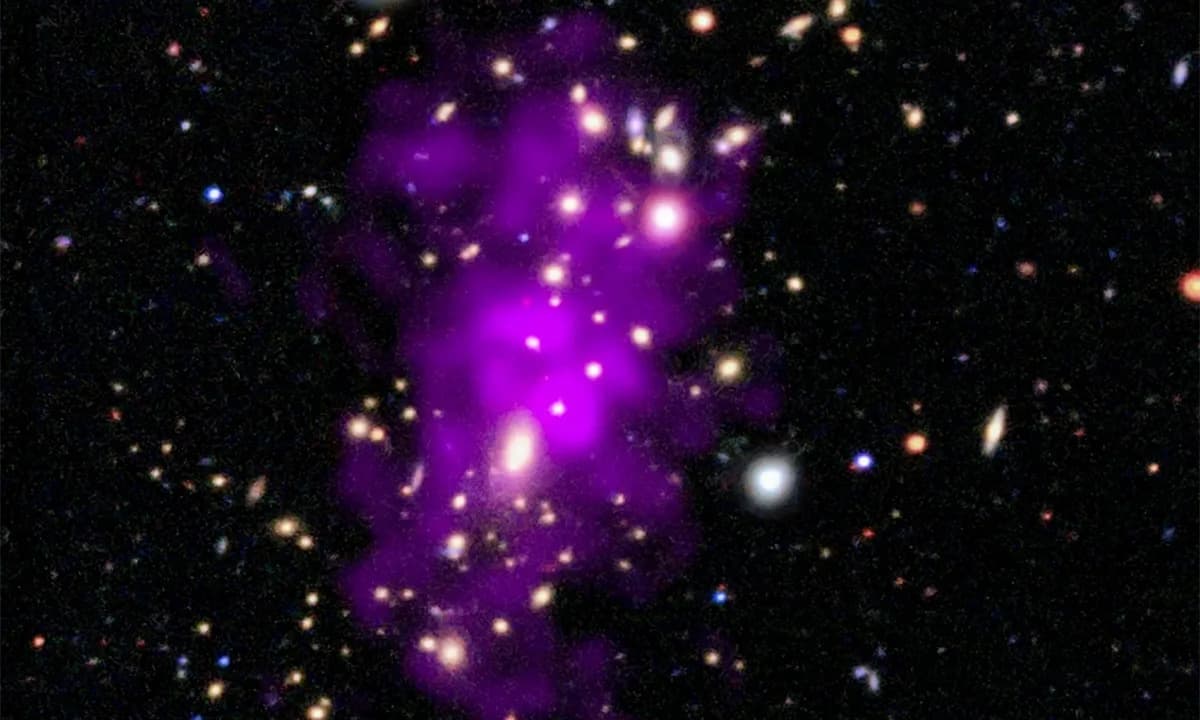
Researchers at the Leibniz Institute for Astrophysics Potsdam used multi-scale simulations to explain puzzling features of 'radio relics' — vast radio arcs produced by shocks in merging galaxy clusters. Their models show that interactions with infalling cold gas and small clumps create turbulence that strongly amplifies magnetic fields and produces localized, highly efficient particle accelerators. This resolves why radio observations highlight bright patches while X-rays measure lower average shock strengths. The study is accepted to Astronomy & Astrophysics and posted to arXiv on Nov. 18.
How Cosmic Collisions Forge Ghostly 'Radio Relics' — New Simulations Solve Long-Standing Puzzles

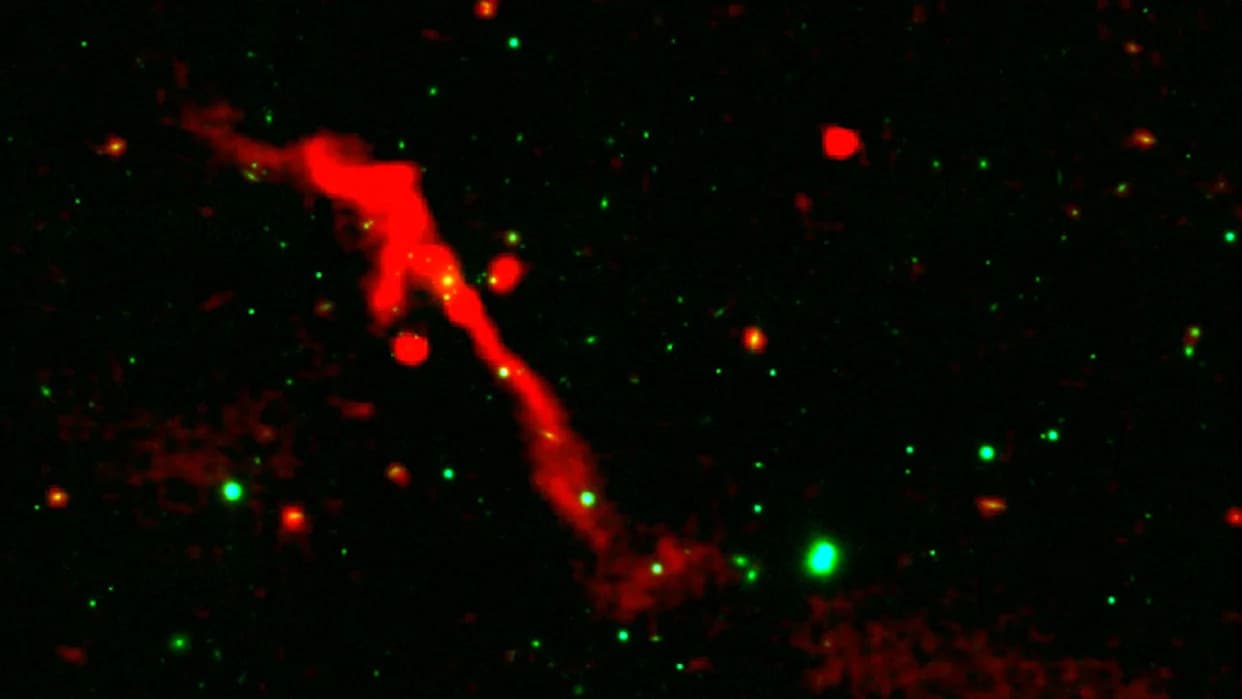
On the largest scales, collisions between galaxy clusters create enormous, ghostlike arcs of diffuse radio emission that can span millions of light-years. These structures, known as 'radio relics', arise when shock waves from cluster mergers accelerate electrons to near-light speeds and thread the intracluster plasma with magnetic fields.
A new study led by Joseph Whittingham of the Leibniz Institute for Astrophysics Potsdam (AIP) uses a multi-scale simulation approach to reproduce and explain several puzzling observational features of radio relics. The team combined cosmological cluster-merger simulations with very high-resolution 'shock-tube' runs to follow a single shock front as it encounters the clumpy, turbulent outskirts of a galaxy cluster.
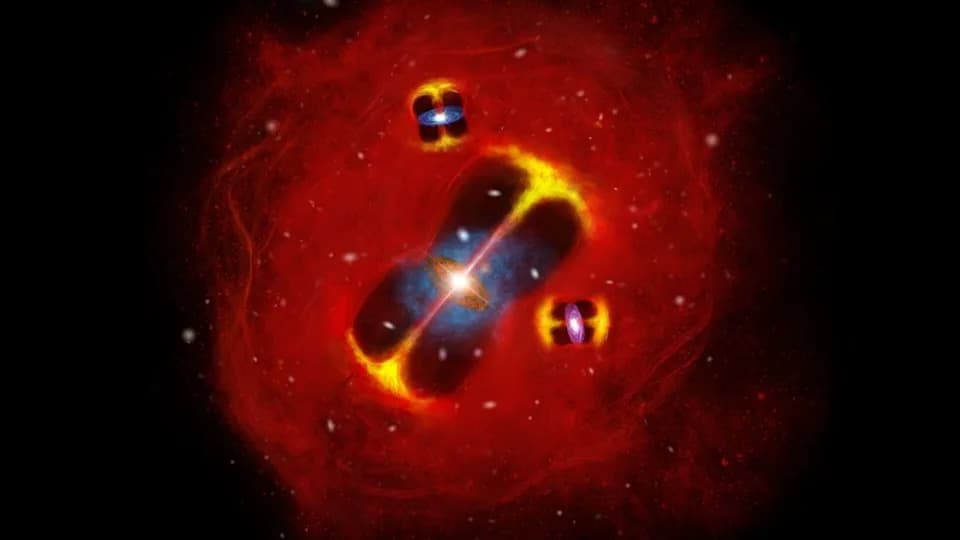
The simulations show that as an outward-moving merger shock meets shocks driven by cold gas accreting from the cosmic web, the plasma is compressed into dense sheets. Those sheets then collide with smaller gas clumps, producing a chaotic, turbulent region that amplifies magnetic fields far beyond what a single, smooth shock would produce. The amplified fields reach strengths consistent with unexpectedly large values seen in X-ray and radio observations.
'Key to our success was tackling the issue using a range of scales,' said Joseph Whittingham, the study's lead author.
Crucially, the models also explain long-standing discrepancies between radio- and X-ray-based measurements of shock strength. When a shock sweeps across dense clumps, parts of the shock front become locally enhanced and much more efficient at accelerating electrons. These bright, compact patches dominate the radio emission, while X-ray telescopes typically measure the shock's average properties — including its weaker regions. As a result, radio estimates emphasize the most intense, localized accelerators while X-rays return lower mean strengths.
'The whole mechanism generates turbulence, twisting and compressing the magnetic field up to the observed strengths, thereby solving the first puzzle,' said Christoph Pfrommer, co-author of the study.
Because only the strongest, localized portions of the shock produce most of the radio emission, the relatively low average shock strengths inferred from X-rays do not contradict the particle acceleration that makes relics visible in radio wavelengths. Taken together, the team's multi-scale simulations successfully reproduce the magnetic, radio, and X-ray signatures of observed relics and resolve several long-standing puzzles about their origin.
The results appear in a paper accepted to Astronomy & Astrophysics and posted to the preprint server arXiv on Nov. 18. The authors say this success motivates further studies to address remaining questions about relic variability, particle acceleration microphysics, and how relics evolve over time.
Help us improve.