Opinion: President Trump’s proposed one-time $5,000 payment to every adult would add more than $1 trillion to the deficit and could worsen inflation and interest-rate pressures. The columnist argues that prominent democratic socialist proposals — estimated by some analysts to cost tens of trillions over a decade — present comparable or greater long-term fiscal risks. Census Bureau data showing record median household income and falling poverty rates complicate the case for broad, expensive payouts. Voters should weigh short-term political promises against lasting economic consequences as Election Day nears.
Both Trump And Democratic Socialists Are Trying To Buy Votes — And Both Pose Fiscal Risks
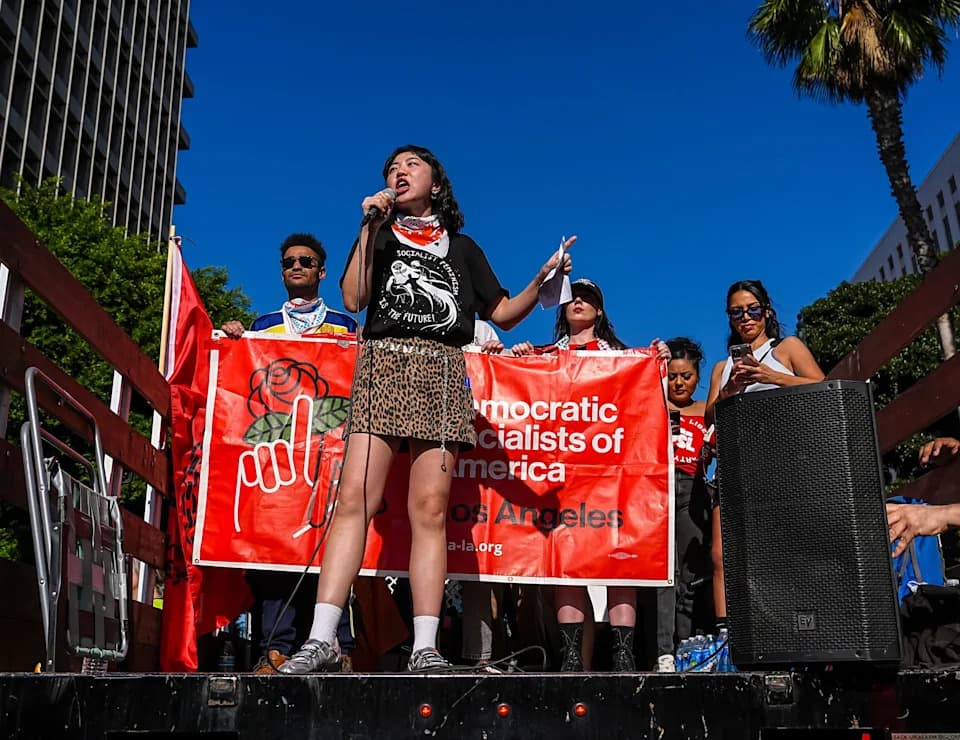
Democratic Socialists of America's Leslie Chang addresses a general strike in Los Angeles on Jan. 30, 2026.
President Donald Trump's proposal to issue a one-time $5,000 "dividend" to every American adult has drawn sharp criticism — even from some of his usual allies — and highlights a broader debate about the role of government spending in election-season pitchbooks.
What The Proposal Would Do
Trump's $5,000 Payment: Analysts estimate the plan would add more than $1 trillion to the federal deficit, potentially stoking inflationary pressure and contributing to higher interest rates amid a national debt that approaches $40 trillion. Critics call it a politically timed payout designed to win votes rather than address long-term fiscal priorities.
Where Democratic Socialists Fit In
Comparable Fiscal Concerns: The columnist argues that prominent democratic socialist proposals — such as universal health care and reparations — also carry very large price tags. The libertarian Cato Institute, for example, has estimated core democratic socialist proposals could cost at least $71 trillion over the next decade. Democratic socialists say they would fund these programs largely through higher taxes on wealthy individuals and corporations, but skeptics warn higher tax receipts may not fully cover the long-term costs.

President Donald Trump campaigns for Republican U.S. Senate candidate Michael Whatley in Gastonia, North Carolina, on Sept. 16, 2026.
Data That Complicates The Debate
Recent Census Bureau data suggests many families are financially better off than they were in earlier years. In 2025, median household income reached a record $87,460. Median income rose 4.8% for Black households and 3.0% for White households. The national poverty rate fell to 10.2%, a 19.7% decline since 2016, while child and Hispanic poverty rates hit record lows. These indicators are used to argue that a universal $5,000 payout may be unnecessary for many households.
"While President Trump's payout is a short-term, politically charged fix, I believe sweeping democratic socialist policies could carry deeper, longer-lasting economic risks," writes Tim Swarens, former deputy opinion editor of USA TODAY.
Bottom Line
The column frames both Trump’s one-time dividend and the democratic socialist agenda as forms of election-season buyoffs that risk undermining fiscal stability. It urges voters to weigh immediate political incentives against long-term economic consequences as Election Day approaches.
About the author: Tim Swarens is a former deputy opinion editor of USA TODAY and former opinion editor of The Indianapolis Star.
Help us improve.