On December 27, 2022, NASA’s Juno spacecraft observed the most powerful volcanic eruption recorded beyond Earth when multiple vents on Jupiter’s moon Io erupted simultaneously, producing an estimated 140–260 terawatts over roughly 40,400 square miles. Juno’s JIRAM instrument detected a primary 400 km hot region and many nearby hotspots that brightened by more than 1,000×, despite parts of the detector saturating. Researchers propose a sponge-like network of magma pockets beneath Io that may explain the coordinated activity and estimate the event could have produced ~100 cubic kilometers of lava.
NASA Captures Most Powerful Volcanic Eruption Beyond Earth — Massive, Coordinated Eruptions Rock Jupiter’s Moon Io
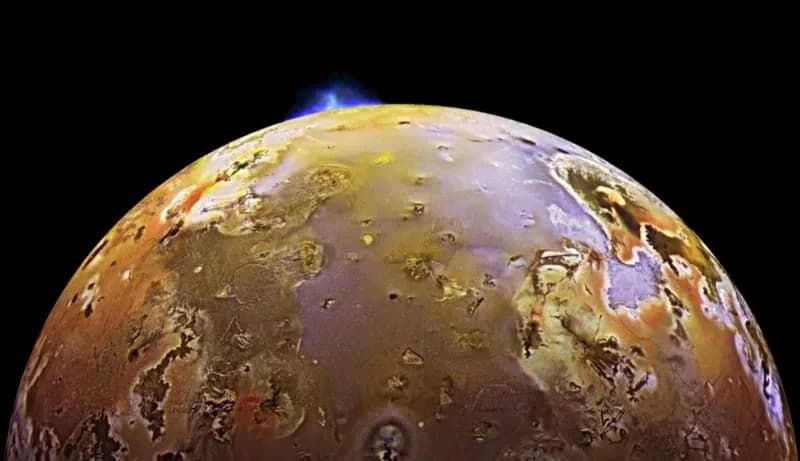
NASA’s Juno spacecraft captured the most powerful volcanic eruption ever seen on Jupiter’s moon Io. (CREDIT: NASA / JPL / University of Arizona)
NASA’s Juno spacecraft recorded the most powerful volcanic eruption observed outside Earth on December 27, 2022, when multiple vents on Jupiter’s moon Io erupted simultaneously, releasing vastly more energy than any previously measured event in the solar system.
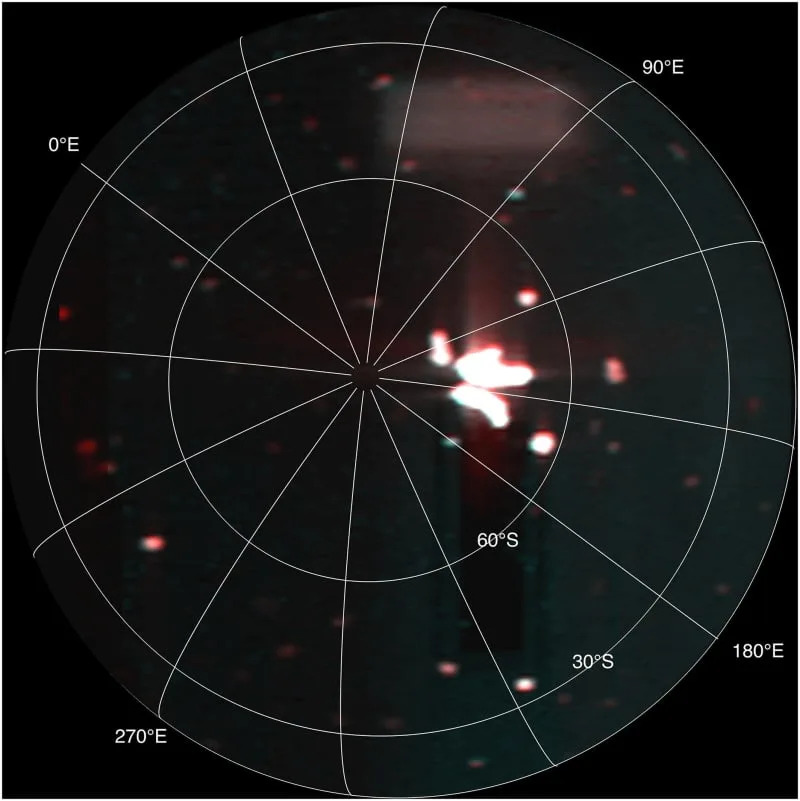
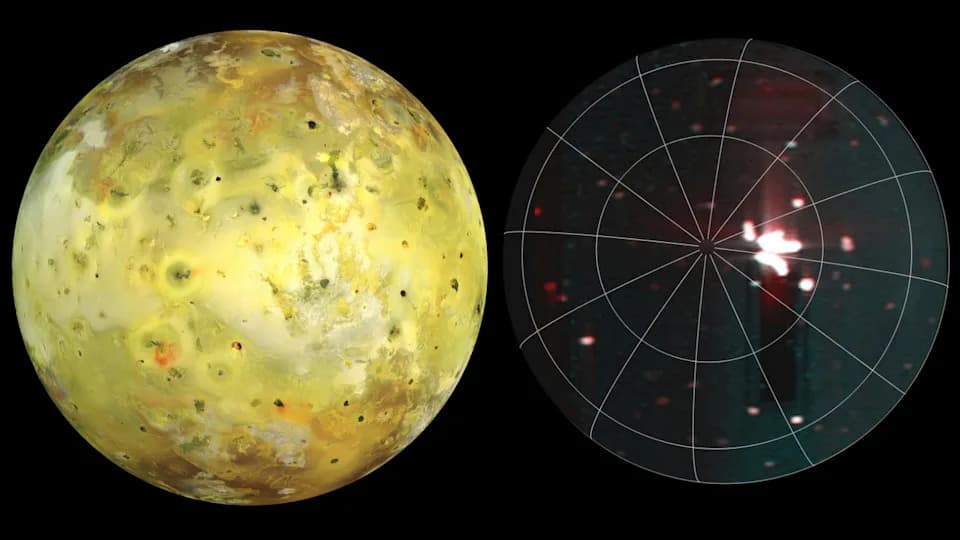
A massive hotspot — larger the Earth’s Lake Superior — can be seen just to the right of Io’s south pole in this annotated image taken by the JIRAM infrared imager aboard NASA’s Juno on Dec. 27, 2024, during the spacecraft’s flyby of the Jovian moon. (CREDIT: NASA/JPL-Caltech/SwRI/ASI/INAF/JIRAM
What Juno Saw
During one of its closest flybys—about 46,200 miles (74,400 km) above Io—Juno’s Jovian Infrared Auroral Mapper (JIRAM) detected intense thermal emissions from a cluster of eruptions. The combined eruptive area covered roughly 40,400 square miles (≈105,000 km²) and produced an estimated 140–260 terawatts of power, far exceeding the ~52 terawatts estimated for the 1980 Mount St. Helens eruption on Earth.
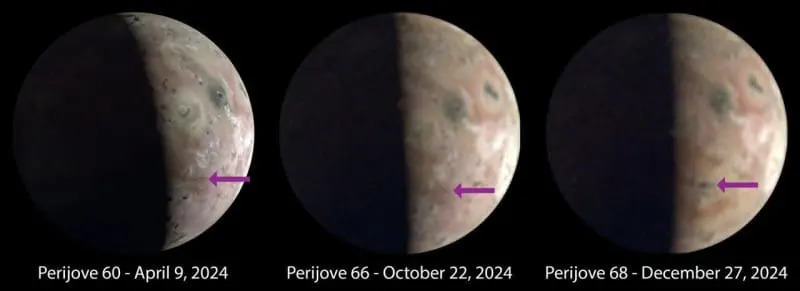
Images of Io captured in 2024 by the JunoCam imager aboard NASA’s Juno show significant and visible surface changes (indicated by the arrows) near the Jovian moon’s south pole. These changes occurred between the 66th and 68th perijove, or the point during Juno’s orbit when it is closest to Jupiter. (CREDIT: NASA/JPL-Caltech/SwRI/MSSS Image processing by Jason Perry)
Data Challenges and Analysis
Thermal signals were so strong that portions of the JIRAM detector saturated. Researchers overcame this by using additional spectral measurements and by analyzing stray-light patterns on the instrument to reconstruct temperature and pressure values. Those efforts revealed a primary hot region about 400 kilometers long that remained hot throughout the observation window, plus numerous nearby hotspots that brightened by more than 1,000× compared with typical activity.
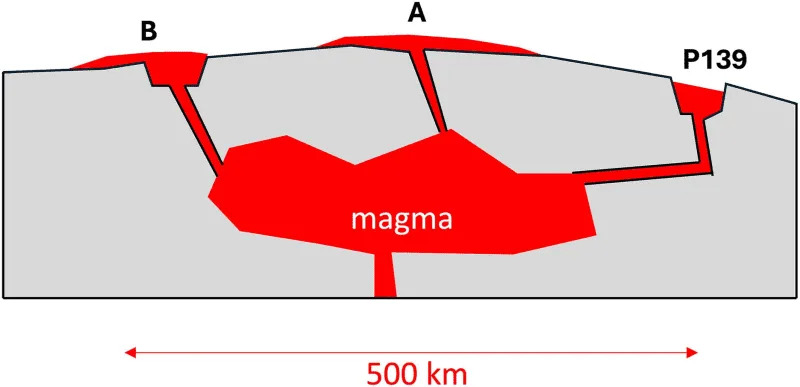
Conceptual cross-section showing the proposed subsurface magma chamber system. A large, interconnected magma reservoir (red) feeds surface eruptions at Features A, B, and P139. (CREDIT: Journal of Geophysical Research: Planets)
“It is also notable that this eruption occurred simultaneously from multiple active sources; as such, the eruption increased its brightness by over 1,000 times from what would be expected in typical conditions,” said Dr. Alessandro Mura of the National Institute for Astrophysics (INAF).
What This Means for Io’s Interior
The spatial pattern—some vents in the same region erupting while adjacent ones remained quiet—suggests that certain volcanoes may be linked by shared subsurface magma pathways while others draw from isolated reservoirs. The INAF-led team proposes a “sponge-like” network of molten pockets beneath Io’s crust. A sudden pressure change or rapid magma surge through that network could have triggered the coordinated eruptions across distances of hundreds of kilometers.
Io’s prodigious volcanism is driven by tidal heating: Jupiter’s gravity flexes Io’s interior on every orbit, generating heat that melts rock to magma. Scientists describe parts of Io’s system as a heat-pipe, where magma continually rises, erupts, cools, and then sinks—helping keep the moon’s interior hot and shaping its dramatic landscapes.
Scale, Duration, and Future Observations
Based on thermal intensity and extent, researchers estimate the event may have lasted several days and could have produced on the order of 100 cubic kilometers of lava—enough to reshape large swaths of Io’s surface. Future Juno flybys should reveal fresh lava flows, ash deposits, and altered volcanic landforms; some vents may appear dramatically changed after this episode.
Broader Significance
The discovery provides an important clue about how magma migrates through the crusts of tidally heated, rocky bodies and helps improve models of heat transport and volcanic activity on other worlds, including implications for understanding volcanic hazards on Earth. The full results are published in the Journal of Geophysical Research: Planets.
Help us improve.