Researchers using Finite Element Limit Analysis find that Venus could support large lava tubes, with widths of several hundred meters and possibly up to 0.62 miles (≈1.0 km), thanks in part to the planet's ~91% Earth gravity. These structures would help explain observed channel sizes and shed light on Venusian volcanism. The team calls for higher-resolution imaging and geophysical missions to search for pit chains, skylights, and other subsurface signs, though thick clouds and funding uncertainties complicate such searches.
Scientists Say Venus May Hide Massive Lava Tubes Beneath Its Scorching Surface
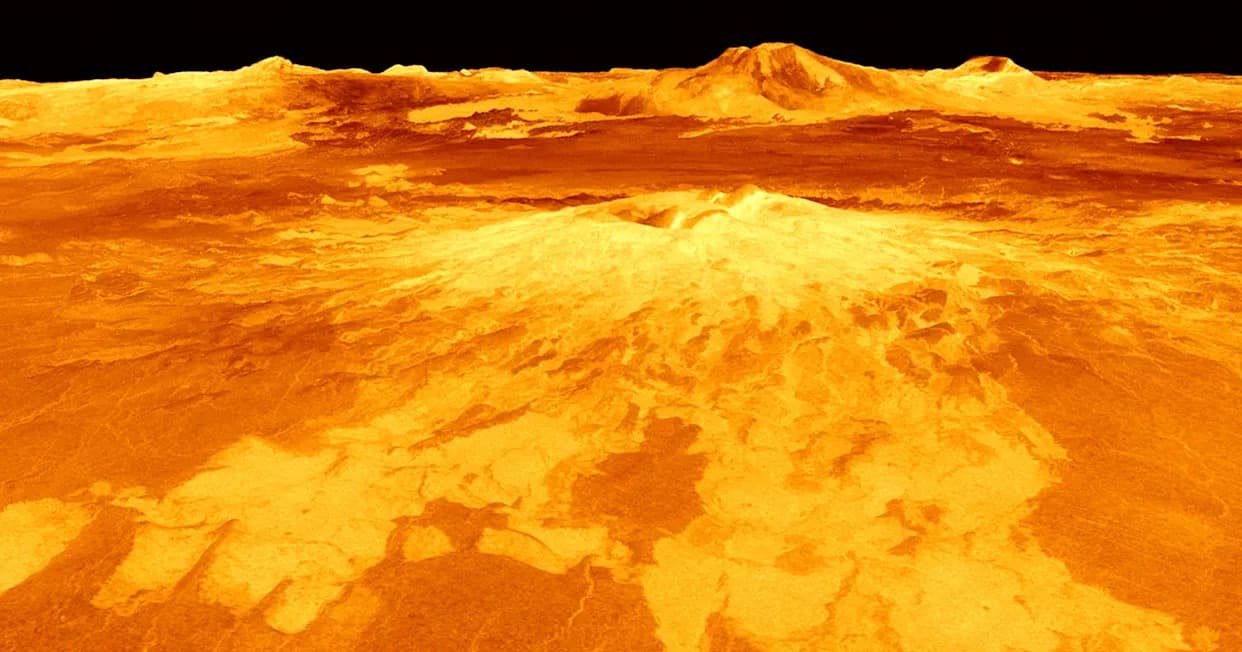
The case that Venus is harboring enormous lava tubes continues to build. A recent paper suggests they could measure up to 0.62 miles across.
Venus is often called Earth's hostile twin: similar in size to our planet but brutally different in environment. Surface temperatures can exceed 900°F (about 475°C), clouds are largely sulfuric acid, and surface pressure is nearly 100 times Earth's — roughly equivalent to the pressure experienced about 1 km (≈3,300 ft) underwater. Yet beneath this extreme exterior, an international team of researchers suggests Venus may host vast cavernous features known as lava tubes.
What the Study Found
The researchers — in a paper accepted by Icarus — used Finite Element Limit Analysis (FELA) to estimate how large lava tubes could be and remain structurally stable under Venusian conditions. Their calculations indicate that lava tubes with widths of a few hundred meters could persist, and that tubes as wide as 0.62 miles (≈1.0 km) may be stable given Venus’s surface gravity (about 91% of Earth’s).
These size estimates align with observed channel dimensions on Venus and build on earlier modeling of the planet's volcanic activity. The results also match a separate study from last year that reached a similar conclusion: Venusian lava tubes are plausible and, in some cases, could be very large.
Why This Matters
On Earth, lava tubes form when flowing molten rock drains away, leaving behind hollow tunnels. Similar features are believed to exist on the Moon and Mars. While Venus’ hostile surface conditions make such voids unsuitable as human shelters, identifying lava tubes is important for understanding the planet's volcanic history, internal structure, and potential niches for future robotic exploration.
Search Strategies and Challenges
The team urges follow-up missions with higher-resolution imaging and geophysical instruments to search for indicators such as pit chains (rows of circular depressions), skylights (vertical openings into subsurface passages), and other signs of subsurface voids. Detecting these features is difficult: Venus is shrouded by dense, reflective clouds that complicate optical observations, so radar and near-infrared techniques are crucial.
Missions That Could Help
NASA's DAVINCI (Deep Atmosphere Venus Investigation of Noble gases, Chemistry, and Imaging), tentatively planned for launch around 2030, will send an orbiter and an atmospheric probe to study Venus' atmosphere and surface at higher resolution. VERITAS (Venus Emissivity, Radio Science, InSAR, Topography, and Spectroscopy) was proposed to map Venus with high-resolution radar and near-infrared instruments. Funding and political decisions have affected these mission plans, but recent congressional action has helped keep continued exploration prospects alive.
Quote: Barbara De Toffoli (University of Padova) noted at a recent meeting that Venus may host exceptionally large tube volumes compared with Earth, Mars, and the Moon, potentially disrupting previously observed size trends.
Confirming lava tubes directly will require specialized, higher-resolution data and possibly new mission concepts focused on subsurface exploration. Until then, modeling studies like this one provide valuable constraints and targets for future observations.
Help us improve.