New theoretical work argues that white dwarfs and neutron stars may slowly evaporate through gravitational pair production similar to Hawking radiation. Including such effects produces a much smaller upper bound for the universe’s lifetime — roughly 1078 years — than some earlier estimates that considered only black hole evaporation. These results are theoretical and debated, and in any case the timescales remain astronomically long compared with human history.
Scientists Say the Universe Could End Far Sooner Than Thought — New Work Points to ~10<sup>78</sup> Years

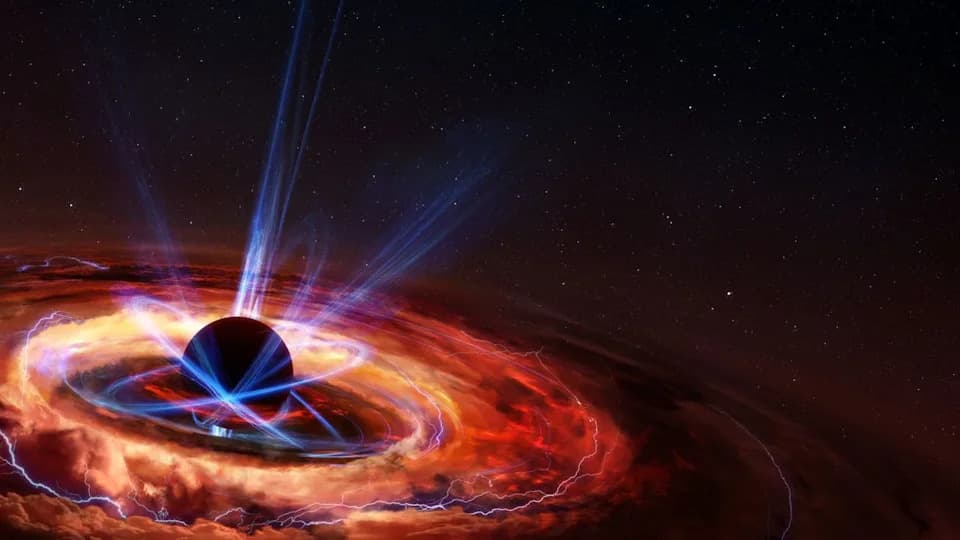
The Universe Will Evaporate Sooner Than We Thoughtsdominick - Getty Images
Despite its spectacular birth, the universe’s final act may be a quiet fade rather than a dramatic explosion. Recent theoretical work suggests that not only black holes but also other ultradense objects — such as white dwarfs and neutron stars — could slowly lose mass through processes analogous to Hawking radiation, dramatically shortening some estimates of the universe's maximum lifetime.
What the Researchers Propose
Astrophysicist Heino Falcke, quantum physicist Michael Wondrak, and mathematician Walter van Suijlekom have explored how gravitational pair production or gravitational curvature radiation might drive evaporation in objects that lack event horizons. In Hawking’s familiar picture for black holes, particle–antiparticle pairs pop into existence near the event horizon; one falls in while the other escapes, producing radiation. Falcke and colleagues argue a related effect can operate around very dense objects that do not have an event horizon, causing them to decay over extremely long timescales.
Revised Longevity Estimates
Including evaporation of white dwarfs, neutron stars, and other dense structures yields much shorter upper limits for the universe’s lifetime than some earlier estimates. The team’s back-of-the-envelope lifetimes place white dwarfs, supermassive black holes, and certain dark-matter supercluster haloes near about 1078 years, while neutron stars and stellar-mass black holes are estimated to persist to roughly 1067 years. For perspective, a previous upper bound that considered only black hole evaporation reached about 101100 years.
Why Black Holes Behave Differently
Paradoxically, ordinary black holes can outlast some other dense objects despite their stronger gravity. Because black holes lack a material surface, some emitted quanta can be reabsorbed before escaping, while objects with surfaces absorb inward-directed particles and reradiate from the surface — a mechanism that can enhance net mass loss for horizonless bodies.
Practical Implications (and Caveats)
These timescales are unimaginably long compared with human history and civilization. The Sun will engulf Earth in roughly 5 billion years, and even if humans spread across the stars the estimated cosmic upper limit of ~1078 years is effectively infinite for practical purposes. The authors also estimate that ordinary human bodies would take on the order of 1090 years to vanish by this mechanism.
As the authors write in the Journal of Cosmology and Astroparticle Physics: “Using gravitational curvature radiation, we find that also Neutron Stars and White Dwarfs decay in a finite time in the presence of gravitational pair production.”
Importantly, this work is theoretical and relies on semi-classical arguments about quantum fields in curved spacetime. The mechanism and the numerical estimates are subject to further scrutiny, debate, and refinement by the broader physics community.
Bottom Line
Accounting for evaporation of dense, horizonless objects can reduce some estimates of the universe’s maximum lifetime dramatically — from staggeringly large values like 101100 years down to figures closer to 1078 years — but these revisions concern timescales so vast they have no bearing on near- or medium-term human concerns. The proposal is an interesting theoretical development that will require further analysis and confirmation.
Help us improve.