Researchers suggest an unusually energetic neutrino detected in 2023 could be explained by the final evaporation of a primordial black hole. Published in Physical Review Letters, the paper argues that very low-mass PBHs heat up as they lose mass and may end in explosive bursts of Hawking radiation. The authors introduce a speculative "dark charge" to reconcile the neutrino data and note that such PBHs could potentially account for dark matter. Additional observations are required to confirm the claim.
Did a Black Hole Just Explode? Scientists Say a 2023 Neutrino Event Might Be Its Smoking Gun
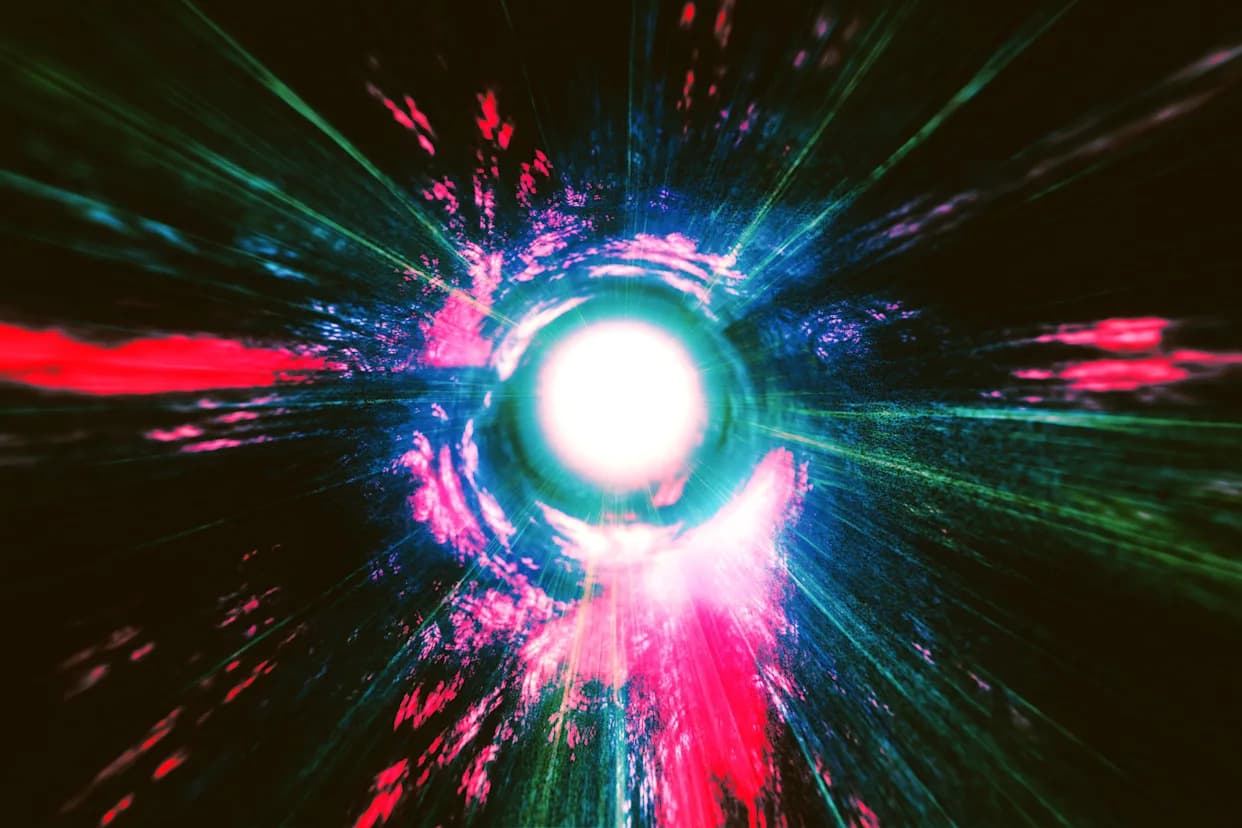
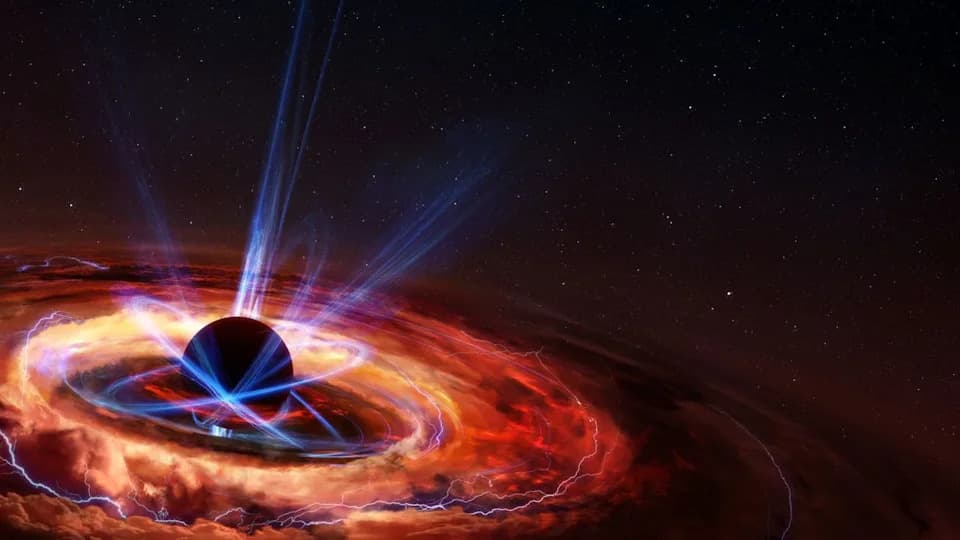
Illustration by Tag Hartman-Simkins / Futurism. Source: Getty Images
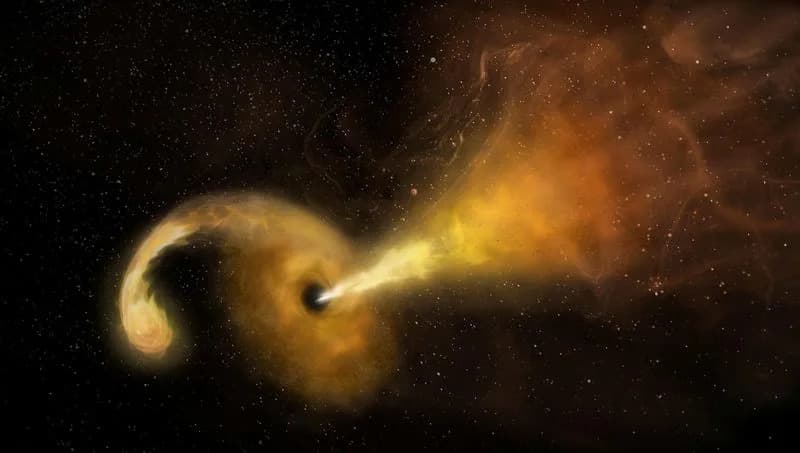
Black holes normally form when massive stars die in violent explosions. But could a black hole itself end in an explosive outburst? A team of researchers argues that a strange, extremely energetic neutrino detected on Earth in 2023 might be explained by the final evaporation of a tiny primordial black hole (PBH).
The study, published in Physical Review Letters, explores how very low-mass PBHs—hypothetical black holes formed in the first instants after the Big Bang—could end their lives in brief, intense bursts of particles and radiation as they finish evaporating via Hawking radiation.
In 1974 Stephen Hawking proposed that black holes emit a faint flux of particles due to quantum effects near the event horizon. For ordinary stellar black holes this process is vanishingly slow: modern estimates put complete evaporation at quadrillions upon quadrillions of times the current age of the Universe. But because Hawking radiation grows stronger as a black hole loses mass, very light PBHs could heat up and emit particles ever more rapidly, potentially ending in an observable “explosion.”
The authors connect these theoretical final bursts to an anomalous neutrino recorded in 2023. That single neutrino carried far more energy than expected for an individual particle and was not confirmed by other observatories—making it puzzling. While the simplest explanations are a statistical fluke or an experimental error, the team explores a bolder possibility: the neutrino could be the aftermath of a PBH undergoing terminal evaporation.
To make the scenario fit the data, the researchers introduce a speculative additional property for some PBHs: a "dark charge", analogous to electric charge but mediated by a hypothetical particle sometimes called a "dark electron." In their model, a PBH carrying such a charge would evaporate with different dynamics and could produce signatures compatible with the observed neutrino.
"The lighter a black hole is, the hotter it should be and the more particles it will emit," said coauthor Andrea Thamm, assistant professor of physics at UMass Amherst. "As PBHs evaporate, they become ever lighter, and so hotter, emitting even more radiation in a runaway process until explosion. It's that Hawking radiation that our telescopes can detect."
The idea is speculative and remains on the margins of mainstream astrophysics. However, the team notes a potential payoff: if PBHs with a dark charge exist in significant numbers, they could contribute to or even account for dark matter— the invisible substance thought to make up roughly 85% of the Universe’s matter.
"If our hypothesized dark charge is true," coauthor Joaquim Iguaz Juan of UMass Amherst said, "then we believe there could be a significant population of PBHs, which would be consistent with other astrophysical observations, and account for all the missing dark matter in the universe."
Crucially, this explanation is far from confirmed. The 2023 neutrino was recorded by a single detector and has not been replicated; additional observations and cross-checks from independent instruments will be required to test whether the event was truly the signature of a primordial black hole explosion or a more mundane anomaly.
What’s next? Researchers say follow-up searches across neutrino observatories, gamma-ray telescopes, and other detectors are needed to seek corroborating bursts or coincident signals. Until then, the PBH explanation remains an intriguing but provisional idea.
Help us improve.