Researchers led by the University of Michigan used a multi-messenger imaging technique at Lawrence Berkeley National Lab to capture the highest-resolution "movie" of laser-driven shockwaves that initiate fusion. Combining ultrafast X-rays and electron-beam probes, they recorded shockwave dynamics on trillionths-of-a-second time scales. The team discovered an unexpected thin water-vapor layer around a proxy jet that improved compression symmetry — a feature not predicted by simulations. These findings reveal model-versus-reality gaps that can inform better inertial confinement fusion designs.
Scientists Record Highest-Resolution 'Movie' Of Laser-Driven Shockwaves That Trigger Fusion
Photo Credit: iStock
Researchers have produced the clearest, highest-resolution view yet of the ultra-fast shockwaves that play a central role in initiating nuclear fusion — a step that sharpens diagnostic tools and could improve future fusion designs.
Multi‑Messenger Imaging Reveals Unexpected Detail
A study published in Nature Communications reports that a team led by the University of Michigan used an advanced "multi-messenger" imaging approach to track laser-driven shockwaves at microscopic scales. The experiments were conducted at Lawrence Berkeley National Laboratory as part of the U.S. Department of Energy's LaserNetUS program.
Instead of using actual fusion fuel, the researchers fired synchronized laser pulses at an ultra-thin, flowing water jet that served as a safe proxy. By combining ultrafast X-ray imaging with high-energy electron-beam probes, they assembled a high-speed "movie" capturing shockwave evolution on trillionths-of-a-second time scales.
"We wanted to demonstrate that the X-rays produced by extremely intense lasers have unique properties that allow us to capture a 'movie' of the extremely fast motion of plasma," said Alec Thomas, a study author and plasma physicist at the University of Michigan.
Key Discovery: A Hidden Vapor Layer
The measurements revealed an unexpected, very thin layer of water vapor surrounding the jet. That vapor layer helped compress the target more uniformly, producing greater symmetry in the implosion — a behavior similar to the low-density foam layers sometimes applied to inertial confinement fusion (ICF) targets.
"Every time we looked at the X-ray image, it surprised us," said Hai-En Tsai, a study author at Berkeley Lab. "The simulations were very different from what we actually saw."
Because the vapor layer had not been anticipated by the team's simulations, the results expose gaps between models and real-world behavior. Closing those gaps can guide finer target designs, better diagnostics, and control strategies that reduce instabilities and improve fusion efficiency.
Why It Matters
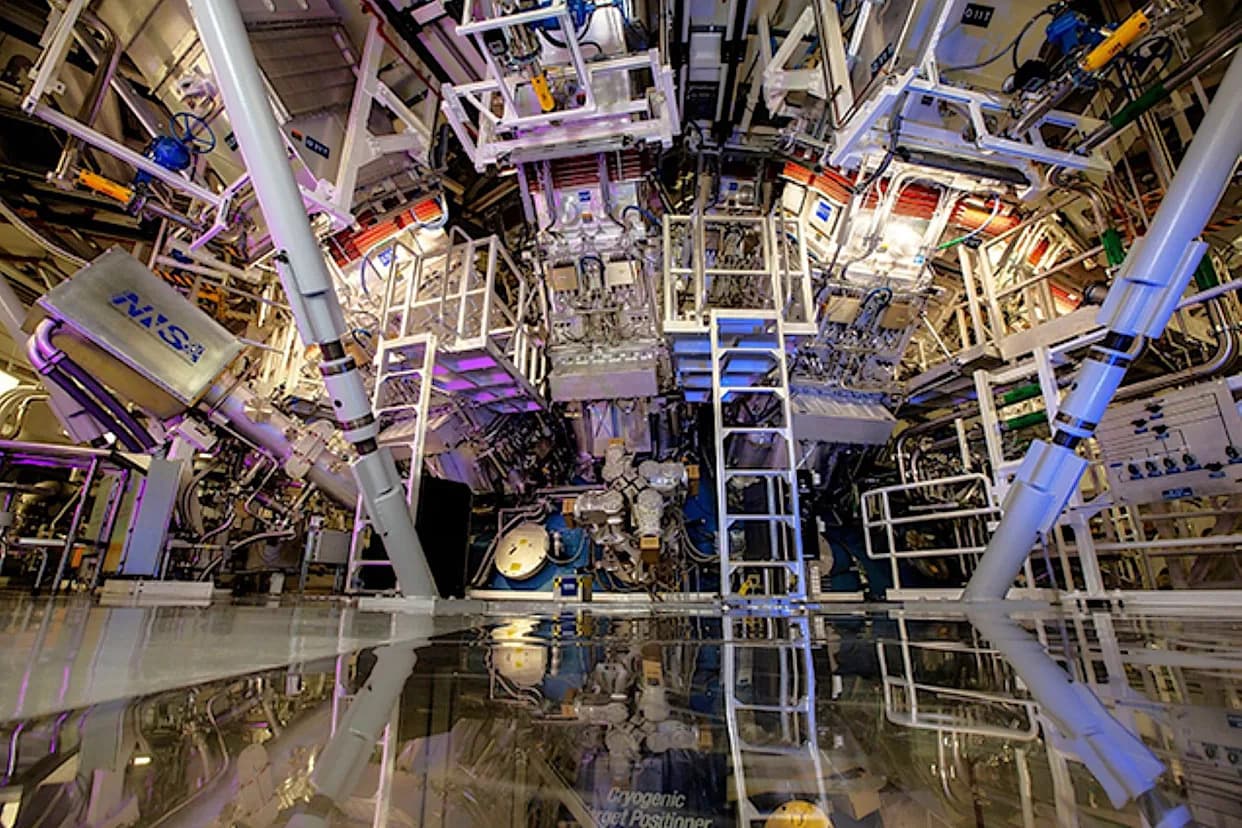
Inertial confinement fusion — where powerful lasers compress a small fuel capsule to trigger fusion — is extremely sensitive to tiny asymmetries and instabilities. More accurate, high-speed observations like these give scientists actionable information to refine simulations and experimental targets.
Commercial fusion power remains years away, but advances in diagnostics and target engineering are essential steps toward making fusion a practical, low-carbon complement to wind, solar and other energy sources.
Help us improve.