China's EAST tokamak sustained plasma stability at 1.3–1.65× the Greenwald Limit, accessing a theorized 'density-free regime' where stability persists as density rises. By precisely controlling initial fuel pressure and electron cyclotron resonance heating, researchers kept the plasma stable at densities that usually trigger instability. Published Jan. 1 in Science Advances, the results build on prior U.S. experiments and could influence future tokamak design, including ITER.
China's 'Artificial Sun' Breaks Major Fusion Density Limit, Reaching 'Density-Free' Regime
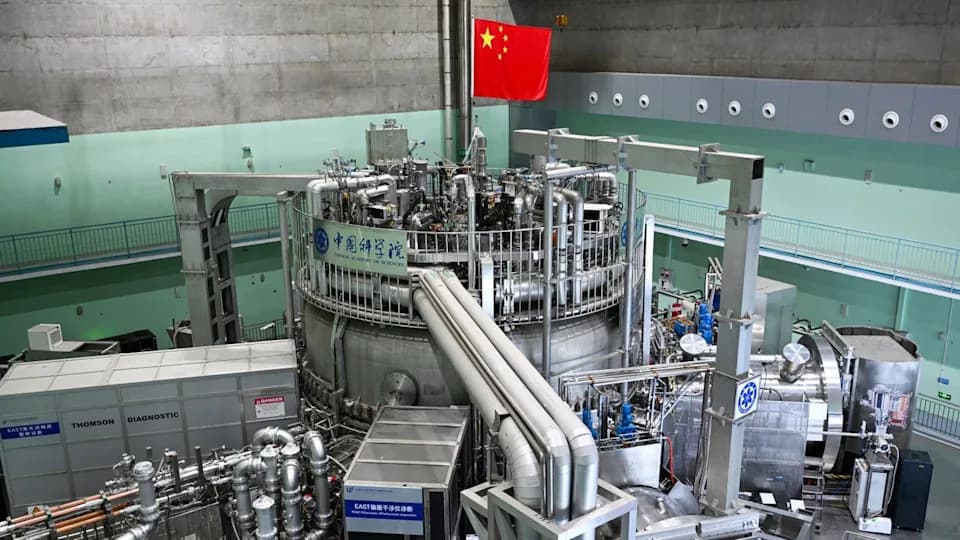
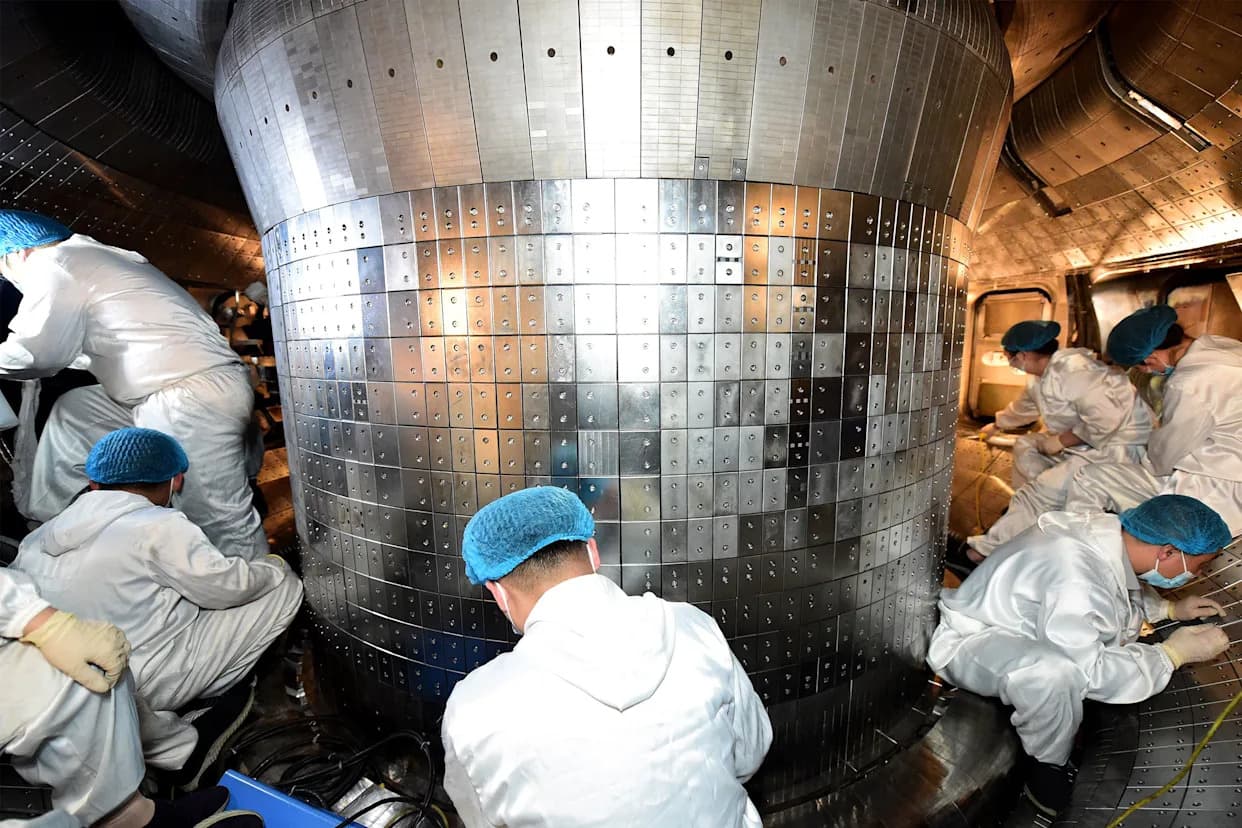
The Experimental Advanced Superconducting Tokamak (EAST), dubbed China's "artificial sun," has made a habit of breaking fusion records. | Credit: Zhang Dagang/VCG via Getty Images
China's Experimental Advanced Superconducting Tokamak (EAST), often called the "artificial sun," has demonstrated stable, high-density plasma at levels well above a long-standing operational threshold, a notable advance for fusion research. The results, published Jan. 1 in Science Advances, suggest a practical pathway to operate tokamaks at higher densities without triggering the instabilities that typically shut down fusion experiments.
What Researchers Achieved
Scientists operating EAST maintained plasma stability at densities between 1.3 and 1.65 times the Greenwald Limit—a density boundary that has traditionally caused plasma to become unstable. According to the Chinese Academy of Sciences and co-lead author Ping Zhu of the University of Science and Technology of China, the team accessed a theorized "density-free regime" in which stability persists as density increases.
How They Did It
The team carefully controlled the plasma's interaction with the reactor walls by tuning two key startup parameters: the initial fueling gas pressure and the electron cyclotron resonance heating frequency (the microwave frequency at which electrons in the plasma absorb energy). This precise control appears to have pushed the device into a self-organized state consistent with the plasma-wall self-organization (PWSO) theory.
'The findings suggest a practical and scalable pathway for extending density limits in tokamaks and next-generation burning plasma fusion devices,' said Ping Zhu, co-lead author and professor in the School of Electrical and Electronic Engineering at the University of Science and Technology of China.
Context and Comparisons
Breaching the Greenwald Limit is not entirely new: the U.S. Department of Energy's DIII-D tokamak in San Diego exceeded it in 2022, and a 2024 experimental device at the University of Wisconsin–Madison reportedly sustained plasma at roughly 10 times the Greenwald Limit. What distinguishes the EAST result is the claim that researchers reached a density-free regime, where increasing density does not automatically undermine stability—a key theoretical milestone for tokamak operation.
Why This Matters
If reproducible and scalable, these findings could inform the design and operation of next-generation fusion reactors by relaxing density constraints that previously limited performance. Experiments like EAST will help guide construction and operational strategies for larger international projects such as ITER, the multinational tokamak under construction in France.
Limitations And Outlook
Despite progress, fusion remains an experimental field: most devices still consume more energy than they produce, and fusion power plants are not an immediate solution to today's climate crisis. ITER aims to demonstrate sustained, large-scale fusion and is expected to begin full-scale operations in the late 2030s. The EAST results are an important step, but further replication, longer pulses, and integration with other advances are required before commercial fusion becomes viable.
Publication: Science Advances, Jan. 1. Lead Institutions: Chinese Academy of Sciences and University of Science and Technology of China. Key Technical Terms: Greenwald Limit, electron cyclotron resonance heating, plasma-wall self-organization (PWSO), tokamak, ITER.
Help us improve.