Chinese scientists led by Pan Shilie at the Chinese Academy of Sciences have produced an all-solid-state vacuum-ultraviolet laser operating at a record 158.9 nm using a novel ammonium fluorooxoborate (NH4BF4, ABF) crystal. The ABF-based system delivered 4.8 mJ nanosecond pulses with conversion efficiency near 6%, setting new records for second-harmonic-generation VUV lasers. ABF was first synthesized in 2016 and grown to centimetre scale over about a decade, combining VUV transparency, strong nonlinearity and sufficient birefringence for phase matching. The study appears in Nature and points to applications in quantum computing, semiconductor fabrication, and space communications.
China Builds Record Solid-State VUV Laser at 158.9 nm Using New ABF Crystal
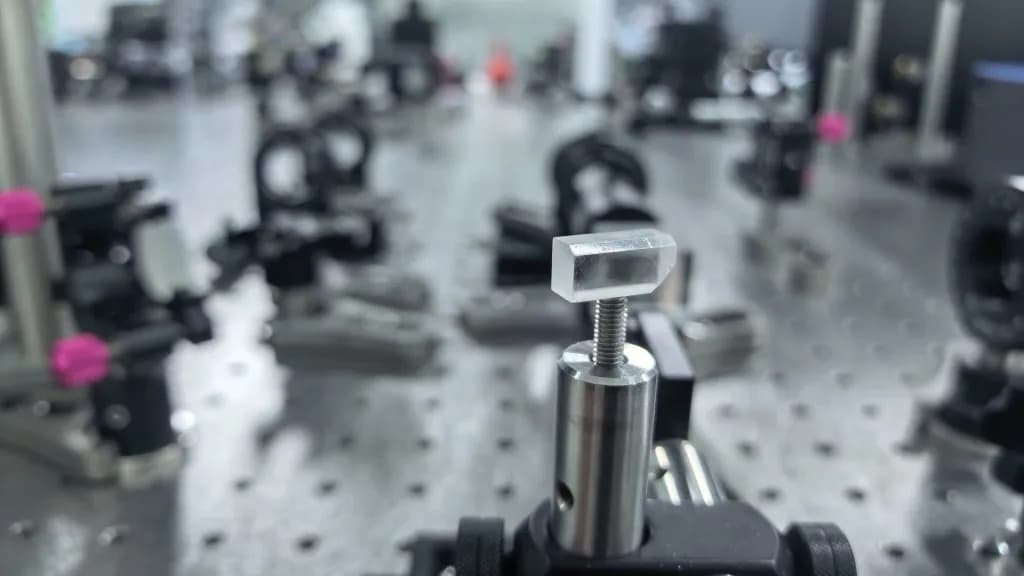
Chinese researchers at the Chinese Academy of Sciences (CAS), led by Pan Shilie, have produced an all-solid-state vacuum-ultraviolet (VUV) laser operating at a record-short wavelength of 158.9 nm. The milestone was reached using a newly developed nonlinear optical crystal, ammonium fluorooxoborate (NH4BF4), abbreviated ABF.
Breakthrough Details
Using ABF and direct frequency doubling (second-harmonic generation), the team generated 158.9 nm light and demonstrated nanosecond pulses with 4.8 mJ energy and a conversion efficiency approaching 6%. According to the researchers, these figures constitute new records for VUV lasers produced via second-harmonic generation.
The development of ABF paves the way for compact, efficient all-solid-state VUV lasers, said Pan Shilie.
Why ABF Matters
ABF combines properties rarely found together in a single material: high transparency in the vacuum-ultraviolet band, a strong nonlinear optical response, and sufficient birefringence to allow phase matching at extremely short wavelengths. The crystal was first synthesized in 2016 and, after roughly a decade of development, grown to centimetre-scale dimensions with optical quality suitable for practical laser devices rather than laboratory curiosities.
Until now, potassium beryllium fluoroborate (KBBF) was essentially the only practical crystal capable of producing direct frequency-doubled output below 200 nm, but KBBF has presented challenges in crystal growth and device fabrication. ABF overcomes many of those limitations and demonstrates a materials-design strategy—introducing fluorine into a borate framework—that could guide discovery of future VUV nonlinear optical crystals.
Applications and Outlook
The shorter wavelength gives higher photon energy, enabling applications in advanced spectroscopy, semiconductor fabrication, precision manufacturing, and quantum research where precise control of atomic and ionic energy levels is required. The team says further optimization of crystal growth and processing should improve performance and broaden practical deployment, including potential roles in space communications and next-generation quantum platforms.
The work is reported in the journal Nature.
Help us improve.