Researchers found that honey hunters in Mozambique use distinct local dialects when calling greater honeyguide birds. A study of 131 hunters across 13 villages in Niassa Special Reserve showed vocal patterns (trills, grunts, whoops and whistles) vary by village and are adopted by newcomers. The cooperation benefits both species: people obtain honey while honeyguides eat the leftover wax and larvae. Scientists suggest honeyguides may help preserve human dialects by responding preferentially to familiar local calls.
Mozambique Honey Hunters and Honeyguides Use Distinct Local Dialects to Find Bee Nests
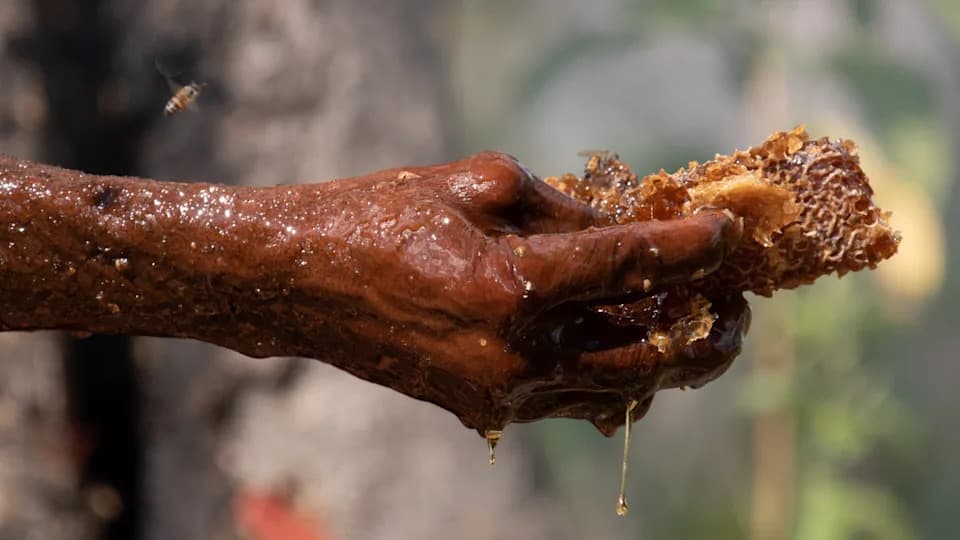
Honey-harvest in the Niassa Special Reserve, Mozambique. | Credit: Claire Spottiswoode
Researchers report that honey hunters in northern Mozambique use clearly distinct local dialects when calling greater honeyguide birds, and that this shared communication benefits both humans and birds.
How the Partnership Works
Greater honeyguides (Indicator indicator) are small, brown birds found across southern Africa. They lead people to wild bee colonies: a hunter summons a honeyguide with a characteristic call, the bird responds and then actively guides the hunter to the nest. Humans access the honey — often using fire to subdue the bees — and the honeyguides feed on the leftover wax and larvae, avoiding dangerous stings themselves. This is one of the few well-documented examples of cooperative behaviour between people and a wild animal.
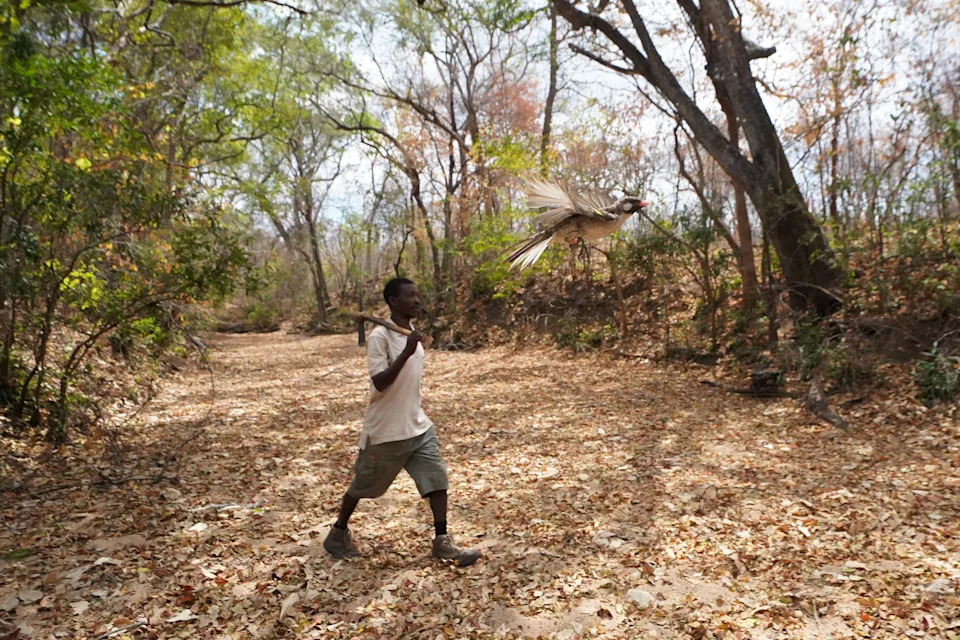
Carvalho Nanguar, Yao honey-hunter from northern Mozambique, with amale greater honeyguide released from the hand after being caught for research purposes. This photo is illustrative of the special relationship between wild honeyguides and the humans they guide to wild bees' nests. | Credit: David Lloyd-Jones and Dominic Cram
New Study: Dialects Across Villages
An international team led by Jessica van der Wal of the University of Cape Town recorded calls from 131 honey hunters across 13 villages inside northern Mozambique's Niassa Special Reserve, where the Yao people rely on wild honey and honeyguides as part of their livelihoods. The study, published in the journal People and Nature, found that hunters' trills, grunts, whoops and whistles varied systematically with distance between villages. These differences were not explained by habitat type.
"There is one language that they use with the birds, but there are different dialects," said Jessica van der Wal.
Learning and Cultural Reinforcement
The team observed that people who move into a village adopt the local call pattern, much like adopting an accent. External experts not involved in the study suggested that honeyguides may reinforce these human dialects by responding preferentially to familiar local signals. If birds learn to ignore unfamiliar calls, their selective responses could reduce dialect drift and help preserve a mosaic of local vocal traditions among human communities.

Landscape of Niassa Special Reserve, northern Mozambique. | Credit: David Lloyd-Jones
Honeyguides are brood parasites — they lay eggs in other birds' nests — so they probably do not learn guiding behaviour directly from their parents. Van der Wal and colleagues propose that honeyguides acquire guiding skills by observing or interacting with other honeyguides that already guide humans. Her team is investigating whether humans and birds influence each other's cultural practices.
Implications and Next Steps
The researchers emphasize that this human–wildlife cooperation is both culturally rich and ecologically significant. Van der Wal now leads the Pan-African Honeyguide Research Network to document honeyguide behaviour across multiple countries and expand comparisons of human calls, practices and bird responses.
Study details: 131 hunters, 13 villages, Niassa Special Reserve (northern Mozambique); published in People and Nature. The work highlights how human culture shapes interactions with wild, untrained animals and suggests reciprocal cultural influences between species.
Help us improve.