Researchers operating an ROV in the Pacific recovered jet‑black cocoons at about 6,200 meters (3.85 miles). At least four intact cocoons contained fragile white flatworms that DNA analysis identified as a previously undescribed species of Platyhelminthes. This represents the deepest confirmed record of free‑living flatworms, and the deep‑sea worms appear superficially similar to their shallow‑water relatives. The discovery, published in Biology Letters, expands understanding of abyssal biodiversity.
Jet‑Black Cocoons From the Ocean Abyss Yield a Previously Unknown Deep‑Sea Flatworm
4 Black Eggs Surfaced From the Deep OceanTammy616 - Getty Images
During a robotic survey of the Pacific abyssopelagic zone, researchers recovered unusual jet‑black, egg‑like cocoons attached to a rock at about 6,200 meters (3.85 miles) depth. The specimens—brought to the surface for study—contained tiny, fragile white flatworms that DNA testing later showed belong to a previously undescribed species in the phylum Platyhelminthes.
Why This Discovery Matters
Any confirmed record of complex life at such extreme depths is important: the abyssopelagic zone is one of the least understood environments on Earth, and biological life cycles there remain poorly documented. These specimens represent the deepest confirmed record of free‑living flatworms, expanding our picture of biodiversity in the deep sea.
Researchers from the University of Tokyo and Hokkaido University encountered the cocoons while piloting a remotely operated vehicle (ROV). Marine researcher Yasunori Kano collected multiple samples and brought them to the surface for further analysis. Most of the capsules were torn and empty on recovery, but at least four intact cocoons were preserved and sent to invertebrate biologists for closer examination.
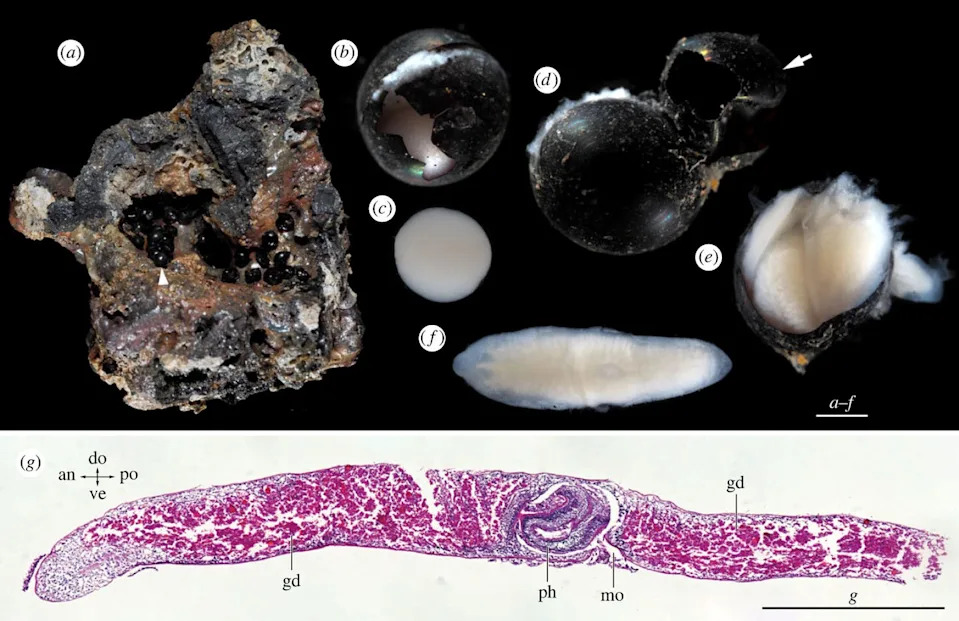
Above are the egg capsules, or cocoons. (A) Egg capsules on rock fragment. (B) Partly opened egg capsule containing three spherical-stage flatworms. (C) Spherical-stage flatworm extracted from egg capsule. (D) Cracked egg capsule containing seven flatworms. (E) The same, half of egg capsule shell removed. (F) Flatworm extracted from egg capsule.Kakui and Tsuyuki - Biology Letters
Keiichi Kakui of Hokkaido University, a co‑author on the study in Biology Letters, described the moment of discovery: under a stereomicroscope he cut open a cocoon, a milky fluid leaked out, and fragile white bodies became visible—revealing the cocoons to be those of platyhelminths.
After detailed morphological inspection and DNA sequencing, the team concluded the animals belong to a previously undescribed species of flatworm. Although they live far deeper than known relatives, the deep‑sea specimens appear superficially similar to shallow‑water platyhelminths and show no obvious drastic developmental differences.
The find is particularly noteworthy because previously reported deep records were shallower or ambiguous: the prior deepest observation of a flatworm was at roughly 5,200 meters, but that specimen was attached to a piece of wood and may not have originated at that depth. Earlier confirmed records were around two miles deep.
Published in Biology Letters and reported to outlets including IFLScience, this discovery sheds light on life in the ocean's darkest, high‑pressure reaches and underscores how much remains unknown about deep‑sea ecosystems.
Help us improve.