Ammonite (2023 KQ14) is a newly discovered sednoid first imaged by the Subaru Telescope in 2023. It orbits the Sun at an average distance of ~252 AU (perihelion ~66 AU), measures an estimated 137–236 miles (220–380 km) across, and takes about 4,000 years to complete one orbit. Unlike the three previously known sednoids, Ammonite's orbit is misaligned—an observation that weakens simple versions of the Planet Nine hypothesis and points to alternative origins such as a past stellar encounter or an ejected ninth planet.
Newly Discovered Sednoid 'Ammonite' Could Change How We See the Solar System's Past
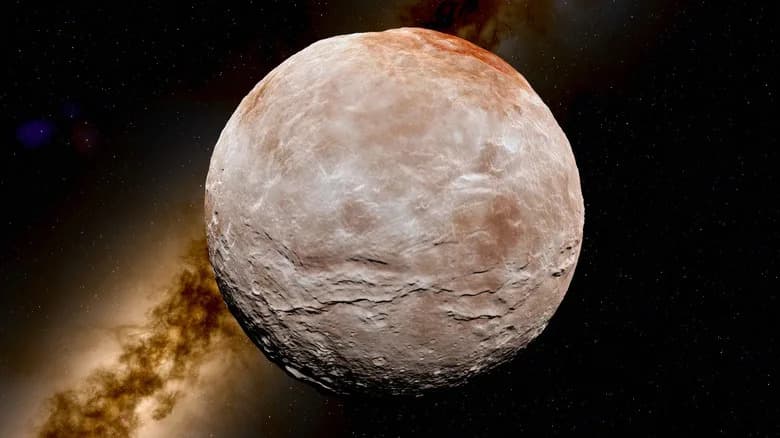
Picture of pluto with a hint of the Milky Way galaxy in the background. - Coreyford/Getty Images
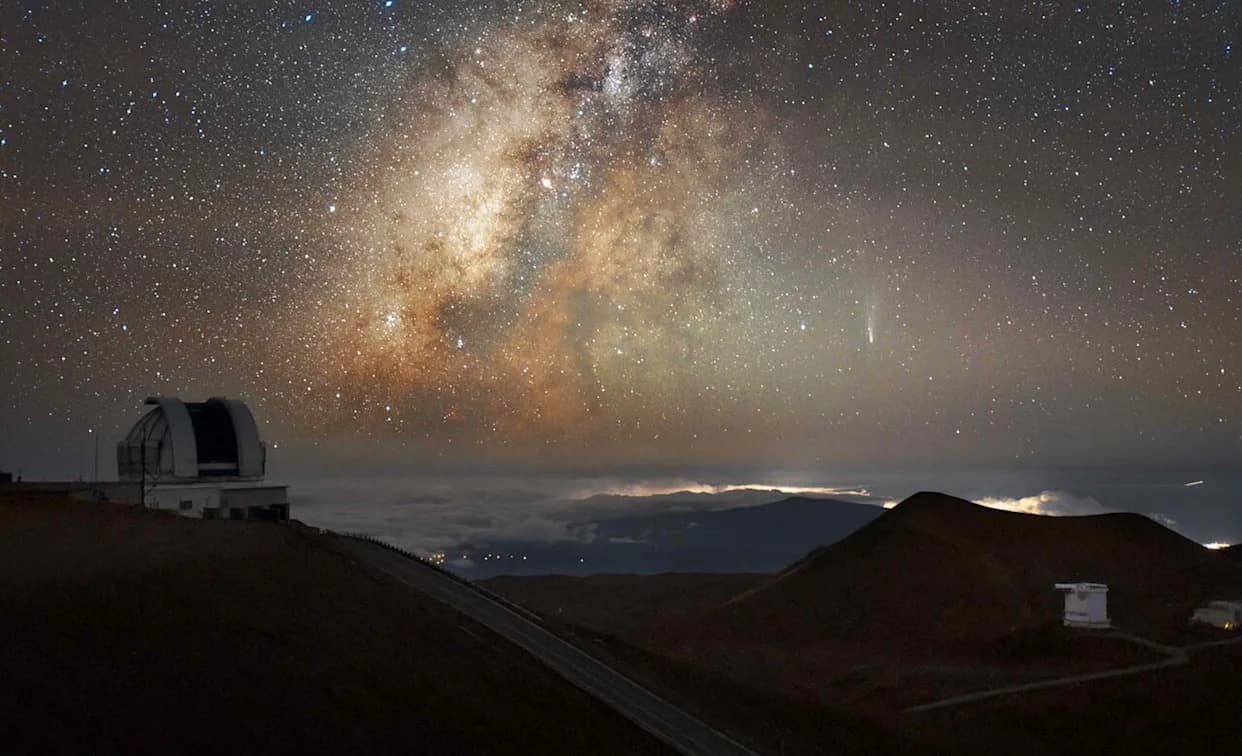
A tiny, icy world discovered in 2023 may offer a fresh window into the early dynamics of our solar system. The trans‑Neptunian object 2023 KQ14—nicknamed "Ammonite"—was first imaged by the Subaru Telescope in Hawaii and identified by an international team working on the FOSSIL Project (Formation Of The Outer Solar System: An Icy Legacy).
Discovery and Classification
Cataloged as 2023 KQ14, Ammonite is not a planet or dwarf planet but belongs to a rare class of distant objects known as sednoids. Sednoids have very distant, detached orbits that keep them far from Neptune's gravitational influence, making them valuable tracers of the solar system's early history.
Orbit, Size, and Motion
Ammonite's closest approach to the Sun (perihelion) is approximately 66 astronomical units (AU)—more than twice Neptune's perihelion. One AU is about 93 million miles (150 million kilometers). On average, Ammonite orbits at roughly 252 AU (~23.4 billion miles) from the Sun. Its highly elongated, tilted path means a single orbit takes about 4,000 Earth years.
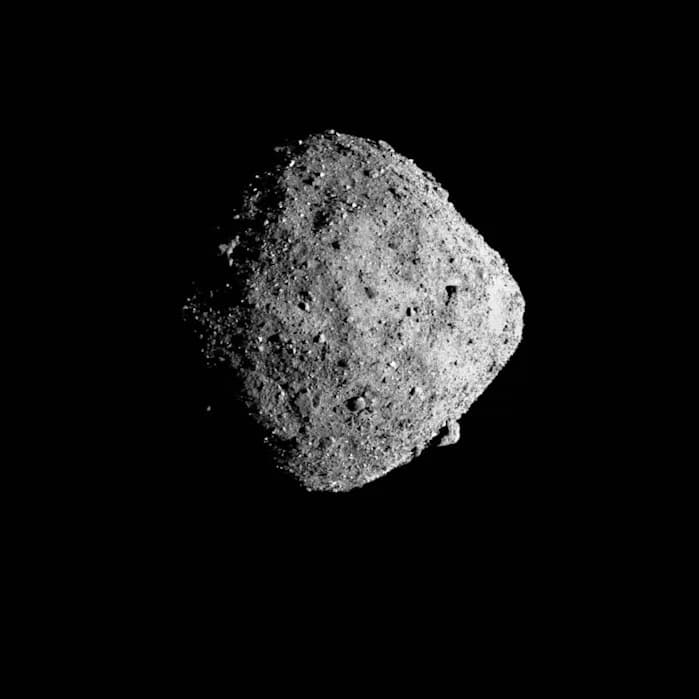
Astronomers estimate Ammonite's diameter at roughly 137–236 miles (about 220–380 kilometers), which is under one‑tenth of Pluto's diameter.
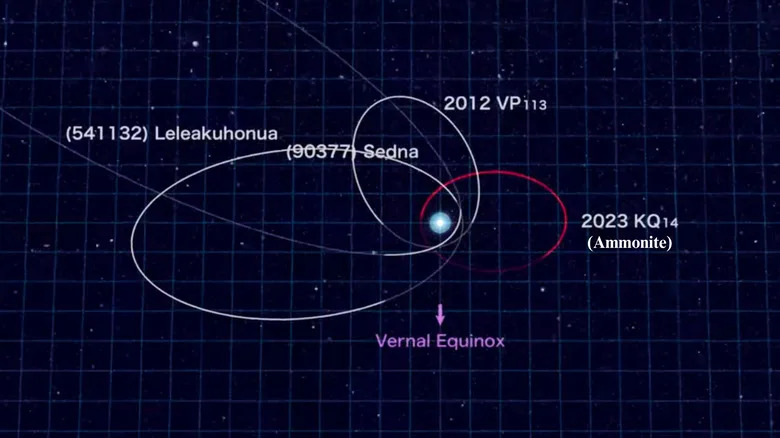
Visual representation of Ammonite's orbit around the sun in comparison to other sednoids - Subaru Telecope, NAOJ / YouTube
Why Ammonite Matters for Planet Nine
The discovery of sednoids has fueled the so‑called Planet Nine hypothesis: the idea that a distant, massive planet might shepherd or tilt the orbits of small icy bodies beyond Neptune. However, Ammonite's orbit points in a different direction from the three previously known sednoids—Sedna (2003), 2012 VP113, and 541132 Leleākūhonua—challenging the simple interpretation of a single unseen planet forcing their alignment.
Yukun Huang, who ran orbital simulations, said: "The fact that Ammonite's current orbit does not align with those of the other three sednoids lowers the likelihood of the Planet Nine hypothesis."
Alternative Explanations and What Comes Next
Huang and other researchers still consider scenarios in which a now‑absent ninth planet once influenced these objects before being ejected, or where the gravity of a passing star scattered them into detached orbits roughly 4.2 billion years ago. Each new sednoid discovery refines models of the early solar system and helps distinguish among competing hypotheses.
Although Ammonite is a small object in a vast system, it is an important clue. Continued surveys and improved orbital simulations will determine whether Ammonite is an outlier or part of a more complex, unseen architecture in the outer solar system.
Read more: This discovery was reported by the Subaru Telescope and the FOSSIL Project; original reporting appeared on SlashGear.
Help us improve.