Short Version: Astronomers discovered 2025 PN7 in 2025 — a near-Earth quasi-satellite that orbits the Sun in resonance with Earth. NASA confirms it is not gravitationally bound to Earth, so calling it a "second moon" is misleading. The object has likely remained in this configuration since about 1957 and is expected to stay for roughly 60 more years; it poses no known threat and could be a useful target for unmanned missions.
Fact Check: 2025 PN7 Is a Quasi-Satellite — Not a True ‘Second Moon’
Wikimedia Commons
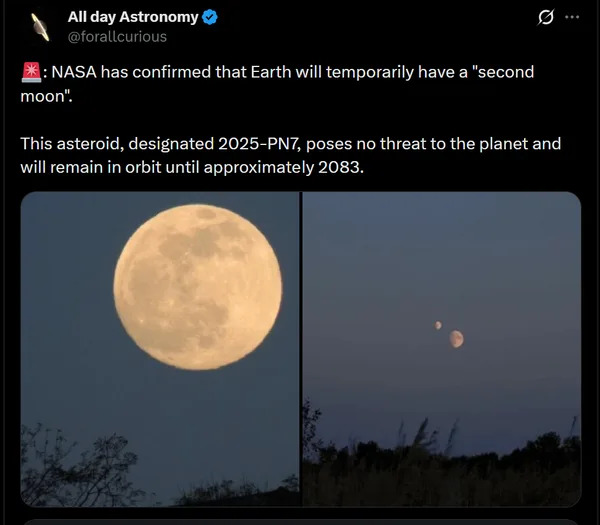
Claims that NASA confirmed Earth had gained a temporary “second moon” lasting until 2083 exaggerate the science. Astronomers did identify a near-Earth object in 2025, designated 2025 PN7, but it is a quasi-satellite — an object that orbits the Sun in step with Earth rather than orbiting Earth directly.
What Was Discovered
Researchers reported 2025 PN7 in a Research Notes paper published by the American Astronomical Society in September 2025. The object was first detected by the Pan-STARRS observatory on Hawai‘i on Aug. 2, 2025. Major outlets including The New York Times, CNN and ABC News covered the finding.
Why "Quasi-Satellite" Is Different From A Moon
A NASA spokesperson told fact-checkers that 2025 PN7 is an asteroid and a “quasi-moon” (or quasi-satellite). Unlike a true moon, a quasi-satellite is not gravitationally bound to Earth. It follows its own orbit around the Sun that happens to remain near Earth for an extended period due to orbital resonance. By contrast, a true moon is captured by and orbits the planet itself.
"Unlike a moon a quasi-moon is not gravitationally bound to Earth but follows an orbit around the Sun that makes it linger near Earth for an extended period of time," a NASA spokesperson said.
Timeline And Proximity
NASA told Snopes that 2025 PN7 has likely been in its current quasi-satellite configuration for at least the past 70 years and is expected to remain so for roughly another 60 years — a timeline that aligns with reporting that the object moved into this configuration around 1957. During its orbit, its closest approach to Earth has been about 186,000 miles, which is farther than the Moon’s average distance of 238,855 miles.
Scientific Value And Safety
Researchers say objects like 2025 PN7 are scientifically interesting and potentially practical targets for unmanned missions, because they can be relatively easy to reach. Importantly, astronomers report no known threat from 2025 PN7.
Terminology Clarified
The AAS paper distinguishes between: quasi-satellites (quasi-moons) — Sun-orbiting bodies in resonant trajectories near Earth but not bound to it — and mini-moons — objects that are temporarily captured by Earth’s gravity and thus briefly become true moons.
Bottom Line
Astronomers did discover 2025 PN7, a near-Earth quasi-satellite that will remain near Earth for decades. However, it is misleading to call it a “second moon” because it does not orbit Earth and is not gravitationally bound to our planet. The discovery is real and noteworthy, but the phrase "second moon" misrepresents the object's nature.
Selected sources: Research Notes of the AAS (De La Fuente Marcos & De La Fuente Marcos, Sept. 2025); NASA Small-Body Database; reporting from The New York Times, CNN, ABC News.
Help us improve.