The 2003 Greenland-area marine heat wave triggered a persistent rise in marine heat wave frequency across the North Atlantic, according to a review of over 100 studies. Ocean circulation changes allowed warm subtropical water to flood the Norwegian Sea, raising temperatures down to 700 m and reducing sea ice. That shift drove rapid ecosystem reorganization—from plankton and benthic communities to fish and whales—while human-driven greenhouse gas emissions and Arctic feedbacks likely amplify future events.
How a Single 2003 Marine Heat Wave Continues to Reshape the North Atlantic
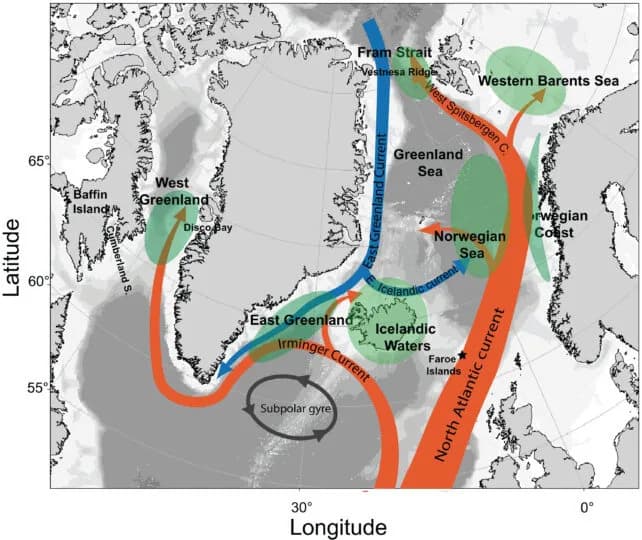
Major currents in the Northern Atlantic, with study areas highlighted in green. (Werner et al.,Sci. Adv., 2026)
A major marine heat wave that struck waters around Greenland in 2003 continues to reshape North Atlantic ecosystems decades later, researchers report. A review of more than 100 scientific studies finds an abrupt, sustained rise in marine heat wave (MHW) frequency after 2003 and widespread ecological reorganization from microscopic plankton to whales and commercially important fish.
What Happened in 2003?
The 2003 event was driven by changes in ocean circulation: a weakened subpolar gyre allowed large volumes of warm subtropical water to surge into the Norwegian Sea via the Atlantic inflow, while the usually cooling Arctic inflow was unusually weak. These shifts caused a sharp loss of sea ice and substantial increases in sea surface temperatures. In parts of the Norwegian Sea, warming penetrated to depths of about 700 meters (2,300 feet).
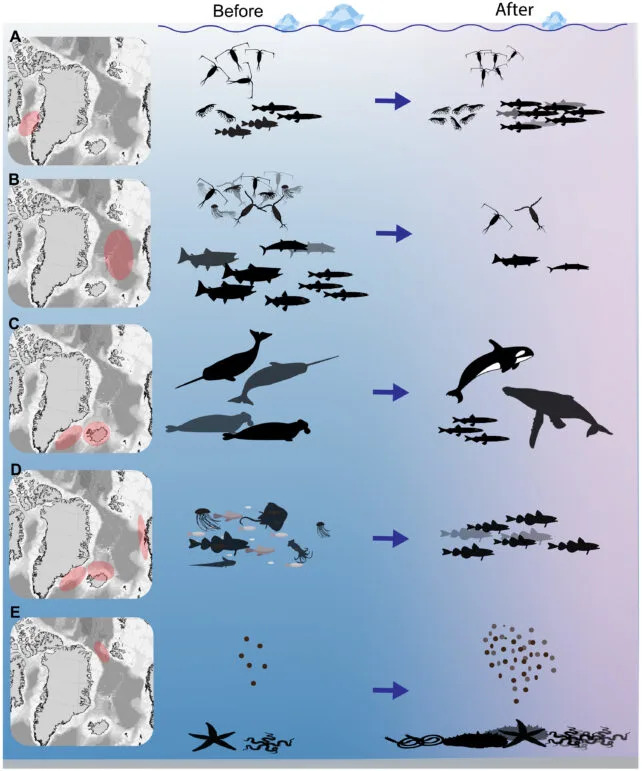
The year 2003 marked a "turning point" in marine ecosystems in the North Atlantic ocean. (Werner et al.,Sci. Adv., 2026)
Ecological Consequences
Warmer conditions favored species that tolerate higher temperatures and disadvantaged cold-adapted, ice-associated organisms. The review documents abrupt shifts across multiple trophic levels and regions:
- Plankton and Primary Production: Massive phytoplankton blooms followed many heat waves, producing large pulses of organic material that sank to the seafloor.
- Benthic Communities: Deposit feeders such as brittle stars and polychaete worms exploited the increased food supply at the seabed.
- Fish: Opportunistic predators like Atlantic cod benefited from new prey availability, while sandeel (Ammodytes) populations experienced abrupt disappearances—altering diets of species such as haddock.
- Forage Fish: Capelin, a key prey species for cod and whales, shifted northward to find cooler spawning and feeding grounds, reducing availability in traditional fishing areas.
- Mammals: Reduced sea ice opened feeding areas to baleen whales by 2015, and orcas—largely absent for decades—have been sighted more frequently. Conversely, catches of ice-dependent narwhals (Monodon monoceros) and hooded seals (Cystophora cristata) fell markedly after 2004.
Why This Matters
These changes can destabilize marine food webs and local fisheries. As species redistribute, some may find new opportunities while others lose critical habitat or prey. The review's authors caution that even predictable metabolic responses to warming do not guarantee positive outcomes if species encounter new predators or lack suitable spawning grounds in their new ranges.

Subscribe to ScienceAlert's free fact-checked newsletter
Causes and Feedbacks
Marine heat waves are increasingly linked to human-caused greenhouse gas emissions. The ocean absorbs most of the excess heat trapped by greenhouse gases, and in the Arctic, reduced sea ice exposes darker ocean surfaces that absorb more sunlight—amplifying regional warming in a feedback loop. Although researchers understand key drivers such as the subpolar gyre and air-sea heat exchange, many mechanisms behind MHW initiation, persistence, and ecological knock-on effects remain incompletely resolved.
"The repeated heat waves following 2003 may have produced additional yet undetected ecological implications potentially interacting with other stressors," write Karl Michael Werner and colleagues. "Understanding the importance of the subpolar gyre and air-sea heat exchange will be crucial for forecasting MHWs and their cascading effects."
The review was published in Science Advances. The authors call for improved monitoring of ocean circulation, better forecasting of MHWs, and adaptive management to reduce risks to ecosystems and fisheries.
Help us improve.