
Researchers at Cornell University found that 44 laboratory mice given access to a large outdoor enclosure returned to baseline anxiety-like behavior after one week, suggesting brief "rewilding" can prevent or reverse fear responses caused by standard lab housing. Using the elevated plus maze (EPM), rewilded mice explored open and closed arms equally, behaving as if they were encountering the maze for the first time. The effect occurred whether mice were rewilded from birth or later, prompting questions about how much lab environments shape measured anxiety and how well mouse models translate to humans.
Rewilding Reset Mouse Anxiety: One Week Outdoors Reverses Lab-Induced Fear

A mouse exploring in grass
Dozens of laboratory mice allowed to roam a large outdoor enclosure returned to typical mouse anxiety levels after just one week, a Cornell University team reports — a result that suggests brief "rewilding" can both prevent and reverse fear responses produced by standard laboratory housing.
The researchers freed 44 lab mice from conventional cages and gave them access to a spacious, naturalistic outdoor enclosure where the animals could burrow, climb and experience varied sensory and environmental conditions. After one week, the mice were retested on the elevated plus maze (EPM), a standard anxiety assay. Rewilded animals explored the open and enclosed arms about equally, behaving as if encountering the maze for the first time.
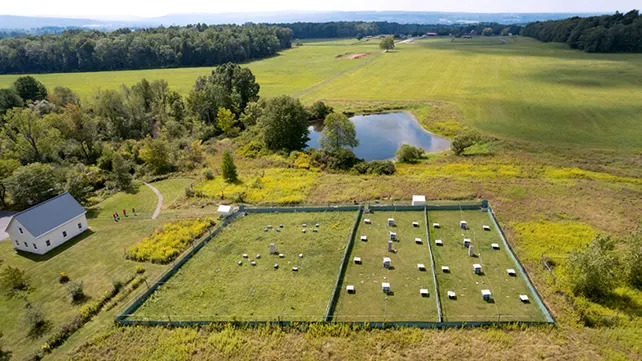
The open field labs where mice are rewilded. (Chris Kitchen/Cornell University)
What the Study Shows
The Cornell team interprets this rapid behavioral change as a "reset" of anxiety-like responses. According to biologist Matthew Zipple, "Living in this naturalistic environment both blocks the formation of the initial fear response, and it can reset a fear response that's already been developed in these animals in the lab." The change was observed whether mice were rewilded from birth or later in life.
"We put them in the field for a week, and they returned to their original levels of anxiety behavior." — Matthew Zipple
How Anxiety Was Measured
Scientists commonly use the elevated plus maze (EPM) to measure anxiety-like behavior in rodents. The apparatus has two enclosed arms that feel safer to mice and two open arms that are more exposed; mice typically avoid open arms after an aversive experience, an avoidance that can persist despite SSRI treatment in some experiments. In this study, rewilded mice no longer showed that avoidance pattern, suggesting environmental experience strongly influences the behavior.

Subscribe to ScienceAlert's free fact-checked newsletter
Broader Implications
Neurobiologist Michael Sheehan commented that a narrow range of life experiences may make novel situations more likely to provoke anxiety: "If you experience lots of different things that happen to you every day, you have a better way to calibrate whether or not something is scary or threatening. But if you've only had five experiences, you come across your sixth experience, and it's quite different from everything you've done before, that's going to invoke anxiety."
The authors argue the results raise questions about how anxiety is produced and measured in laboratory animals and how well such models translate to humans. Behaviors often attributed to hardwired fear responses might instead reflect the restricted sensory and behavioral environments typical of lab housing.
While the study highlights the environment's powerful influence on anxiety-like behavior, the researchers note that human anxiety is multifactorial and cannot be reduced solely to experience diversity or risk exposure. The work, published in Current Biology, opens new avenues for exploring how an individual's "library of experiences" shapes responses to novelty and threat.
"This opens a lot of possibilities for asking interesting questions about how our library of experiences shapes our response to novel experiences, because I think that's essentially what anxiety is — when you have an inappropriate response to something that isn't actually scary." — Michael Sheehan


