Scientists at Sejong University analyzed 26,500 wide binary stars using Gaia data and found that systems with ultralow orbital accelerations (~0.1 nm/s²) exhibit measured accelerations about 30–40% higher than Newtonian and Einsteinian predictions. Binaries with accelerations above ~10 nm/s² conform to classical gravity. The observed anomaly is consistent with the MOND/AQUAL prediction of an ~1.4× boost but requires independent confirmation and careful checks for observational biases.
Gaia Study of Wide Binary Stars Finds Anomaly That Challenges Standard Gravity Models
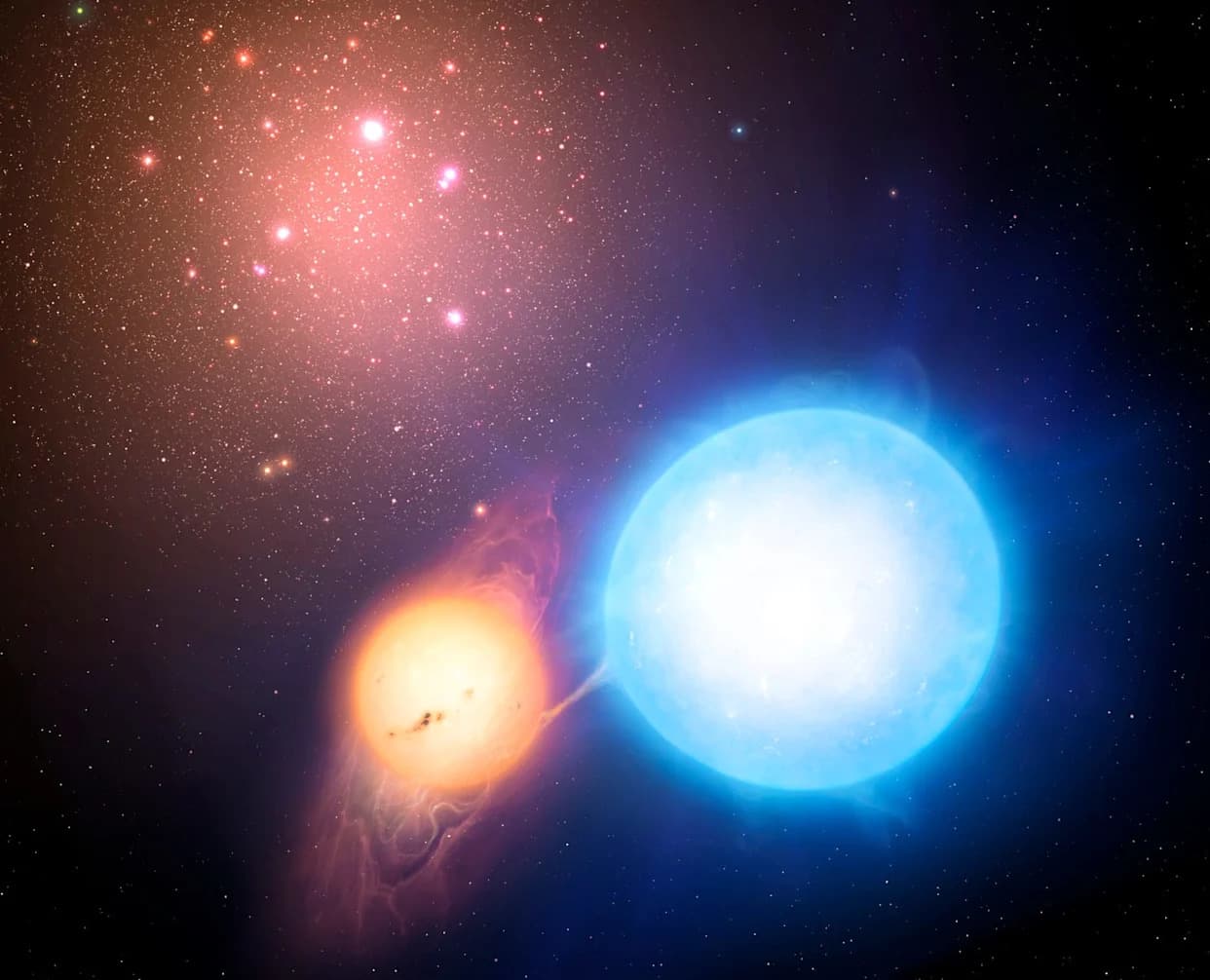
Weird Gravity Around Binary Stars Flouts EinsteinMARK GARLICK/SCIENCE PHOTO LIBRARY - Getty Images
Einstein's general relativity remains our most successful description of gravity, but a new analysis of slowly orbiting, widely separated binary stars suggests there may be a previously untested regime where standard gravity underperforms. Researchers at Sejong University analyzed a large Gaia data set and found a systematic deviation at ultralow accelerations that aligns with predictions from Modified Newtonian Dynamics (MOND) and its AQUAL formulation.
What the Team Did
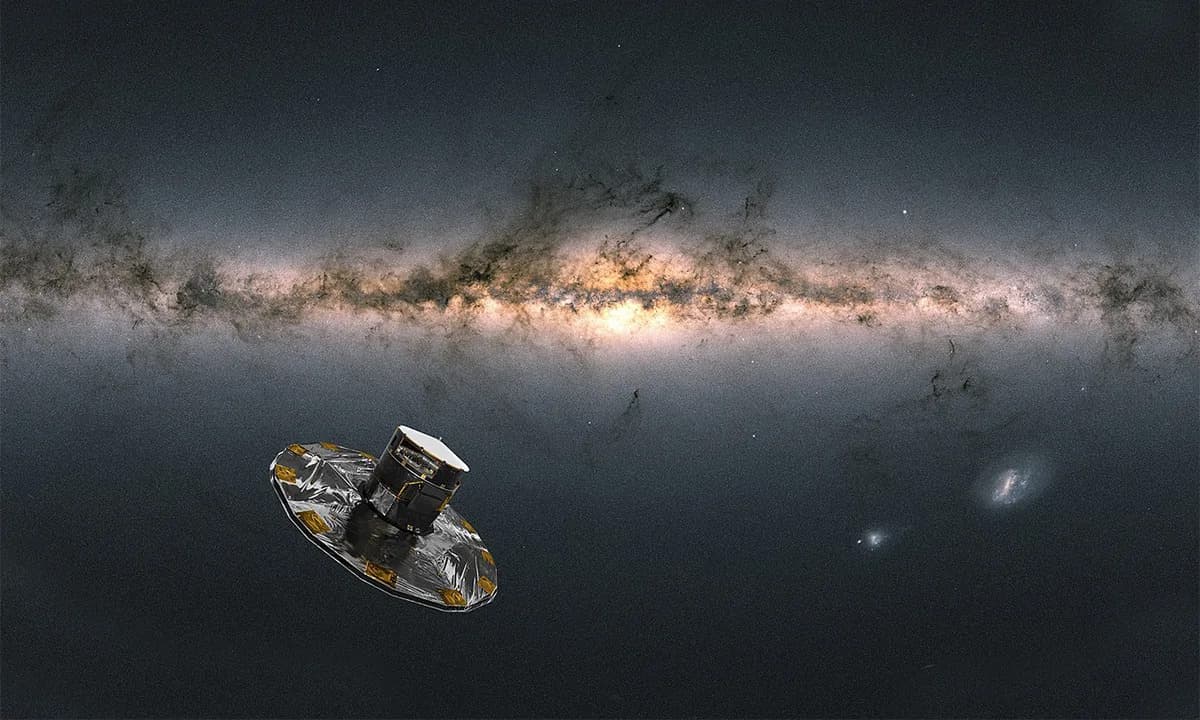
Using European Space Agency Gaia observations, the authors examined 26,500 wide binary systems within roughly 650 lightyears. Wide binaries are long-period stellar pairs with separations large enough that their mutual orbital accelerations become extremely small — useful for testing gravity in the weak-acceleration regime.
Key Findings
The study reports that when orbital accelerations fall to about 0.1 nanometers per second squared (nm/s²), the measured accelerations are about 30–40% higher than predictions based on Newtonian gravity and general relativity (the “Newton–Einstein” expectation). At higher accelerations — roughly above 10 nm/s² — the binaries follow classical predictions.
Interpretation
Under the standard cosmological model, discrepancies in gravitational behavior are often attributed to dark matter. However, dark matter is not an obvious explanation for dynamics of nearby binary stars. The observed boost is consistent with a MOND-inspired formulation called AQUAL (A QUAdratic Lagrangian), which predicts an effective acceleration factor near 1.4× under certain external-field conditions.
“This systematic deviation agrees with the boost factor that the AQUAL theory predicts for kinematic accelerations in circular orbits under the Galactic external field,” the paper states.
Caveats and Next Steps
MOND and AQUAL remain controversial and face conceptual and empirical challenges. Alternative explanations include observational biases, unresolved stellar companions, selection effects, or unmodelled influences from the Galactic environment. The result is intriguing and testable, but requires independent confirmation with different samples, deeper analysis of systematics, and complementary observational tests before revising the standard gravitational framework.
Bottom line: Wide binaries at ultralow accelerations show a measurable deviation from Newton–Einstein predictions that matches a MOND/AQUAL expectation, but further work is required to rule out conventional explanations.
Help us improve.