The ZARM team in Germany has published a study proposing that the accelerating expansion of the universe might be explained without invoking dark energy. The paper explores Finsler gravity, a modified-gravity framework that allows anisotropy and can reproduce observed expansion behavior by changing how gravity acts on gas in the early universe. A Chandra X-Ray Observatory survey did not confirm universal isotropy, leaving room for direction-dependent models. The authors stress this is not a definitive refutation of dark energy but an invitation to further observational tests.
German Study Suggests Dark Energy May Be Unnecessary — Finsler Gravity Offers an Alternative
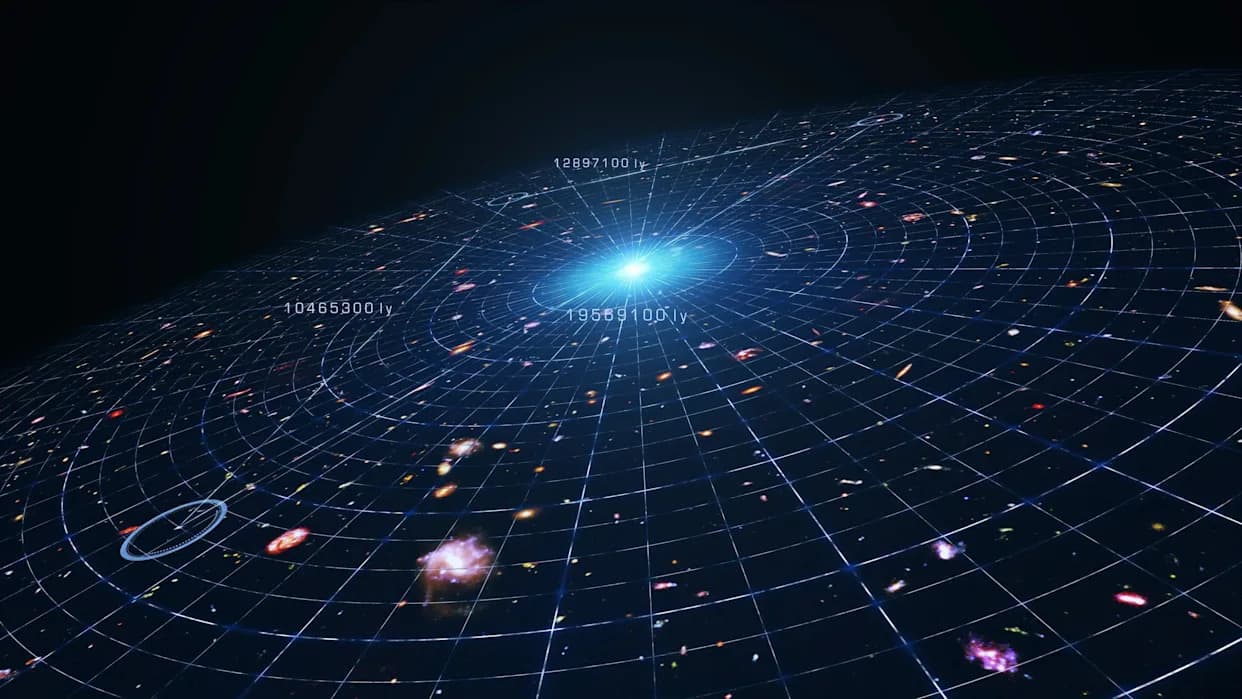
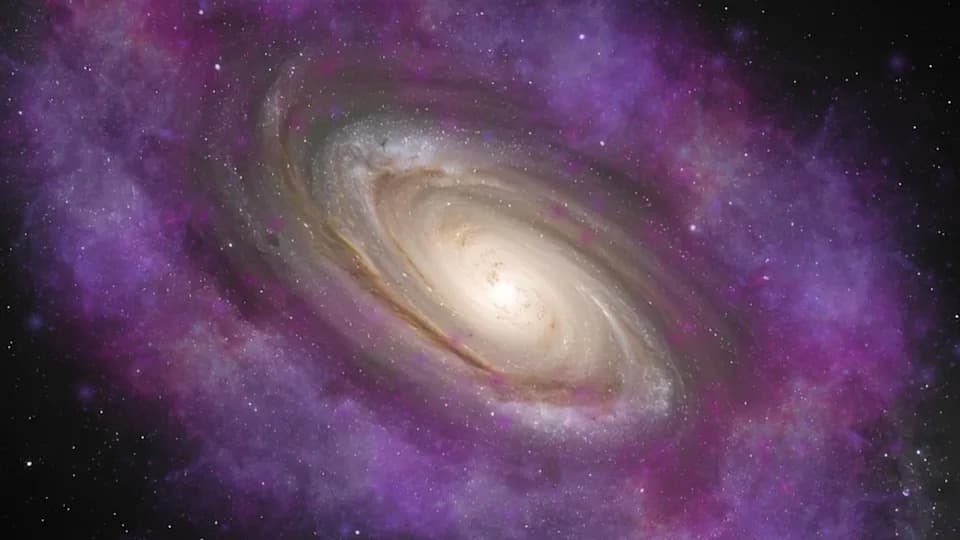
A render of a dark energy universe from NASA's Goddard Space Center. (Credit: NASA)
A research team at the Center of Applied Space Technology and Microgravity (ZARM) in Germany has published a new study proposing that the phenomenon known as dark energy may not be required to explain the accelerating expansion of the universe. While the result is not a definitive refutation of dark energy, it presents a viable alternative framework that could simplify aspects of cosmology and motivate new observational tests.
Why Dark Energy Was Proposed
Dark energy was introduced to account for the surprising discovery — first revealed by Hubble-era and later precision observations — that the universe's expansion is accelerating rather than slowing under gravity alone. In practice, dark energy has often been treated as an ad hoc component whose properties are chosen to reproduce the measured expansion history.
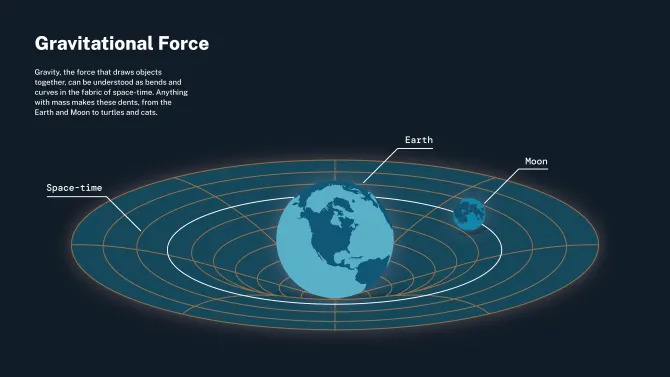
NASA gravity well diagram
Finsler Gravity: A Modified-Gravity Alternative
The ZARM paper explores a modified-gravity approach called Finsler gravity. Unlike Einstein's formulation, which assumes space is isotropic (the same in all directions), Finsler geometry allows anisotropy: physical laws can depend on direction. Reformulating cosmological equations within this richer geometric framework can produce expansion histories that resemble the observed acceleration without introducing a separate dark-energy component.
Why This Might Work
A key feature highlighted by the authors is Finsler gravity's different treatment of the gravitational behavior of gases. That difference can affect the early, gas-dominated universe's dynamics and therefore change the inferred expansion history at later times. According to the paper, these effects help the model reproduce features commonly attributed to dark energy.

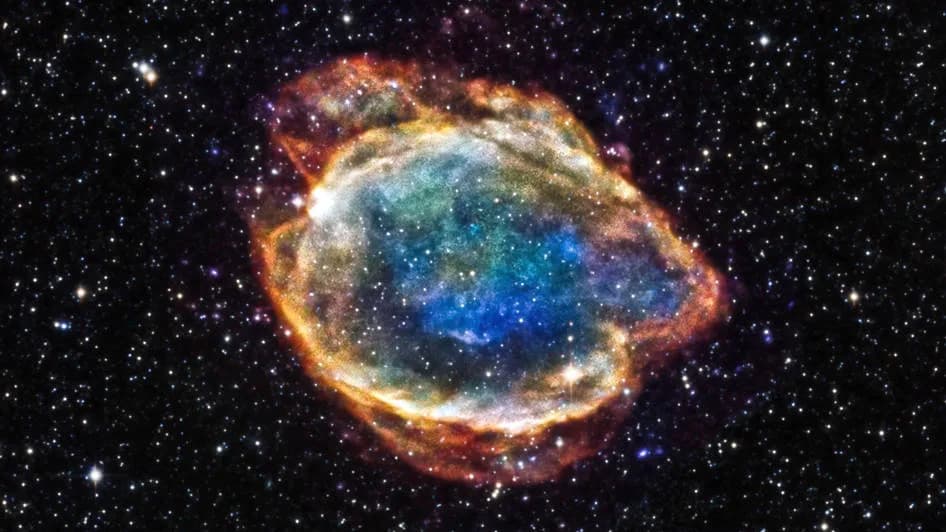
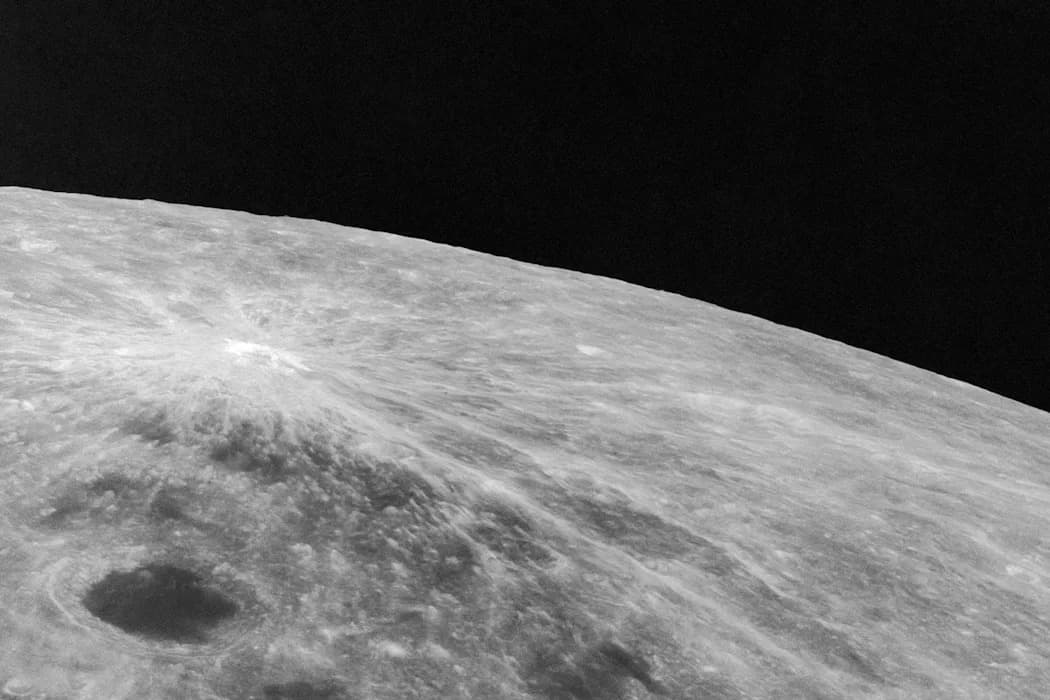
chandra isotropic universe survey
Observational Context
The study notes that a recent survey using data from the Chandra X-Ray Observatory did not confirm universal isotropy, leaving room for direction-dependent effects that anisotropic models like Finsler gravity can incorporate. However, absence of confirmation is not positive evidence for anisotropy — it simply weakens the assumption that the universe must be isotropic at all scales.
Important caveat: The authors emphasize that their work does not disprove dark energy. Rather, it demonstrates a self-consistent, observationally viable alternative that should be tested with additional data.
Next Steps
Distinguishing between dark energy and modified-gravity scenarios will require targeted observational tests: improved large-scale surveys, more precise measurements of cosmic expansion at different epochs and directions, and further studies of gas dynamics in cosmological contexts. If independent observations favor directional dependence or gas-related effects predicted by Finsler models, the standard interpretation may need revision.
Credit: NASA / Chandra X-Ray Observatory (image context)
Help us improve.